


menu Australia's Institutions Australia's Institutions
  • Capabilities
    Overview Alternatives Equities Fixed Income Multi-Asset Institutional Solutions Group
  • Investment Spotlight
    Systematic Fixed Income Emerging Markets
  • Insights
    All Insights Institutional Research AB IQ Capital Markets Outlook Investment Insights ESG in Action Digital Hub Portfolio Perspectives Beyond Consensus
  • About Us
  • Our Firm & Sites
 

Market Matters

Can AI Conquer Demographics and Other Mega Forces?

29 April 2026
8 minute read
Inigo Fraser Jenkins
Inigo Fraser Jenkins Chief Investment Strategist
Alla Harmsworth
Alla Harmsworth Head of Strategic Asset Allocation

A big question around AI is whether its productivity boost can offset downward growth forces like a shrinking working-age population. We examine this—and how it could affect the case for US exceptionalism.

How much can artificial intelligence (AI) boost productivity? And will it be enough to counter downward forces on growth, including a shrinking job force and the impact of climate change? The answer could have a big bearing on economic growth, the future of work and the case for US exceptionalism.

Based on our assessment and analysis, it’s likely that larger productivity gains from AI would lead to more jobs being displaced.

The services sector seems more exposed to AI automation than manufacturing. And, in a departure from previous innovation cycles, white-collar jobs are more in-scope.

Our conclusions continue to support the case for US exceptionalism and an overweight to US stocks. But concerns about the sustainability of US debt will reduce the dollar’s role globally.

How Much Could AI Boost Productivity?

It’s a great question—one that has stirred debate and a look back into history.

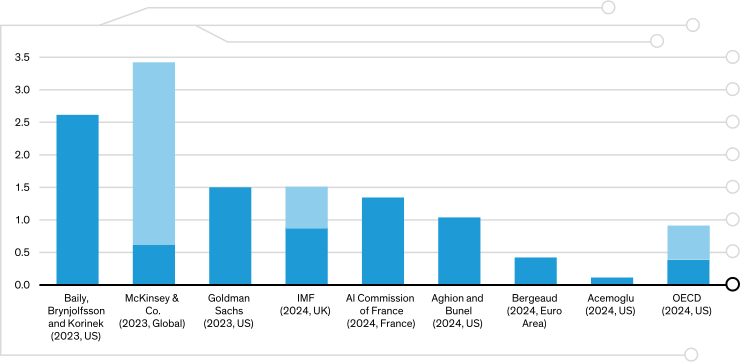
There’s an endless supply of research on the level of productivity gains AI can deliver (Display). The actual impact will depend on many factors, including how exposed individual tasks, types of occupations and industries are to AI. How broadly AI is adopted will make a big difference, too.

Roughly speaking, the Industrial Revolution in the nineteenth century and the inventions that followed raised the trend of economic growth (measured as gross domestic product) by a notable 0.8% per capita annually. We’re wary of any forecasts that are higher.

Divergent Views on Aggregate AI Productivity Gains

Predicted Gain in Annual Labor Productivity from AI over a 10-Year Horizon (Percent)

Current analysis does not guarantee future results.

IMF: International Monetary Fund; OECD: Organisation of Economic Cooperation and Development. When the source presents a range of estimates as the main result, the lower and upper bounds are indicated by the tinted areas. In cases where predictions are for total factor productivity, the predicted labor-productivity gains are obtained by assuming a standard long-run multiplier of 1.5 for the adjustment of capital stock (Acemoglu 2024, Aghion and Bunel 2024, Bergeaud 2024 and OECD). Estimates refer to the countries or regions indicated in the parentheses.

As of December 8, 2024

Source: https://cepr.org/voxeu/columns/miracle-or-myth-assessing-macroeconomic-productivity-gains-artificial-intelligence and AllianceBernstein (AB)

The Rise of AI Isn’t Happening in a Vacuum

Global mega forces pushing downward will have a big say in AI’s ultimate impact on economic growth.

Some of the forces that could limit growth, such as a declining workforce, are easier to predict. We’re assuming that a positive case would keep US immigration rates close to recent years, resulting in slight population growth. A zero-immigration policy would bite harder, reducing growth slightly. But the US could still be better off than the rest of the developed world and China.

Other mega forces like climate change are harder to predict, with the world unlikely to achieve net zero by 2050. The implications for economic growth are widely debated, but there’s general agreement that they would be negative.

The convergence of forces—including AI—will affect corporate earnings in inflation-adjusted terms. So will changes in the profit share of GDP, which has shifted in favor of US corporations. If corporations decide how AI is developed and released, their share could rise even more. Elsewhere in the world, profit share has been more stable; we assume it will stay constant.

What if we “reverse engineer” to gauge how much of an AI boost would fully offset downward growth forces? If we expect those forces to trim real earnings and GDP growth in the developed world by 1.1% annualized over a decade, the base-case AI-driven productivity boost would have to be at the top of historical ranges. We don’t think that’s a prudent forecast.

“

By estimating the percentage of tasks in specific occupations that are exposed to AI automation, we can also estimate the exposure of overall industries.

Could AI Productivity Mean Big Job Losses?

The answer varies substantially depending on the specific industry.

Near-term productivity gains from AI are likely to come from its substitution for labor or by making existing jobs more productive. Any new AI-driven jobs would come later. Generally speaking, the higher the productivity gain, the higher the future job cost.

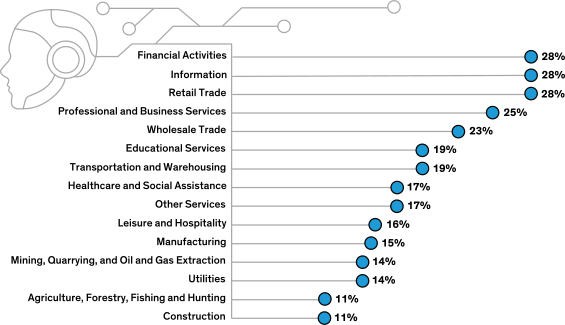
Financial services seem most exposed to AI automation; construction and agriculture the least (Display). The degree of transformation depends a lot on AI adoption and jobs displaced. White-collar jobs are the most exposed, but corporations seem to be in the driver’s seat with AI, so more gains for capital versus labor are likely.

Sector Exposure to AI Automation Varies Widely

Large Language Model Automation Exposure by Sector

Current analysis does not guarantee future results.

Exposure is weighted by industry value-added share. Occupation level automation data is provided by Daron Acemoglu. Value-added data is from Bureau of Economic Analysis (BEA) input- output tables.

As of May 12, 2024

Source: BEA; Daron Acemoglu, “The Simple Macroeconomics of AI,” Economic Policy 40, no. 121 (January 2025): 13-58, https://doi.org/10.1093/epolic/eiae042; and AB

AI and the Case for US Exceptionalism

We think the case still stands, but the growing US debt burden is a problem.

We’ve defended the case for exceptionalism in US growth (and equity returns), and wide-ranging potential outcomes agree. Elsewhere, fast AI adoption would offset a “less bad” possible outcome from downward growth forces, perhaps leaving real growth at zero. But non-US firms have been less effective at harnessing technology, and other major economies have less energy security.

The US, though, is saddled with a faster deteriorating fiscal balance. A sizable AI productivity boost would be needed for the US to grow its way out of the problem, so inflation or financial repression are more likely paths. As a result, we think the US dollar’s appeal will continue to wane.

The Sector Perspective on AI Productivity

Variation in regional employment will likely affect AI productivity gains.

In our view, the US could be a relative beneficiary from AI no matter how much productivity AI adds, and one reason is the composition of its economy. Simply put, the US is more receptive to AI transformation because of how its jobs are distributed.

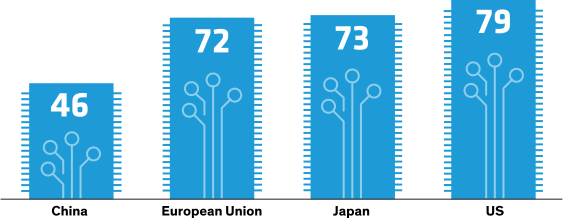
Knowledge- and service-oriented sectors are the most exposed to AI automation, and the US has the biggest share of services employment— nearly 80% of total employment (Display). Europe’s share is considerably lower at around 70%, and China’s only 46%.

Services-Heavy US Likely to Be Biggest AI Beneficiary

Share of Employment in Services vs. Manufacturing (Percent)

Current analysis does not guarantee future results.

As of December 31, 2023

Source: World Bank and AB

In Summary…

The brighter scenarios for AI productivity enhancements could counter downward growth forces in the US, so the case for exceptionalism and an equity overweight still stands. However, more AI gains would be more negative for the future of jobs, and debt concerns could erode the dollar’s status.

Inigo Fraser Jenkins
Inigo Fraser Jenkins Investment Strategist
Alla Harmsworth
Alla Harmsworth Investment Strategist

Market Matters

Delivering timely research-driven insights for navigating dynamic markets.

Discover More

The views expressed herein do not constitute research, investment advice or trade recommendations and do not necessarily represent the views of all AB portfolio-management teams. Views are subject to revision over time.

    Terms and Conditions of Use Privacy Policy Cookie Settings Complaints, Dispute Resolution and Whistleblowing Australian FSC Standard 23 AB's Approach to Carbon Neutral Modern Slavery Statement Consumer Warning Investor Alert

    This information is for exclusive use of the wholesale person to whom it is provided and is not to be relied upon by any other person. It is not intended for retail or public use and may not be further distributed without prior written consent of ABAL.
    This webpage has been prepared by AllianceBernstein Australia Limited (“ABAL”)—ABN 53 095 022 718, AFSL 230 698. Information in this webpage is only intended for persons that qualify as “wholesale clients,” as defined by the Financial Markets Conduct Act 2013’, and is not to be construed as advice. This webpage is provided solely for informational purposes and is not an offer to buy or sell securities. The information, forecasts and opinions set forth in this webpage have not been prepared for any recipient’s specific investment objectives, financial situation or particular needs. Neither this webpage nor the information contained in it are intended to take the place of professional advice.
    You should not take action on specific issues based on the information contained in this webpage without first obtaining professional advice. Past performance does not guarantee future results. Projections, although based on current information, may not be realized. Information, forecasts and opinions can change without notice and ABAL does not guarantee the accuracy of the information at any particular time. Although care has been exercised in compiling the information contained in this webpage, ABAL does not warrant that this webpage is free from errors, inaccuracies or omissions. ABAL disclaims any liability for damage or loss arising from reliance upon any matter contained in this webpage except for statutory liability which cannot be excluded.
    No reproduction of the materials on this webpage may be made without the express written permission of ABAL. This information is provided for persons in Australia only and is not being provided for the use of any person who is in any other country.

    © AllianceBernstein L.P.