
Spotlight on Global Commercial Real Estate Debt

27 November 2024
5 min read

The outlook for commercial real estate in both the US and Europe presents a mix of challenges and opportunities. While interest rates and regulatory pressures create headwinds, sectors that adapt to changing tenant preferences and sustainability standards are well-positioned for growth. Investors who remain agile and informed about market dynamics are likely to find promising opportunities in this evolving landscape.

At AB, we specialize in lending against commercial real estate assets. As a top 10 alternative lender globally, we leverage our extensive platform to capitalize on the unique dynamics of the US and European markets while fostering collaboration across our global teams.

Focused Strategy in the European Market

We see two critical themes emerging in the commercial real estate debt (CRED) landscape in Europe. First, in Europe the CRED market is relatively young, with banks historically dominating this space (display). As regulatory pressures and rising interest rates impact their lending capacity, alternative lenders are stepping in to fill the void. This shift presents a unique opportunity for investors to access a growing market with increasing choices.

The US Shows a Diversified Group of Lenders, The EU Is Bank Dominated
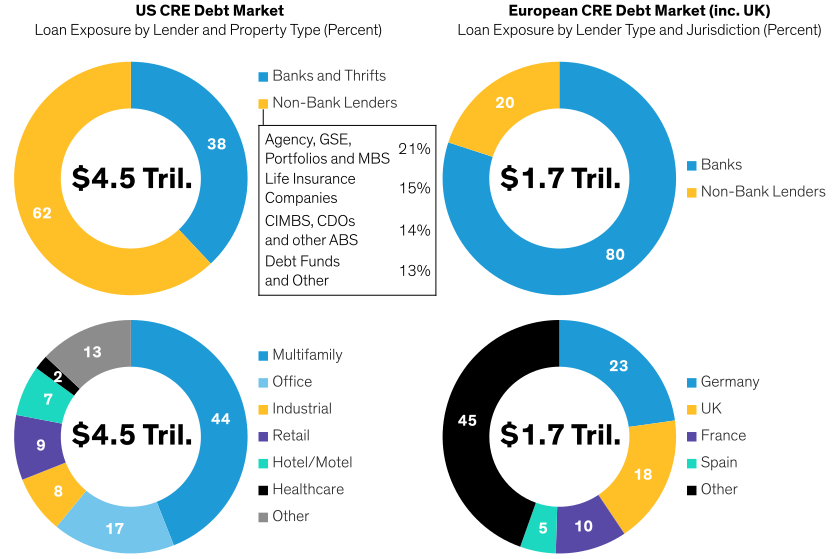

As of September 30, 2024
Source: Bayers Business School, Cohen & Steers, Mortage Bankers Association and AllianceBernstein (AB)

Second, ESG considerations are becoming paramount. Institutional owners and occupiers are now required to invest in energy-efficient properties to meet regulatory standards. Buildings that fail to comply with minimum energy efficiency standards risk becoming obsolete, necessitating significant capital investments. Alternative lenders, like AB, are ideally positioned to provide the necessary capital and oversight to help landlords modernize their assets, ensuring compliance while also enhancing value.

In Europe, AB targets the middle market, defined by transaction sizes ranging from $40 million to $100 million. This segment often presents pockets of illiquidity, granting us disproportionate negotiating power. By focusing on covenant-heavy transactions we can also focus on risk management, which has resulted in a remarkable zero-loss record over the past decade.

Flexibility in the US Market

Conversely, the US market offers a diverse landscape where we have strategically developed our capabilities over the last 12 years. Our ability to deploy capital across the risk spectrum allows us to adapt to market conditions, identifying when it’s more advantageous to invest in safer assets versus assets further up the risk spectrum. This flexibility not only enhances our investment strategy but also enables us to capitalize on varying pricing dynamics throughout different stages of the economic cycle.

Macro Trends Driving Change

Recent disruptions, notably those stemming from the COVID-19 pandemic and subsequent central bank interventions to combat inflation, have significantly impacted traditional lending practices. In the US, banks, which typically play a major role in the lending landscape, have filled their balance sheets with loans in recent years. With interest rates rising and values adjusting, many banks have become less active in the market. This retreat creates a fertile ground for private lenders like AB to explore more lucrative opportunities.

Among the sectors experiencing notable shifts is the office market. While many view office assets with skepticism due to recent trends, we believe there are compelling opportunities, particularly in Tier 1 assets. These properties, often characterized by modern amenities and desirable locations, continue to attract tenants, differentiating themselves from Tier 2 and Tier 3 assets, which have faced greater challenges. Our analysis suggests that despite negative sentiment surrounding the office sector, Tier 1 buildings remain resilient, offering attractive lending prospects.

Shifting Workplace Dynamics

The dynamics of the workplace have also evolved. Historically, employees were required to come to the office, often because the technology available at work surpassed what could be used at home. However, the pandemic shifted this perspective. Companies and employees have adapted to remote work utilizing online tools, and today, while there is a push for employees to return to the office, the demand is for spaces that foster collaboration and connectivity.

Companies are now prioritizing office spaces that provide not only essential amenities but also cater to employees’ lifestyles. This includes well-located buildings with modern features and effective meeting spaces that encourage interaction. Additionally, the emphasis on environmental sustainability is significant. Modern buildings that are energy efficient and environmentally friendly are increasingly sought after by both tenants and investors.

A Collaborative and Diverse Team

A crucial element of our success lies in our team structure. AB emphasizes cross-training within its investment teams, enabling members to understand the full lifecycle of investments—from origination to asset management. This approach ensures that our team is well-versed in both sourcing opportunities and effectively managing them.

Geographically, our presence spans the US and Europe, allowing us to navigate the complexities of diverse markets. The ability to maintain local teams enhances our understanding of regional differences, particularly regarding legal structures and market nuances. In Europe, for instance, the approach to structuring loans varies significantly from country to country, necessitating on-the-ground expertise.

The Case for Debt Investing

When discussing asset classes, CRED is often compared with equity investments. While equity investors take on higher risk for potential higher returns, debt investors enjoy more consistent returns through regular coupon payments. This stability is especially advantageous during market downturns, as debt investments are generally less susceptible to market cycles.

As we navigate the current landscape, the opportunities for CRED investing are robust. Traditional lenders are stepping back, leaving a gap that alternative lenders can fill. For global investors, considering a shift toward debt investments during this market contraction could yield significant benefits.

We look forward to continued growth in both the US and European markets. The landscape for CRED is ripe with opportunity. With the right strategies and a proactive approach, AB is well-positioned to leverage these dynamics, delivering value for our investors and partners alike.

The views expressed herein do not constitute research, investment advice or trade recommendations, do not necessarily represent the views of all AB portfolio-management teams and are subject to change over time.

This information is for exclusive use of the wholesale person to whom it is provided and is not to be relied upon by any other person. It is not intended for retail or public use and may not be further distributed without prior written consent of ABAL.

This webpage has been prepared by AllianceBernstein Australia Limited (“ABAL”)—ABN 53 095 022 718, AFSL 230 698. Information in this webpage is only intended for persons that qualify as “wholesale clients,” as defined by the Corporations Act 2001, and is not to be construed as advice. This webpage is provided solely for informational purposes and is not an offer to buy or sell securities. The information, forecasts and opinions set forth in this webpage have not been prepared for any recipient’s specific investment objectives, financial situation or particular needs. Neither this webpage nor the information contained in it are intended to take the place of professional advice.

You should not take action on specific issues based on the information contained in this webpage without first obtaining professional advice. Past performance does not guarantee future results. Projections, although based on current information, may not be realized. Information, forecasts and opinions can change without notice and ABAL does not guarantee the accuracy of the information at any particular time. Although care has been exercised in compiling the information contained in this webpage, ABAL does not warrant that this webpage is free from errors, inaccuracies or omissions. ABAL disclaims any liability for damage or loss arising from reliance upon any matter contained in this webpage except for statutory liability which cannot be excluded.

No reproduction of the materials on this webpage may be made without the express written permission of ABAL. This information is provided for persons in Australia only and is not being provided for the use of any person who is in any other country.

© 2024 AllianceBernstein L.P.


About the Authors