We assess where our themes for 2025 stand after a tumultuous start to the year.
Investors, including European insurers, entered 2025 expecting a soft economic landing and limited regulatory developments. Instead, trade wars, an equity sell-off and rebound, and bond volatility were the order of the day. At the midway point of the year, how have the industry and our themes for the year fared so far?
Tariffs Alter the Macro and Market Landscapes
As 2025 got under way, the surprises came not from incoming data on the state of the global economy or fundamental conditions. It was policy shock that reshaped investment plans, as the US announced sweeping tariffs in April.
As concerns about a global economic recession mounted and investors digested the implications of the levies, stock markets tumbled and credit spreads on corporate bonds rose. In private markets, more of a “wait and see” approach prevailed.
Questions about the US security commitment in Europe have raised the prospect of substantial fiscal stimulus in Europe, particularly in Germany, where the political consensus has shifted dramatically. This development could create structural investment opportunities in European markets.
The Regulatory Front: A Now-Evolving Landscape
At the start of the year, things were quiet from a regulatory perspective. Since then, we’ve seen a pickup in European Union (EU) and UK activity.
We expect imminent reforms to the EU’s securitization regime to be announced this month. The industry hopes the European Insurance and Occupational Pensions Authority (EIOPA) will align capital charges on non–“simple, transparent and standardized” (STS) securitizations more closely with their inherent risks. This would follow sustained engagement from banks, insurers and investment managers advocating that the regulator move toward a regime more in line with other global regulations. The changes being discussed for securitizations not meeting the STS designation could reduce the capital charge by 17%–40%, making investment far more viable.
Other key updates to the EU Solvency II framework include relaxed eligibility criteria for long-term equity investments, which could foster growth in private-equity and infrastructure-equity allocations. A new volatility-adjustment framework accounts for duration matching and seeks to better reflect the characteristics of government bonds from the insurers’ home countries. The revised framework should be implemented by 2026.
In the UK, the Prudential Regulation Authority (PRA) Consultation Paper 7/25 on the Matching Adjustment Investment Accelerator (MAIA) proposes a new framework. It would allow firms to invest in assets they believe are eligible for matching adjustment (MA) before seeking formal regulatory approval. This reflects the MA “sandbox” the industry has called for since initial consultations on Solvency UK’s implementation. This new flexibility aims to boost competition in UK pension risk transfer and speed formal approvals so insurers don’t miss investment opportunities.
Firms have 24 months to seek regulatory approval for new assets invested in their MA portfolios and can request them retrospectively. We’re not expecting market turmoil to slow deals anytime soon. In a more competitive market, firms will likely seek better pricing by investing in illiquid and more complex assets.
This year’s reform follows 2024 reforms boosting investment flexibility for MA firms; it introduced the “highly predictable” category and removed penalties for sub-investment-grade assets. Many insurers will likely start tapping the flexibility of the “highly predictable” asset categorization, and we may see more investments in such areas as real estate or infrastructure assets in the construction phase as well as public securitizations.
Quality, Diversification and Risk Management
In today’s environment, prudent risk management entails matching asset and liability durations, prioritizing liquidity and keeping a higher-quality bias within fixed-income allocations. These two levers offer flexibility and protection when the path forward is murky. There are opportunities in the private-asset space, too; we think asset-class selection is the key to unlocking them.
A volatile US dollar suggests higher costs for euro investors to hedge out currency risk. However, from our perspective, the benefit of geographic diversification and the broader US-dollar investment universe make this cost acceptable. Allocation changes demand a focus on liquidity risk. Because the industry has robust practices to manage this risk, we see no imminent concern for large liquidity calls, but it’s sensible to factor in the possible implications of our views.
The market still draws a line between public and private investments—as we do here. But we see this line giving way over time to a more granular liquidity assessment for each opportunity—especially as private opportunities expand. The EIOPA recently published a consultation paper on enhancing liquidity risk management, so it seems sensible for insurers to think about evolving their considerations of investment-book liquidity alongside their capacity to take more illiquidity risk.
Private Credit: Opportunities Across Segments
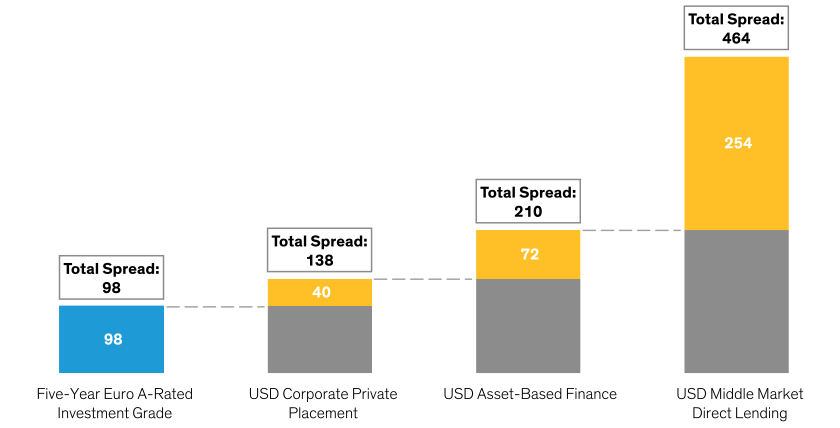
We continue to see value beyond public bond markets in private asset classes, which generally offer spread advantages over their public counterparts (Display). They include direct lending, asset-based lending and net-asset-value lending—floating-rate assets that expand insurers’ opportunity sets.