The AI ecosystem’s response rhymes. Technology companies and newer specialists are investing aggressively to secure capacity by building data centers. Yet capital intensity cuts both ways. Data centers require large upfront commitments and ongoing reinvestment as technology rapidly evolves, so today’s scarcity economics may not endure.
Productivity Can Deepen the Cycle
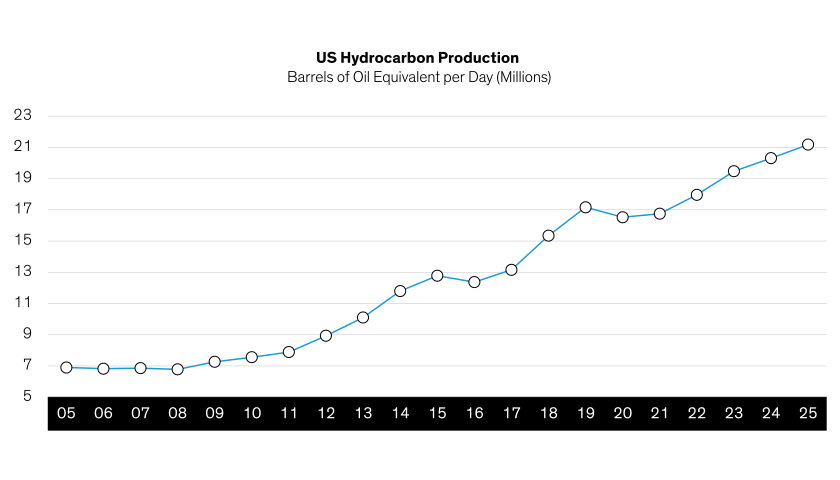
Supply growth is only part of the story. In shale, operators continuously improved drilling speed, automation, planning, intelligence and well productivity. These enhancements, combined with increased scale, lowered the cost of producing a barrel of oil year after year, helping US producers close much of the gap with Middle Eastern competitors. Pricing trends supported returns and encouraged further activity—and investment. The cumulative impact was easy to underestimate because many improvements compounded at once—a powerful force that is often underestimated in the early stages of a new opportunity. US hydrocarbon production has continued to rise through 2025 despite a 30% decline in Helmerich & Payne’s available US land rigs since the peak.
AI is arguably in an earlier stage of development, but we already see similarities in the pace of innovation. Since 2022, new large language models and GPU designs continue to redefine AI’s potential at lightning speed. Just as shale pushed oil prices down, the cost of generating a token is falling because of better chips, more efficient software and system architecture, as well as an abundance of models, including more low-cost open-source models. Lower costs can unlock new use cases and broaden adoption. But they may also intensify competition by making today’s scarce capability more widely available. As shale demonstrated, compounding productivity gains can eventually create enough effective supply to reshape industry economics.
Abundance Changes the Economics
Eventually, customers focus less on access and more on price, performance and reliability. Supply catches up in parts of the market, buying behavior changes and pricing power can erode. Incremental innovation releasing more effective capacity into an already expanding system accelerates the shift from scarcity to competition.
That is where the shale analogy becomes most useful. By late 2014, US E&Ps had created so much excess supply that it disrupted the global energy market, triggering a collapse in energy prices in 2015. Shale didn’t disappear, but we saw a reordering of returns, capital allocation and competitive positions. Strong operators kept improving, weaker participants consolidated or exited, and investors increasingly looked elsewhere for attractive opportunities.
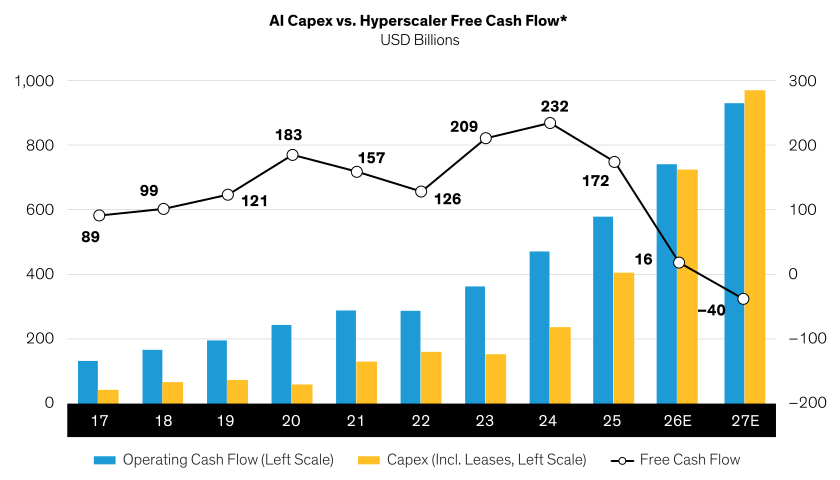
For AI, the demand curve, industry structure and the timing of any adjustment remain uncertain. Yet the focus is already shifting from adding capacity to improving efficiency, economics and more recently, safety. As cost-per-token falls and capacity grows, we believe investors must distinguish between businesses that benefit from scarcity and those that can sustain differentiation when scarcity fades. Scale, productivity, customer relevance and disciplined reinvestment may matter more than headline growth. Massive capital spending is already putting pressure on hyperscalers’ free cash flow (Display) and drawing increased scrutiny of how the AI build-out will affect profitability.