menu AllianceBernstein AllianceBernstein
  • Funds
  • Our Clients
    Overview Global Insurance Family Offices
  • Capabilities
    Alternative Strategies Equity Strategies Fixed Income Strategies Multi-Asset Strategies Institutional Solutions Group Responsible Investing
  • Investment Spotlight
    Systematic Fixed Income Emerging Markets Alternatives. We Deliver, Differently
  • Insights
    All Insights in English Einblicke auf Deutsch Institutional Research AB IQ Investment Insights Retirement Insights Market Matters Podcasts The Book
  • About Us
    Why Us Awards Corporate Responsibility Contact Us
  • Our Firm & Sites
 

Market Matters

Is Cryptocurrency Moving onto the Asset-Allocation Radar?

21 August 2025
3 Minute Read
Inigo Fraser Jenkins
Inigo Fraser Jenkins Investment Strategist
Alla Harmsworth
Alla Harmsworth Investment Strategist

Potentially higher long-term inflation could lead more investors to consider a mix of investments to complement stocks and cushion against rising prices. Many financial firms are looking at crypto as a possible option.

Investors: Get Ready for Higher Long-Run Inflation

Sky-high inflation driven by the COVID-19 pandemic has faded—good news for consumers, businesses and investors. But long-run inflation is still a concern.

Broad mega-forces could push inflation higher in the decades ahead. Deglobalization is fragmenting supply chains and labor markets; an aging population is shrinking the labor force; and a slower energy transition could bring severe weather shocks, making inflation more volatile.

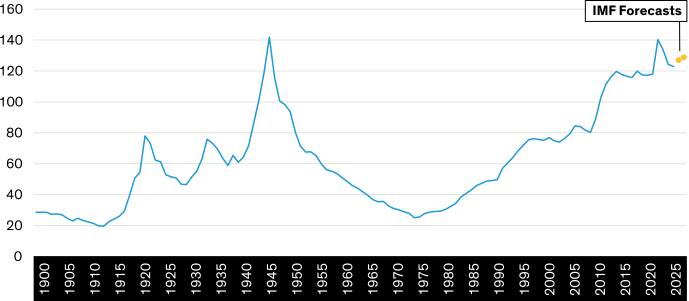
Governments might also give inflation a longer leash to relieve their growing debt burdens (Display) in inflation-adjusted terms, which could weaken currencies by eroding purchasing power, investors’ confidence and economic stability. The risk of higher inflation seems to argue for investors to think strategically about portfolio inflation protection.

Major Governments’ Debt Burdens Are Soaring

G7 Government Debt to GDP Ratio (Percent)

Current analysis and forecasts do not guarantee future results.

G7 debt ratio is weighted by countries’ GDP. Data from 1900–2023 is from Global Financial Data; 2024/2025 forecast is from the International Monetary Fund.

As of November 18, 2024

Source: Global Financial Data, International Monetary Fund (IMF) and AllianceBernstein (AB)

More Inflation Ahead? Bolster Inflation Protection

We think equity exposure should be a core building block because of its potential to generate returns that outpace inflation. But a well-rounded mix of diversifiers is also critical.

As investors become more aware of long-term inflation risk, they may start designing portfolios to achieve specific return levels above inflation, which could help defend against the loss of purchasing power as price levels rise. But this could bring higher portfolio volatility.

As a core building block, public stocks are the largest, most liquid asset class capable of delivering returns above inflation, or positive “real” returns. This stems from firms’ ability to pass higher costs on to consumers through higher goods and services prices. Equity returns in the years ahead could be lower than those of the past decade, but we still expect them to stack up favorably versus other asset classes.

What assets could complement equity exposure?

The expected environment plays a major role in answering that question. Bonds might be less effective at diversifying stocks than they’ve been in past decades. Governments might also be willing to tolerate higher inflation to reduce the face value of their debt—weakening their currencies in the process.

For complementary exposures, investors might consider private and real assets, factors and active strategies. Assets whose prices have historically had little relationship with interest rates—like gold and silver—might also make sense. Cryptocurrency might be in the mix in the future, though it hasn’t yet made inroads into many professional investors’ portfolios.

Cryptocurrency in the Portfolio Mix

Cryptocurrency may have a future role in inflation protection, as investors assess aspects such as higher volatility and regulatory clarity.

The need to diversify equities and hedge against inflation and currency weakening could cause demand for gold-like assets to rise, and cryptocurrency may soon be worth considering, too.

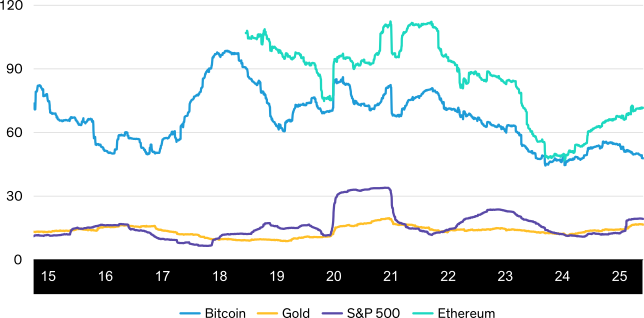
Crypto’s high volatility (Display) could decline, but not for a while. We’ve seen signs that its correlation with equities is falling and its correlation with gold rising, which could make it more gold-like.

A new US policy agenda raises concerns about fiscal sustainability and higher inflation, which could make the dollar less of a safe haven and crypto more attractive. And regulatory clarity on crypto could improve.


Crypto Has Been Much More Volatile than Equities and Gold

12-Month Trailing Annualized Volatility (Percent)

Past performance does not guarantee future results.

As of July 22, 2025

Source: LSEG Data & Analytics and AB

Addressing Objections to Investing in Cryptocurrency

There are arguments against including cryptocurrency in allocations as many investors explore its feasibility. Here’s some perspective on the major areas of pushback.

“

Crypto could warrant future consideration for investors’ strategic allocations—as part of a mix of assets that diversify equity exposure while protecting against inflation.

What’s Next for Cryptocurrency Investments

Crypto allocations are still limited among professional investors, but we think its time will come as an equity diversifier.

Many financial firms are still exploring cryptocurrency, with only small exposures among some institutions. Many of these allocations may be tactical—we think crypto can be more effective as a strategic diversifier.

We think the time will come for broader crypto exposure. It should focus on cryptocurrencies with limited supplies as hedges against government-enabled inflation; crypto with unlimited supplies may face price headwinds.

Because the rationale for cryptocurrency is related to the case for gold, the mechanics of access could be similar. Today, most institutional investment in gold is indirect, using gold ETFs or gold-related equities. We see this as a pathway for crypto exposure, too.

In Summary…

Over the long run, we think inflation will settle higher, so investors should bolster their inflation defenses. We see stocks as a core allocation, given their potential to deliver positive real returns. Complementary exposures could include private assets, factors and gold. Cryptocurrency may someday also play a role in countering inflation.

Inigo Fraser Jenkins
Inigo Fraser Jenkins Investment Strategist
Alla Harmsworth
Alla Harmsworth Investment Strategist

Market Matters

Delivering timely research-driven insights for navigating dynamic markets.

Discover More

The views expressed herein do not constitute research, investment advice or trade recommendations and do not necessarily represent the views of all AB portfolio-management teams. Views are subject to revision over time.

Investing in digital tokens, such as cryptocurrencies and other blockchain-based assets, carries risks and we recommend that investors conduct their own research thoroughly and consult with financial advisors specialising in digital assets before investing. Key risks to consider include market volatility, regulatory, security, liquidity and lack of consumer protection.

    Terms of Use Privacy Policy Cookie Settings Management Company Important Disclosures Modern Slavery Statement

    This is a marketing communication. This information is provided by AllianceBernstein (Luxembourg) S.à r.l. Société à responsabilité limitée, R.C.S. Luxembourg B 34 305, 2-4, rue Eugène Ruppert, L-2453 Luxembourg. Authorised in Luxembourg and regulated by the Commission de Surveillance du Secteur Financier (CSSF). It is provided for informational purposes only and does not constitute investment advice or an invitation to purchase any security or other investment. The views and opinions expressed are based on our internal forecasts and should not be relied upon as an indication of future market performance. The value of investments in any of the Funds can go down as well as up and investors may not get back the full amount invested. Past performance does not guarantee future results. 

    This information is directed at Professional Clients only and is not intended for public use.

    © AllianceBernstein L.P.