US Exceptionalism, AI and Towards the Total Portfolio

The Book 2026 Edition

Perspectives on Markets, Strategic Allocation and the Investment Industry's Future


This information is directed at Professional Clients only and is not intended for public use.

Deglobalization and AI—alongside demographics, public debt and climate change—raise a key question: is the US still exceptional? We think yes for equities, but less so for the dollar. In the age of AI, the productivity debate is tied to demographics and the future of labor.

Our strategic response links these issues to portfolio construction, arguing for greater use of a total portfolio approach. For asset managers, the future will likely see wider AI adoption and evolving client demand for solutions.

Challenges and Themes


US Exceptionalism


Artificial Intelligence


Defensive Strategies

Introduction to The Book 2026 Edition

What is the Book?

The Book is an annual collection of thought-provoking strategic research and thought leadership from AB’s Institutional Solutions team.

How a New Investment Regime Could Change Investing

Our strategic outlook is for higher long-term equilibrium inflation, somewhat lower economic growth and high starting multiples for equity markets. This view implies a future in which real returns are lower and traditional return sources provide less diversification.

Historical analysis and current forecasts do not guarantee future results.

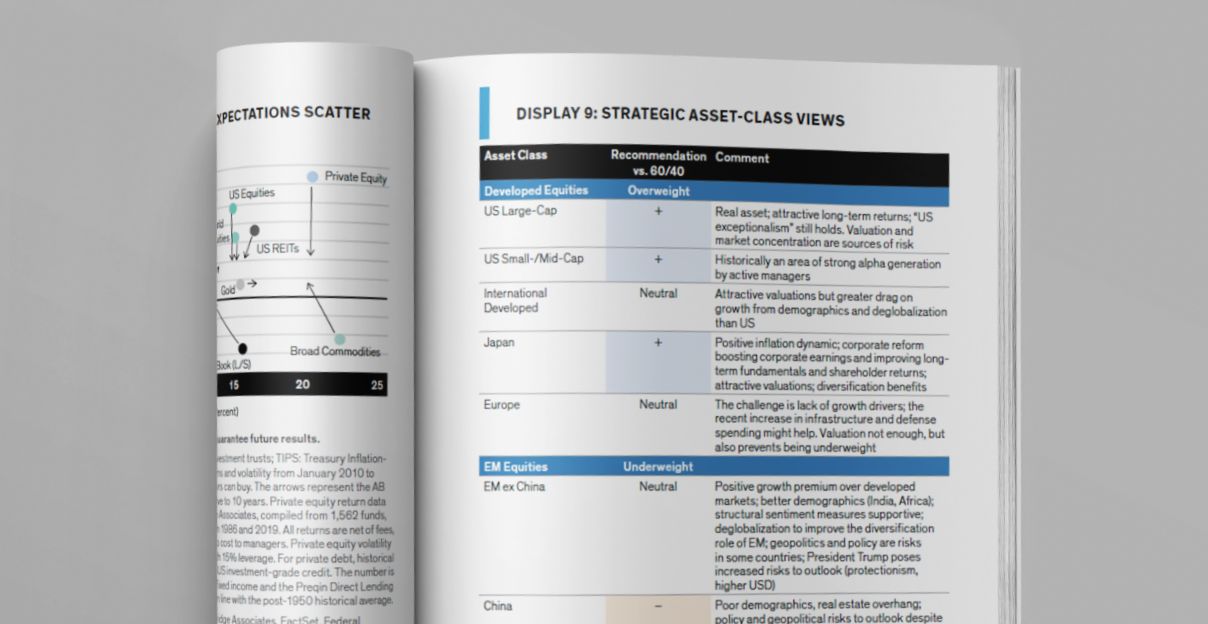
L/O: long-only; L/S long/short. The circles represent real returns and volatility from January 2010 to December 2022 period for the major return streams investors can buy. The arrows represent the AB Institutional Solutions team's forecasts for the next five to 10 years. Private equity return data from the US Private Equity Index from Cambridge Associates, compiled from 1,562 funds, including fully liquidated partnerships, formed between 1986 and 2019. All returns are net of fees, expenses, and carried interest. Data are provided at no cost to managers. Private Equity volatility is estimated from MSCI US Small Cap Value Index, with 15% leverage. For Private debt, historical and future volatility is expressed as volatility of public US investment-grade credit. The number is between the historic volatility of public US high-yield fixed income and the Preqin Direct Lending return index. Factor future volatility is assumed to be in line with the post-1950 historical average.

As of October 5, 2023.

Source: Cambridge Associates, FactSet, Federal Reserve Bank of St. Louis, , Kenneth R. French Data Library, Preqin, and AB


Implications for Portfolios and the Investment Industry

  • For investors who need to defend purchasing power against inflation, the outlook implies a need to have a strategic overweight in real assets—and equities are the largest real asset available. 

  • We also think it makes sense to underweight nominal duration, and we continue to see value in incorporating exposure to private assets, factors and non-fiat assets.

  • Many of these positioning decisions are similar to those implied from a total portfolio approach (TPA). We see more interest in TPA, which moves beyond traditional asset-class definitions.

  • For the asset management industry, interest in multi-asset investing and OCIO mandates could increase. The industry will also play a role in tokenizing assets, facilitating allocations to illiquid real assets.


Webcast: Exploring The Book 2026 Edition

Wednesday 24th June at 9am ET / 2pm BST / 3pm CEST

Join Inigo Fraser Jenkins, Chief Investment Strategist, and Alla Harmsworth, Head of Strategic Asset Allocation, as they host a special launch webcast to discuss the research topics in The Book 2026.