
DC Members Have Clear Preferences Regarding UK Investments

16 June 2026
4 min read
Which of the Following Types of Investments Would You Be Most Interested in Within the UK?
AllianceBernstein (AB) YouGov UK DC Survey Findings (Percent)
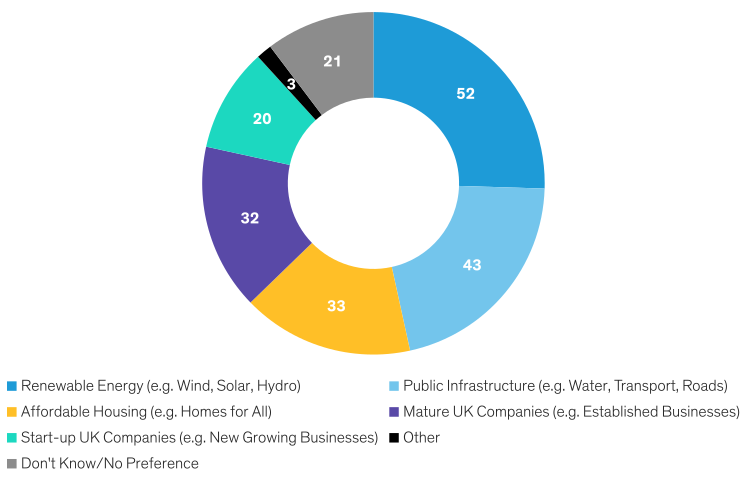
A clear majority of DC survey respondents preferred to invest in projects such as renewable energy.

Unweighted base: All GB employees with a defined contribution pension arranged through their current employer who expect to fully retire at some point
Note: respondents were asked to select all options that apply, hence the resulting percentages do not sum to 100%.
As of 9 September 2026
Source: YouGov and  AllianceBernstein (AB)

Based on our latest YouGov survey of over 2,000 UK defined contribution (DC) members, many savers are receptive to the idea of supporting UK investment, but support weakens when it’s framed as coming at the expense of potential returns.

That distinction matters as the government intensifies efforts to channel more pension capital into UK private-market “productive assets”—a broad label often used in policy debates to describe long-term investments that support growth and development.

So, where do members actually want their UK investment to be directed?

When respondents were asked which UK investment areas they would be most interested in, the strongest preferences were for tangible, real-economy assets (Display, above). Renewable energy was the highest-ranked option (52%), followed by public infrastructure (43%). Also on the list were mature UK companies (32%) and start-up UK companies (20%).

One interpretation of these results is that members may be less focused on the label of “UK equities” or “UK business investment” and more focused on where they can see clear, understandable outcomes—such as in energy, transport or utilities—that extend beyond financial returns into broader benefits for their day-to-day lives.

Members might also be reflecting on the investment reality of the UK economy, where risk-adjusted returns from “rentable” real assets have been far more attractive in overseas markets than in UK PLC. This is illustrated by the lacklustre performance of the UK stock market over the past decade: the FTSE 100 Index has underperformed its US equivalent (the S&P 500) by 5% per annum over the last 10 years (or 6% per year allowing for weakening of the pound). This fact is not lost on members: they may not know the exact numbers but can see the reality in their everyday lives.

These distinctions are easy to miss in policy discussions. If the government’s aim is to mobilize DC at scale, the survey suggests that initiatives may resonate more when they emphasize visible, investable projects where members can see a return opportunity that’s supported by historical data. In our view, this approach is likely to be more compelling than technical debates about where pension capital should sit within the corporate funding stack

The views expressed herein do not constitute research, investment advice or trade recommendations, do not necessarily represent the views of all AB portfolio-management teams and are subject to change over time.


About the Authors