
Defensive Equities

A high-conviction, core equity approach for reducing risk through volatile markets


We’re living in a fast-changing world, fuelled by dramatic geopolitical upheavals, macroeconomic change and technological disruption. With so much uncertainty and market volatility, how can equity investors meet their long-term return goals without taking on too much risk?

Start by rethinking the classic investing maxim that you must take more risk to get more return. It might sound counterintuitive, but a strategy that curbs losses in down markets can still beat the market over time. It’s a different way of defining investment success that leans on downside defences in the pursuit of long-term goals. Here’s how it works.

How Can Investors Avoid Succumbing to Risk Aversion?


We think the key is to build a portfolio that aims to create more consistent return patterns through volatile markets. The goal: to reduce the pain of absolute losses when markets fall while capturing most (but not all) of the market’s gains through a recovery. When a portfolio loses less on the way down, it has much less ground to cover to recoup losses.

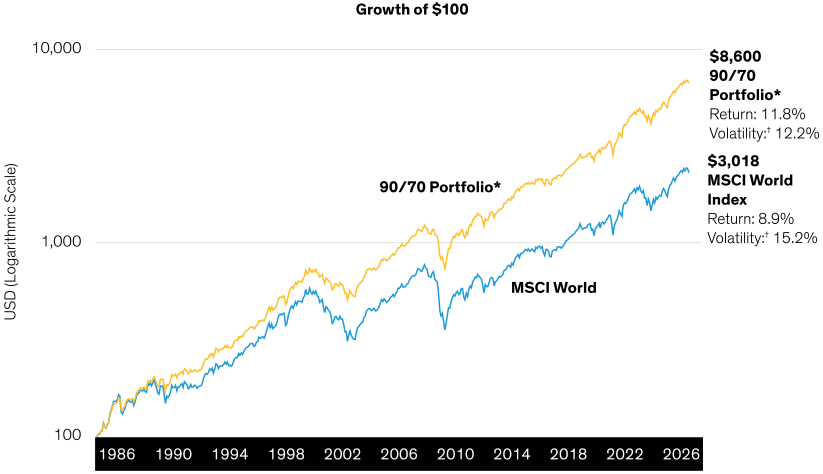
Our research suggests that a strategy that seeks to capture 90% of market gains but only 70% of losses can even generate outperformance versus the broad market over the long term.

The value of an investment can go down as well as up and investors may not get back the full amount they invested. Capital is at risk.
Can Investors Reduce Losses in Downturns and Still Beat the Market?
Line graph with time from 1986 to 2024 on the X-axis and dollar value on the Y-axis, comparing two investment portfolios.

Past performance does not guarantee future results. Returns shown are for illustrative purposes only and are not representative of any AB fund. It is not possible to invest in an index.
*Performance calculated by multiplying all positive monthly returns (0% or greater) of the MSCI World Index by 90% and all negative returns (less than 0%) by 70%; shown in logarithmic scale
†Annualized standard deviation
Data from March 31,1986 (inception date of MSCI World Index) through March 31, 2025
Through March 31, 2025
Source: MSCI and AllianceBernstein (AB)


Our Recipe for Reducing Risk


It’s not easy to build a portfolio that captures upside during rising markets and also mitigates risk during downturns over time. In our experience, the secret to delivering on the 90%/70% potential lies in finding high-quality stocks with stable trading patterns and attractive prices. We call it Quality Stability and Price (QSP).

Our QSP approach helps form an equity allocation that doesn’t only rely on traditional defensive sectors like consumer staples and utilities. Through the QSP lens, we’ve found a diverse universe of lower-risk companies with standout business models across an array of sectors by deploying deep fundamental research and thoughtful stock selection. Exposures are adjusted as insights into risks and opportunities evolve. 

Quality

Companies that typically have high profitability and durable competitive advantages.

Stability

Stocks of lower-risk companies with predictable earnings streams often have steadier trading patterns.

Price

Attractive valuations are essential; overpaying for downside mitigation can be counterproductive.


Overcoming Market Uncertainty

Market volatility can shake the resolve of even the most patient investors. By targeting more consistent return patterns, we aim to bolster investors’ confidence to stay invested through turbulent market episodes. That’s important because it’s hard to time market inflection points—and selling in a down market often means locking in losses and sacrificing gains in a recovery.
 
With an active strategy focused on both up and down markets, our defensive portfolio aims to address constantly evolving risks. From trade wars to technology, investors must constantly be attuned to the evolving forces that affect business outcomes and investment returns.

Our Defensive Core Equity Portfolios

Discover our range of defensive core equity portfolios, which aim to help reduce the impact of market volatility and capture strong long-term return potential amid the powerful challenges and forces of change that are transforming our world.
 
 
Global Equities
AB Low Volatility Equity Portfolio
Emerging Market Equities
AB Emerging Markets Low Volatility Equity Portfolio
US Equities
AB US Low Volatility Equity Portfolio

Some of the principal risks of investing in the Funds include Derivatives risk, Emerging-markets risk, Equity securities risk and Focused portfolio risk. A full explanation of the risks is provided in the Portfolio’s Prospectus. There can be no assurance that any investment objectives will be achieved.

Emerging Markets: Opportunities Beyond China

Emerging markets are seeing renewed attention. From structural growth and innovation in Asia to strong domestic sectors in South America, opportunities are expanding across the asset class for those who know where to look.

Sammy Suzuki, Head of Emerging Markets Equities, shares where he sees opportunities in EM and strategies for mitigating volatility. 

MSCI makes no express or implied warranties or representations and shall have no liability whatsoever with respect to any MSCI data contained herein. The MSCI data may not be further redistributed or used as a basis for other indices or any securities or financial products. This report is not approved, reviewed or produced by MSCI.

Frequently Asked Questions

Defensive equities are shares of companies selected for their potential to deliver more stable returns across market conditions. They typically reflect resilient business models, consistent earnings and strong financial fundamentals. Allocations to defensive equities can help investors reduce volatility while maintaining long-term equity exposure.

Traditional equity strategies often prioritise maximising upside participation, which can increase volatility. Defensive equity strategies place greater emphasis on downside risk management by focusing on stocks that are more likely to demonstrate relatively stable trading patterns across market cycles.

At AB, a defensive core equity approach aims to participate in equity market growth while limiting drawdowns during periods of market stress. By seeking to reduce losses, the strategy aims to support more consistent long-term outcomes for client portfolios, thus enabling investors to stay invested in turbulent markets. Our approach helps investors stay in the market through changing conditions with a target up-market capture of 90% and down-market capture 70%.

The QSP approach to defensive equities assesses companies based on financial strength and business quality, earnings stability and valuation. This framework is designed to identify investments with steadier trading patterns, helping to balance risk management with long-term return potential in a portfolio.

Our definition of quality is rooted in the fundamental business attributes of a company. That means we look for companies with sturdy business models, competitive advantages, consistent cash flows and attractive measures of profitability like return on invested capital. Healthy balance sheets are another important ingredient in high-quality companies.

Defensive equity strategies may participate in market recoveries, although they may not fully capture upside in rapidly rising markets. By limiting losses during market drawdowns, they help support stronger long-term compounding over a full market cycle.

Defensive equity portfolios may be appropriate for investors seeking equity exposure with a greater focus on managing volatility. This includes those with lower tolerance for drawdowns or those approaching key financial objectives, who may want to reduce the risk of short-term losses. Within the overall equity bucket, defensive allocations can complement other, higher-risk equity strategies—such a Growth or Value. They help reduce overall portfolio risk and improve Sharpe ratio, a measure of risk-adjusted return, while offering an uncorrelated return pattern to both higher-octane equities and bonds.

Defensive equity strategies are subject to equity market risk and may underperform during strong market rallies. Returns are not guaranteed, and investors may lose capital. Suitability depends on individual objectives, time horizon and risk tolerance. In general, our strategy may lag in up markets while mitigating the risk of capital loss in down markets. The strategy is most vulnerable in an environment where highly cyclical and low-quality stocks rally sharply.

The value of an investment can go down as well as up and investors may not get back the full amount they invested. Capital is at risk. There can be no assurance that any investment objectives will be achieved.