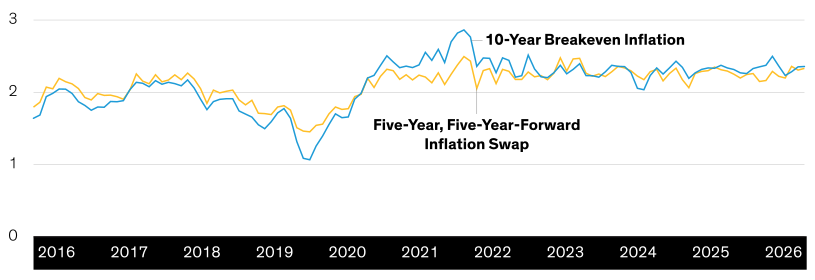
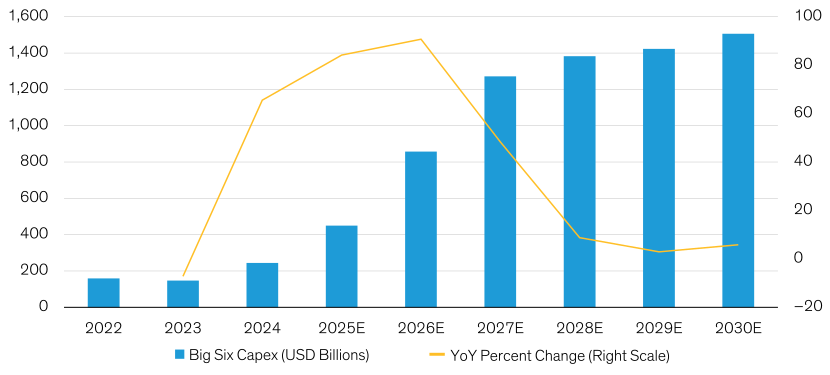
So, growth expectations should rise, especially if productivity gets a boost from AI investment. Pandemic era aside, productivity was below 1.5% for most of the past 15 to 20 years. Over the past two and a half to almost three years, it has edged up closer to 2%. We think that’s another reason to think that growth will pick up and part of the reason yields are moving higher.
Stronger economic growth affects longer-term interest rates through the neutral rate: the level of interest rates that should prevail over the long run. The faster the economy grows, the higher the neutral rate will likely be. It’s a major reason the Fed decided to raise rates. Because the neutral rate may be higher than policymakers thought, rates should be higher over time.
But AI investment isn’t all good news. This year’s boom in corporate debt issuance, particularly by hyperscalers, is competing with Treasuries for investors’ dollars. Hyperscaler issuance was about 8% of Treasury issuance last year; this year, it’s on pace to exceed 25% by year end and could rise further. There’s a finite pool of investor capital, and investors choose the most appealing assets. If they buy more hyperscaler debt, they have fewer dollars available to buy Treasuries, which is likely contributing to higher Treasury yields.
AI’s Possible Role in the Populist Policy Resurgence
AI is also reshaping the economy in other ways, including by widening inequality, which has implications for public policy. Labor’s share of GDP has fallen to its lowest level in the post-WWII era, while the corporate profit share has reached its highest—a trend that could disrupt the political order. Populism, which straddles the traditional left and right of the political spectrum, is increasingly driving the narrative.
A rise in populism matters to investors because politics drives policy, and populism has historically made policy volatile. When people are less satisfied with labor’s share of national income, the political system often swings sharply from left to right, creating a growth headwind. How can a business lay out a five- or 10-year plan without a clear view of what the regulatory, tax or trade regime will be? That uncertainty requires a higher risk premium in the market—another factor in higher rates.
“Unpredictable” is also an adjective turning up in how policymakers are interacting with markets recently. The US Department of the Treasury has intervened in the Japanese currency market using its own money for the first time in many years. It has also adjusted its Treasury issuance and buyback calendars. The long-standing mantra for issuance and buybacks had been “regular and predictable,” because predictability reduces risk premiums. Today’s more volatile policy may lead investors to demand more risk compensation.
Bigger Government Debt Burden, Heavier Debt Servicing
Populist policies, historically more common in emerging markets, are increasingly shaping political campaigns and policy decisions, which ultimately drive economic outcomes. But fiscal discipline isn’t part of the populist playbook, which rarely calls for governments to spend less or raise taxes. That stance translates into persistent budget deficits.
The US, for example, is running a budget deficit of roughly 6% of GDP. That’s about double the historical average of 2.5% to 3% outside of periods that featured wars and recessions. We don’t expect the budget deficit to narrow, given the political unpopularity of spending cuts and tax increases. Given that, basic math says that consistently big deficits will continue to increase outstanding debt.
This summer, total debt outstanding for the US Treasury topped $40 trillion—another round number that attracts headlines. As a percentage of GDP, that works out to roughly 120%, and the ratio is highly likely to continue rising. With more debt outstanding, a larger share of annual government spending is earmarked for the required interest payments. Total interest payments are on track to reach 4.5% of US GDP and $1 trillion per year (Display). And as interest rates on government debt rise, those numbers will rise, too.