Effective integration of AI also requires a cultural shift. Senior leaders should set an example by actively using and advocating for AI in their own workflows. Portfolio teams can publish internal agents and playbooks that others can adapt, compounding value across investment platforms. Senior investment leaders can also use AI to improve investment committee (IC) decisions and efficiency. For example, a CIO could input a deal memo ahead of an IC meeting and prompt AI to summarize the memo, suggest anticipated questions, and point out potential investment risks and concerns. And within teams, AI “power users” should mentor peers and share successful use cases.
Use Cases: Public Equities and Corporate Credit
In public equities and credit markets, investors are always looking for changes that can create opportunities or increase risk.
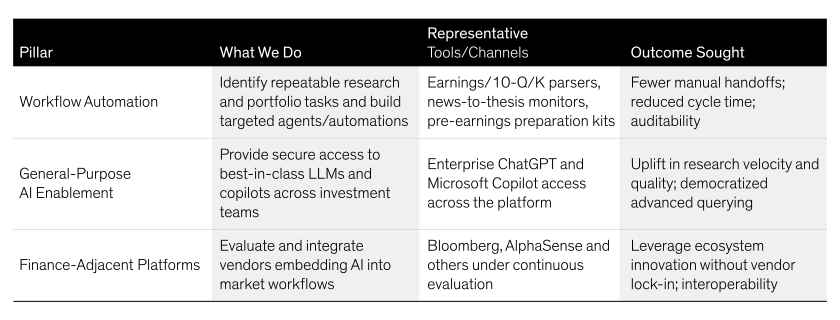
AI tools can be deployed to automatically extract shifts to management guidance and key performance indicators from earnings calls or events. With the right prompts, AI can compare transcripts and filings to previous materials to determine what’s changed, ready for analyst review.
News monitoring is another valuable function. With an investment thesis as a reference point, AI can provide alerts for sector or company news that might undermine confidence in an investment thesis.
At AllianceBernstein, many of our investment teams use both quantitative and fundamental analysis in security selection processes. AI enhances that collaboration, for example, by helping a quantitative analyst articulate a narrative to explain how a data-driven analysis argues for or against a holding. AI drafts devil’s advocate cases for debate so every fundamental thesis is confronted with counterpoints, which can improve the quality of investment decisions.
Use Cases: Private Credit and Specialty Strategies
Private credit investors face different challenges. Often, a single deal involves a massive number of documents. With an AI-powered triage, large document sets for prospective deals can be ingested to produce structured memos, key risk checklists and loan covenant summaries for human follow-up. This can dramatically decrease the time it takes an investment team to conduct a first-round review of a prospective deal.
Rising deal volumes can create big hurdles for private credit underwriting. Automation via AI can address that constraint directly by allowing teams to evaluate more opportunities without making significant headcount increases, saving costs and time.
For private credit and other investors, AI represents an opportunity to build your own IC stocked with respected experts and colleagues. We believe that allowing investors to have a vigorous debate and discussion with a customized and malleable IC should produce superior outcomes while consuming fewer total man hours.
Building Good Guardrails
In our approach, AI supports but doesn’t replace professional security selection, portfolio construction or risk decisions. Our guiding principle is Human in the Loop: we require analysts and portfolio managers to maintain ownership of their judgments and decisions.
Human-guided AI is rooted in our research culture of pairing quantitative analysis and data science with fundamental research. Quantitative models are used to pose better questions and structure debates rather than to autopilot portfolios.
Similarly, we think AI shouldn’t be used as a trading or security recommendation engine. AI model outputs should be treated as inputs to human analysis—not endpoints. Our AI philosophy aims to make our human analysts and investment teams better, enabling deeper and more creative thinking about complex issues that drive successful outcomes.
What Does AI Mean for Clients?
With the help of AI, investment teams can transform overwhelming market noise into actionable insights with unprecedented speed and precision. Faster decision-making processes can provide a competitive edge in an ever-evolving financial landscape.
AI can also enable customized research and reporting to align with specific mandates, and AI-driven processes can provide transparency, with clear evidence trails that support conclusions and foster trust and confidence among clients.
Clients must ask the right questions to understand the potential impact of AI on portfolios. Make sure that firms are using AI to empower people to make smarter decisions—not to replace smart people. Ask front-line analysts how they’re using AI day to day. Informed due diligence can help ensure that an asset-management firm is deploying AI to truly improve your investment journey.