


menu AllianceBernstein AllianceBernstein
  • Funds
  • Our Clients
    Overview Global Insurance Family Offices
  • Capabilities
    Alternative Strategies Equity Strategies Fixed Income Strategies Multi-Asset Strategies Institutional Solutions Group Responsible Investing
  • Investment Spotlight
    Systematic Fixed Income Emerging Markets Alternatives. We Deliver, Differently
  • Insights
    All Insights Institutional Research AB IQ Investment Insights Retirement Insights Market Matters Podcasts The Book
  • About Us
    Why Us Awards Corporate Responsibility Contact Us
  • Our Firm & Sites
 

Market Matters

Keeping Cool in Volatile Markets

The Upside of Defensive Equity Strategies

08 December 2025
8 Minute Read
Kent Hargis
Kent Hargis Chief Investment Officer, Strategic Core Equities

Contrary to popular belief, taking less risk can lead to higher returns. The key is selecting attractively valued, high-quality stocks that can help investors stay invested through both rising and volatile markets.

What Does It Mean to Be Defensive?

Building a strategy for evolving market challenges

Rapid changes in market sentiment are putting even the most experienced investors to the test. Following the 2022 market crash, US technology mega-caps led equities higher—but also contributed to a concentrated market.

Just when it seemed that the so-called “Magnificent Seven” were invincible, returns of the mega-caps diverged through 2025. More broadly, investors have had to digest on-and-off tariffs and unpredictable policy moves.

Even though stocks have advanced, investors understandably feel anxious. Can a defensive strategy succeed in highly concentrated markets? How about when markets are subject to acute policy uncertainty? We think the answer is yes in both cases. The key is generating smoother return patterns with downside-risk reduction.

The Advantages of Defensive Equity Strategies

It’s a deeply ingrained investing maxim that risk and return go hand in hand: to get more return, you must accept more risk. So some investors may find it counterintuitive that the opposite is also true: you can take less risk and still beat the market over time.

That’s especially prescient now as tariffs and escalating trade wars upend the financial markets. Fortunately, defensive equity strategies can shine at times like these.

Defensive strategies tend to reduce the temptation to buy high and sell low—both of which can weigh down returns.

Their smoother return patterns help shield against the corrosive effects of “risk drag”—weaker performance stemming from excessive volatility.

A low-volatility allocation provides flexibility in budgeting portfolio risk, allowing for increased allocations to return-seeking strategies.

Less Volatility, Higher Return Potential

Strategies that target downside-risk reduction can help boost performance over time.

The concept of upside/downside capture helps explain how preserving capital in the near term can drive outperformance over the long term. Imagine a hypothetical global stock portfolio that captured 90% of every market rally but fell only 70% as much as the market during every sell-off. What would its long-term returns look like?

You might think it would underperform; it wouldn’t. In fact, $100 invested in this hypothetical portfolio in 1986 would have built up $7,368 in capital through June 2025 and delivered a smoother ride through the ups and downs of the market (Display).

Can Investors Reduce Losses in Downturns and Still Beat the Market?

Growth of $100

Past performance does not guarantee future results. Returns shown are for illustrative purposes only and are not representative of any AB fund. It is not possible to invest in an index.

*Performance calculated by multiplying all positive monthly returns (0% or greater) of the MSCI World Index by 90% and all negative returns (less than 0%) by 70%; shown in logarithmic scale †Annualized standard deviation

Data from March 31,1986 (inception date of MSCI World Index) through June 30, 2025

As of June 30, 2025

Source: MSCI and AB

Redefining Investment Success

We’ve learned many lessons while managing risk and return over the past decade. Following these four principles can help investors stay invested in any kind of market.

1. Develop a Dynamic Defense: Every downturn is different. When devising a defensive strategy, consider current market behaviors, sensitivities and new forces of change that could redefine the essence of safety.

2. Cast a Wider Net: Preconceived notions of how to source stability can be restrictive. Broadening sources of stability can help diversify risk and return potential. Stable companies can be found in industries ranging from industrials to technology, which aren’t places investors typically search for safety.

3. Steer Clear of Unpredictable Forces: Geopolitical risk and macroeconomic developments can’t be predicted with certainty. When researching a stock, assess how significant the business’s exposure is to an unpredictable risk and avoid companies that appear to be especially vulnerable to forces that can’t be controlled.

4. Don’t Lose Your Nerve: When markets are turbulent, it’s easy to lose your nerve. Even the best-planned strategy may feel flimsy when losses are mounting. But selling equity positions in a falling market means locking in losses and forfeiting recovery potential. Since it’s almost impossible to time market inflection points, investors who sell risk missing the best days of a rebound, which can dramatically impair long-term returns.

Pick Your Poison: Relative vs. Absolute Risk

Many investors evaluate performance based on relative returns—comparing their portfolio to a market-cap-weighted benchmark. We think this is the wrong prism through which to evaluate risk.

When equity markets are dominated by the mega-cap stocks, deviating from large benchmark weights in a small group of stocks dramatically increases relative risk. Benchmarks are also backward-looking. A portfolio that’s tethered too closely to a benchmark will also be tethered too closely to yesterday’s winners.

But, in our view, the biggest flaw in focusing on relative risk is that it doesn’t solve the real problem: having enough money to meet your long-term goals. You can’t spend relative performance.

“

You can't spend relative performance.

Quality, Stability, Price: Finding the Sweet Spot

The secret to lower volatility and potentially higher returns? In our view, it’s high-quality stocks with stable trading patterns at attractive prices—what we call “QSP.”

Quality
High-quality companies that are good stewards of capital, with strong and consistent cash flows, have many ways to protect their margins—even when input costs rise. Measures of profitability, such as return on assets or return on invested capital, are important quality indicators and strong predictors of future earnings power. Similarly, companies that demonstrate capital discipline will be prized in any rate environment.
Stability
We believe shares of companies with predictable earnings patterns tend to offer stability, even in times of limited visibility. Our research suggests that stable companies tend to outperform the market over time and also have better risk characteristics. This lends stability to a portfolio and improves Sharpe ratios, an important measure of risk-adjusted returns.
Price
During periods of market stress, companies seen as having defensive characteristics may become popular but expensive. As a result, investors could end up paying a hefty price for this kind of insurance. That’s why it’s important to make sure that defensive allocations are already appreciated by the market—or are trading at attractive valuations. Buying at the right price is an important way to improve return potential and avoid expensive, vulnerable pockets of the market.

Capturing AI Innovation—Without Too Much Risk

Companies at the heart of the AI revolution may not seem defensive, but select AI firms can fit into a risk-aware equity allocation.

Artificial intelligence (AI) is perhaps the most transformational technology cycle since the birth of the internet. For defensive investors, the key is to look for firms with high-quality business models, a degree of stability and relatively attractive valuations.

Here are some helpful guidelines to follow when considering AI stocks:

  • Learn lessons from past technology cycles: During the dot-com boom, innovation was led mostly by unprofitable companies with unproven business models targeting aggressive growth. Today, many firms building AI infrastructures are profitable, and some top innovators offer quality businesses with stability.

  • Distinguish among technology industries: Much of the AI-driven surge to date has been led by semiconductor manufacturers and cloud infrastructure providers. We think software firms will play a bigger role in enabling efficiencies for companies and consumers, with some offering relatively attractive valuations and more defensive business models.

  • Be selective: While technology mega-caps are generally expensive, some of these firms offer high-quality business models that provide the flexibility to navigate short-term market stresses and longer-term challenges.

By carefully selecting stocks of high-quality AI businesses, we think investors can benefit from a once-in-a-generation technological shift without destabilizing the lower-risk profile of a broad equity allocation.

Stay Focused on Fundamentals— Even in a Trade War

Trade disputes can be unnerving, but this isn’t the time for rash moves.

Tariffs and trade wars are creating new sources of market uncertainty. But patience is critical. Selling equities because of trade concerns in early April would’ve locked in losses while causing investors to miss out on gains when the S&P 500 later reached record highs.

While the outcome of the current trade war is uncertain, we believe staying in the market offers the best chance to capture strong long-term equity returns.

“

While the outcome of the current trade war is uncertain, we believe staying in the market offers the best chance to capture strong long-term equity returns.

The High Cost of Missing Out

Attempting to time the markets is always a risky proposition.

When markets are volatile, investors may be tempted to rush for the exits. But history teaches us that this response tends to be costly.

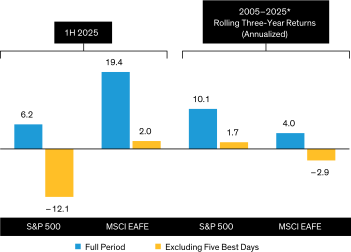
That timeless lesson was reinforced in early 2025. Missing out on the S&P 500’s best five days in the first half of 2025 translated to a 12.1% loss compared with a 6.2% gain for the full period.

For non-US stocks, the MSCI EAFE Index returned 2.0% in US-dollar terms, excluding the best five days, versus a 19.4% gain for those who remained invested (Display). These trends echo patterns observed over the last 20 years in equity markets, when missing the best five days over each rolling three-year period significantly weakened returns.

Index Return: First-Half 2025 and Last 20 Years

Percent

Past performance is no guarantee of future results.

EAFE is Europe, Australasia and the Far East.

*Annualized trailing three-year daily returns of the S&P 500 and MSCI EAFE and trailing three-year daily returns where the best five days are excluded are calculated every business day from January 2008 (trailing three years goes back to January 2005) through end of June 2025. The average of these returns is then calculated to give the results in the chart. MSCI EAFE returns are shown in US-dollar terms.

As of June 30, 2025

Source: FactSet, MSCI, S&P and AB

In Summary…

In a fast-changing world, a defensive equity strategy, rooted in research yet capable of adapting to new conditions, can provide investors with the confidence to stick with equities through volatile times and improve long-term outcomes.

For more information, please read our recent white paper:

Keeping Cool in Volatile Markets: The Upside of Defensive Equity Strategies

Kent Hargis
Kent Hargis Chief Investment Officer, Strategic Core Equities

Market Matters

Delivering timely research-driven insights for navigating dynamic markets.

Discover More

The views expressed herein do not constitute research, investment advice or trade recommendations and do not necessarily represent the views of all AB portfolio-management teams. Views are subject to revision over time.

MSCI makes no express or implied warranties or representations and shall have no liability whatsoever with respect to any MSCI data contained herein. The MSCI data may not be further redistributed or used as a basis for other indices or any securities or financial products. This report is not approved, reviewed or produced by MSCI.

    Terms of Use Privacy Policy Cookie Settings Management Company Important Disclosures Modern Slavery Statement

    This is a marketing communication. This information is provided by AllianceBernstein (Luxembourg) S.à r.l. Société à responsabilité limitée, R.C.S. Luxembourg B 34 305, 2-4, rue Eugène Ruppert, L-2453 Luxembourg. Authorised in Luxembourg and regulated by the Commission de Surveillance du Secteur Financier (CSSF). It is provided for informational purposes only and does not constitute investment advice or an invitation to purchase any security or other investment. The views and opinions expressed are based on our internal forecasts and should not be relied upon as an indication of future market performance. The value of investments in any of the Funds can go down as well as up and investors may not get back the full amount invested. Past performance does not guarantee future results.

    This information is directed at Professional Clients only and is not intended for public use.

    © AllianceBernstein L.P.