A Look Ahead at the Future of Asset Management

08 December 2025
6 min read

Changes are in store for the macro environment, return sources, investment approaches and tools.

The possibility of a less-favorable macro environment ahead holds important implications for the asset-management industry’s outlook. With preserving long-term purchasing power at its core, asset owners may need to reexamine their strategic allocations and portfolio design.

Multi-Asset Investing Is Active Investing

In such a future, we see a bigger role for investing in an explicitly multi-asset context. The experience of 2022, with declines in both equities and fixed income, revealed what can go wrong with a relatively “passive” 60/40 strategy. We see a need for a different, more explicitly active multi-asset approach.

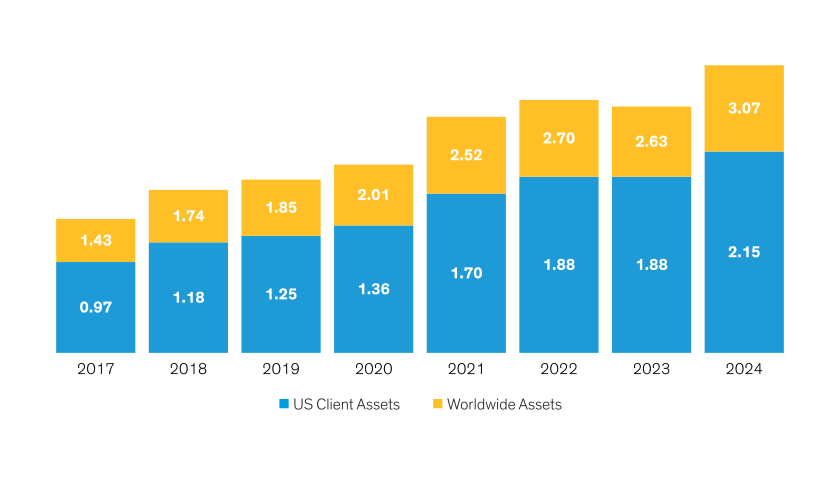
This approach can take many forms, including strategies built to outperform a cash or inflation benchmark as well as income-generating strategies. There has also been more interest in outsourced chief investment officer (OCIO) arrangements with asset managers (Display), given the growing challenge of achieving a specific real return and diversifying with traditional building blocks. The OCIO approach may need to evolve from traditional approaches into taking active positions across asset classes.

This situation also seems to have renewed interest in adopting a holistic total portfolio approach over traditional strategic asset allocation with predetermined asset-class silos. A more active approach also leads to the topic of factors—they’ve had a checkered history, but we see a role for them.


The OCIO Market Is Growing Rapidly
Total Outsourced Chief Investment Officer Assets (US Dollar Trillions)
Growth in the total outsourced chief investment officer assets—US and World

Past performance does not guarantee future results.
As of July 15, 2024
Source: “Investment Outsourcing Special Report,” Pensions & Investments and AllianceBernstein (AB)

Private Assets and a Liquidity Spectrum

Asset owners’ needs and a structural change in capital raising are boosting allocations to private assets. Allocations will likely rise further, given the need for real returns and diversification beyond public markets. Asset managers will likely need to both source private investments and help investors combine public and private assets thoughtfully. We see liquidity as the real limitation to private allocations, given the less liquid nature of current portfolios and more fragile liquidity in public markets.

We think investors will increasingly view liquidity as a spectrum, favoring assets that return cash within a few years or with predefined liquidity events, such as debt, over longer-horizon assets such as private equity. The lion’s share of capital allocated to private markets over the past decade has been to equity, but we expect allocations to broaden to other segments—including debt. The task for strategic asset allocators and the asset-management industry is to thoughtfully allocate across these different risk types.

The Rise of Insurance/Asset-Management Partnerships

Allocations will likely also need to be redesigned for pension plans—the result of longer lifespans and a reduced role for government bonds as diversifiers. From a macro standpoint and irrespective of other industry dynamics, insurers seem likely to become more important as providers of long-term capital; one manifestation of this will likely be more strategic partnerships with asset managers with expertise in generating long-term real returns.

Separately, return streams are needed to address a higher-inflation environment and longevity risk, implying more demand for solutions such as variable annuities and life insurance. Given the macro environment we’ve laid out, solutions with variable outcomes could become more attractive than fixed annuities. We think that this collective solution set will become key in planning for longer retirements, and we would expect more opportunities for joint action by insurers and asset managers.

Tackling the Contemporary Retirement Problem

A less friendly investment landscape and growing longevity are also challenges for defined contribution plans, where individuals shoulder a greater burden to save for retirements that may last decades. The asset-management industry has a key role in addressing the issue.

As we see it, traditional target-date glide paths need rethinking for a more difficult investment outlook. Avenues include higher equity exposure to build savings, diversification into areas such as private assets, reduced long-term bond exposure, an intensified focus on income and a potential shift in benchmarks—perhaps incorporating the need to outpace inflation. Ultimately, these shifts recognize that retirement saving is an active decision; there seems to be no such thing as a passive glide path or allocation.

The Need for Active, Market Concentration and the Active Opportunity Set

With asset-class returns expected to fall short of recent decades, alpha has the potential to play a greater role in allocation. Concentrated markets have challenged long-only active managers, but we still hear investor support for active. High valuations and lower expected growth also imply lower returns from broad, passive index exposures, so alpha could be a larger share of returns. In our view, a broad range of alpha-generation tools is critical, spanning public and private, quantitative and fundamental, and time horizons. Portable alpha strategies offer the potential to source alpha from markets that might not be large portfolio allocations.

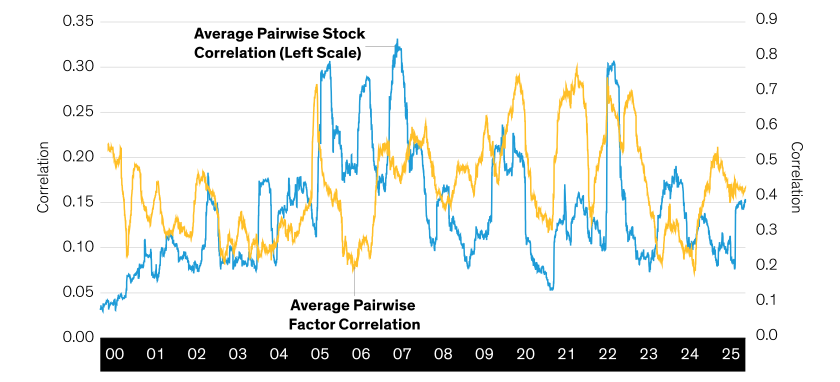
Several reasons are behind the secular shift to passive, including poor after-fee performance, robust beta returns and an investor focus on minimizing headline fees instead of maximizing realized net-of-fee returns. Less-generous returns ahead and a more nuanced view of fees should help the case for active, but alpha has to be persistent. Based on our research, idiosyncratic alpha—stripped of simple, persistent factor exposures—is more likely to be lasting. Market concentration remains a tactical challenge, but other aspects of market structure are more benign, including low correlations among stocks and factors (Display).


Correlations Among Factors and Stocks Have Been Low
Average Pairwise Factor and Stock Correlations
The average pairwise correlations among factors and stocks since 2000

Historical analysis does not guarantee future results.
Stock correlations are based on daily stock returns for the constituents of the MSCI All-Country World Index over rolling six-month periods.
Date from July 4, 2000 through August 28, 2025
Source: FactSet, LSEG I/B/E/S, MSCI and AB

Digital Assets: Crypto, Stablecoins and Tokenization

Innovation such as tokenizing real assets may also be an important step toward incorporating diversifying return streams without compromising liquidity. We think the uptake in digital assets will be significant in years ahead. Crypto is seeing the most demand right now, and some crypto assets make sense as part of a complementary allocation to gold and broader real-asset exposures.

Stablecoins have greater regulatory clarity and acceptance in the US, but we don’t see them as a game changer in how investment views are formed, nor something that would change the range of investment options the way crypto does. The real prize seems to be tokenization, especially of real assets, which asset owners need increased exposure to, given possible higher inflation and lower growth ahead.

The promise of fractionalizing exposure to illiquid, hard-to-access assets will make this an important element of portfolio design over time. We believe that tokenization will ultimately subvert the concept of asset classes, and it’s critical to more-efficient cross-asset active investing. For asset managers, the asks from asset owners are to aid in originating tokenized assets and building them into multi-asset portfolios.

The Financial Industry and AI: Exposure and Tools

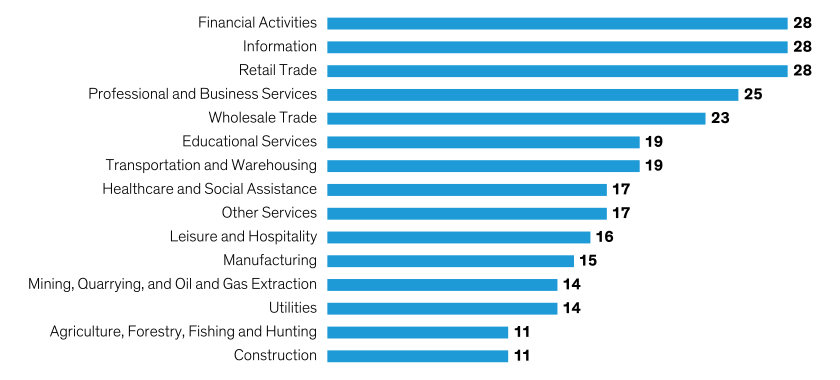
Based on our recent research, the financial industry is the most exposed to AI (Display), featuring many tasks suitable for automation by large language models. These include summarizing documents, synthesizing data, coding and providing feedback.

Large-Language-Model Automation Exposure by Sector
Automation by Sector Weighted by Value-Added Share
Exposure to AI automation by sector in the United States

Current analysis does not guarantee future results.
Occupation-level automation data provided by Daron Acemoglu, value-added data is from Bureau of Economic Analysis input-output tables.
As of May 12, 2024
Source: Daron Acemoglu, Bureau of Economic Analysis and AB

Current AI use in the asset-management industry focuses on administrative tasks, communication and alternative data analysis. Over time, it’s expected to transform investment analysts' roles and potentially alter the very structure of financial models, feats that the onset of Excel and Python failed to accomplish. The predictive efficacy of models might improve, but the ability to explain those predictions may not. It’s challenging to automate investment decisions with AI, because financial markets are self-referential, and there will always be a need for human accountability and explanations when models fail.

The views expressed herein do not constitute research, investment advice or trade recommendations, do not necessarily represent the views of all AB portfolio-management teams and are subject to change over time.


About the Authors