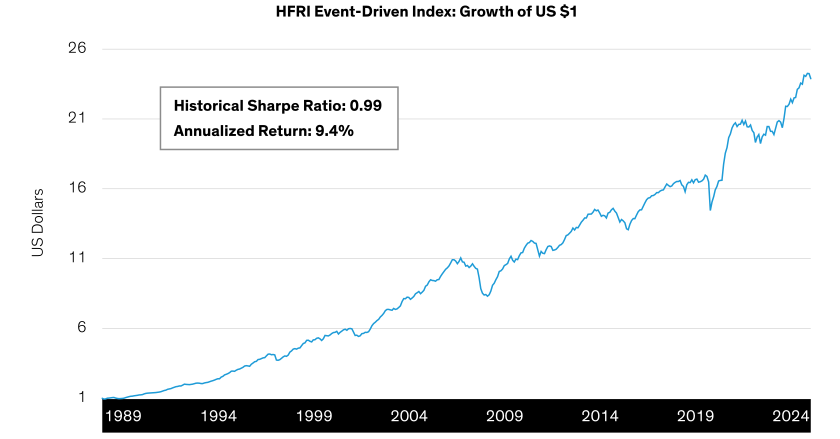
But some event-driven strategies have biases that may make them less effective. In many cases, we think it’s from leaning too heavily into one type of event: merger arbitrage, where managers seek to extract risk premia associated with merger transactions over a defined outcome and timeline. These biases are visible at the index level. Investors might be surprised to learn that the HFRI Event Driven Index had a high correlation of roughly 0.9 to the HFRI Merger Arbitrage index between February 2020 and August 2025.
Make no mistake: we consider the recent acceleration of corporate mergers and acquisitions (M&A) activity a welcome sign of renewed dealmaking after years of muted activity. But for strategies that seek to capitalize on event-driven price anomalies, tie-ups and takeovers aren’t the only events that matter.
Hidden Equity Correlation in Merger Arbitrage
At first glance, leaning heavily into merger arbitrage substrategies may seem prudent. Over the long run, merger arbitrage has generated high-quality returns—roughly defined as returns that are consistent, understandable and uncorrelated over time to the broad equity market. Of the 42 HFRI hedge-fund indices, merger arbitrage has the seventh-smallest maximum drawdown and has logged just two down years over the past 35 years.
But the strategy can be inherently cyclical, driven by the ups and downs of deal flow, which can create challenges. And while merger arbitrage strategies tend to have little correlation to traditional markets, they can exhibit higher sensitivity during periods of market stress.
For event-driven strategies heavily focused on merger announcements—so-called “hard” catalysts with a defined outcome and timeline—this can result in a “long” bias to equity markets. In our view, this may increase the risk of losses when the market struggles.
Embracing a More Systematic Approach
But mergers aren’t the only catalysts that managers can seek out. There are also systematic catalysts—sometimes referred to as “soft” or “diversified” catalysts. They’re often events initiated by corporations, regulatory agencies or constrained investors such as passive fund managers. Unlike mergers, these events typically have a less defined effect on security prices and timeline for monetization.
Many event-driven investors look to these types of catalysts to seek out diversified returns with little or no correlation to the broad equity market. This may also offset some of the “point-in-time” beta to equity markets that merger arbitrage can introduce into a broader event-driven strategy.
The sheer diversity of event types, however, creates challenges for fundamental event-driven managers. In the corporate segment alone, there are dozens of systematic catalyst categories that can be applied globally.
A Closer Look at Systematic Catalysts
The multitude of systematic catalysts can be organized into two subcategories: those that are sentiment-driven and those that are more diversified.
Sentiment catalysts create opportunities to capitalize on directional moves caused by discrete events. For example, an investor might interpret a company’s plans to buy back shares as an expression of confidence in its forward earnings. Or the anticipated rebalancing of a widely followed equity index might provide an opportunity to capture stock price momentum, as passive investors buy or sell shares.
Diversification catalysts focus on persistent market themes. An analyst’s rating change on a particular security, which may create an opening to take a long or short position, fits into this category.
With dozens of event-driven strategies and hundreds of substrategy event categories, we believe a rules-based, systematic approach is an essential ingredient to capture the returns associated with these catalysts. It enables investors to leverage hundreds of quantitative inputs to inform investment decisions and may prevent portfolios from becoming too concentrated in a smaller number of catalysts.
The alternative—conducting fundamental research and analysis on each and every transaction—would require resources that few investors have at their fingertips today.
It’s also important, in our view, to focus on opportunities to profit from catalysts via short positions. Many event-driven strategies tend to have a long bias, which we believe limits the opportunities to generate alpha. Adding short positions in event-driven strategies may also help keep them uncorrelated to the broader market in periods of stress.
Advances in machine learning are also enhancing the appeal of systematic strategies, allowing for a quantitative and AI-driven decision-making process that can interpret vast data sets and help identify and incorporate a wider range of catalysts with the potential to affect prices.
None of this suggests M&A activity won’t continue to anchor event-driven investing. But we think a broader and more diverse event-driven approach with the ability to go long and short has the potential to reduce correlations and make portfolios more durable across market environments.