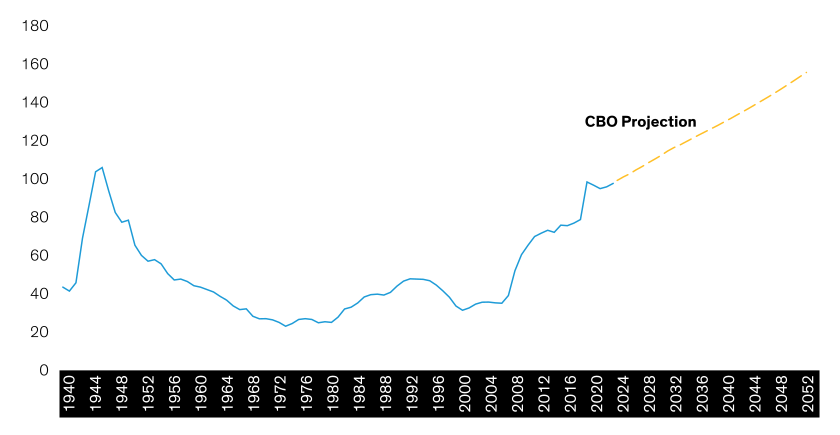
We don’t see an explicit debt/GDP level that’s problematic per se, but a rising ratio poses the risk of an exogenous shock causing a surge in bond yields. This risk should be a feature of high-debt governments when interest rates no longer trend endlessly downward. Interest expense as a share of government spending poses more of a threat, in our view. US debt service exceeded the country’s defense budget in 2024 for the first time in modern history.
Over long horizons, we believe that letting inflation run higher to reduce the real value of debt will likely be preferable to a more aggressive action, such as sharply raising taxes or cutting government spending. An outlook for structurally higher and more volatile inflation, in our opinion, creates a challenge for US nominal duration bonds, so we think investors should consider inflation-protected securities.
Mar-a-Lago, Debt and the US Dollar
Along with debt sustainability, a second concern about US exceptionalism is any potential change in US policy that would hurt foreign bondholders specifically. In our view, both of these concerns are reason to consider hedging more US dollar exposure.
We raised the possibility of negative actions against global bondholders with a putative Mar-a-Lago Accord as a successor to the 1985 Plaza Accord—the international agreement devaluing the dollar. Another recent example is the Section 899 provision in the One Big Beautiful Bill Act that would impose higher taxes on countries deemed to have “unfair foreign tax regimes.” While it’s unclear if any of these measures will be implemented, the extreme policy uncertainty erodes investors’ trust in the US and hastens their desire to look for US dollar and US sovereign-bond alternatives.
While there’s no near-term prospect of an alternative to challenge the dollar’s reserve status, we see a case for a directional move away from it. Any decline of trust in the US implies less willingness to hold dollars. Moreover, trade is predominantly dollar-denominated, so a significant trade decline stemming from US tariffs and policy uncertainty creates less demand for global investors to hold dollars. The result is our view that the dollar’s outlook is directionally more negative and would be less of a safe-haven hedge.
The reason to hedge more dollar exposure now really rests on the notion that among the potential negative outcomes, around policy announcements at least, more of them seem to chart a path that would be negative for risk assets and the dollar at the same time.
Defensive Assets to Balance Exposure to Stocks
With stocks likely to remain a critical allocation for investors seeking to outpace inflation, what investments could serve as defensive counterparts?
If government bonds become somewhat less effective at de-risking and diversifying, broader exposures should come into play. These could include private assets and factor exposures—low volatility, in our assessment, has generally been effective. Active strategies are also worth considering, as is exposure to investment-grade credit—not for its relative value but in place of some US Treasury holdings.
Gold has performed very well through the trade turmoil, and we see a place for it, given that its correlation with equities has historically been zero—even at higher inflation levels. Demand for gold from central banks seems likely to stay robust, and all G7 economies carry high-debt burdens, so inflation or letting currencies weaken against gold could become attractive policy paths.