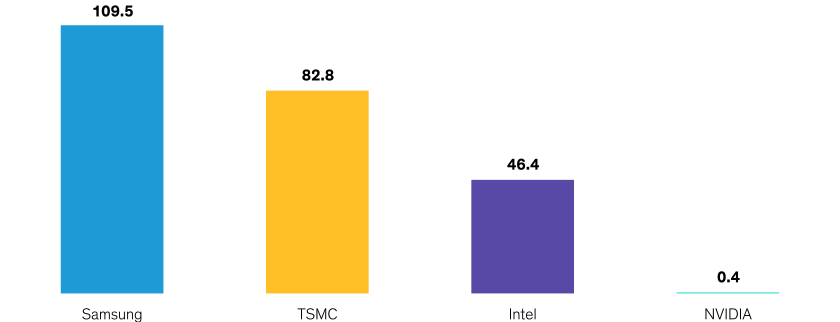
Further, as AI adoption accelerates, rising electricity demand may place additional pressure on water resources in some regions, compounding existing challenges for semiconductor manufacturers. As a result, water stewardship is becoming a differentiator across the semiconductor industry.
How Chipmakers Address Water Risks
Whether too much, too little or too contaminated, water risks come in different forms but are inherently local, requiring equally localized solutions.
In 2021, TSMC faced government-imposed water restrictions during Taiwan's worst drought in a half century. To sustain operations, the company trucked water to key fabrication centers along with strict conservation controls. Today, it’s investing for long-term resilience at its new operations in the dry American southwest, including a 15-acre water reclamation plant in Arizona to support sustainable growth.
Samsung Electronics is pursuing a different path, targeting a return to 2021 water-withdrawal levels by 2030. Central to that effort is expanding water reuse by treating and recycling production water, thereby reducing dependence on new water withdrawals. Pilot projects at its Giheung and Hwaseong facilities aim to reuse 120,000 metric tons daily by 2029.
NVIDIA water consumption appears comparatively small, but it operates a “fabless” business model, outsourcing chip fabrication to partners like TSMC and Samsung. Yet, the underlying water risks remain embedded via its partners.
Taken together, these examples suggest that managing water risk is becoming a strategic capability rather than a compliance exercise.
What Strong Water Stewardship Looks Like
In our view, the companies best positioned for future growth may be those that can adapt their operations and supply chains to local water constraints. Ultimately, strong water stewardship may support better long-term company performance.
Most investors rely on company disclosures to assess water risk, but disclosures alone rarely tell the full story. We believe that evaluating water resilience requires a broader framework that goes beyond reported metrics. We look for evidence that companies are investing in water-reuse systems, reducing freshwater withdrawals, disclosing meaningful performance metrics, engaging with community stakeholders, understanding local watershed conditions and integrating those considerations into capital-allocation decisions. This deeper analysis can help investors assess whether companies are effectively managing water-related risks and positioning their operations for long-term resilience.
As part of this analysis, we see active engagement* as critical, not only between investors and chipmakers but between the firms and the communities that share their limited water resources. Engagement can help investors distinguish between companies that are proactively managing water risks and those that may be underestimating them. Discussions around reuse targets, reclamation investment, disclosure practices and site-level water planning provide important insight into a company’s ability to navigate future water constraints.
Water availability and quality are critical inputs to semiconductor manufacturing and, ultimately, profitability. As AI-driven demand accelerates, investors may benefit from looking beyond production growth alone to evaluate whether companies will have the water resources needed to support that growth. As we see it, the industry’s leaders will be those that can secure, manage and diversify water resources most effectively, turning a growing resource challenge into a competitive edge.
The authors would like to thank Maxwell Lulavy, Responsible Investing Research Analyst at AB, for his significant contributions to the research behind this blog.