Healthcare Leaders Typically Start Outside the Spotlight
For investors who want to allocate broadly to healthcare, the next question is how to gain that exposure—through passive strategies or active management.
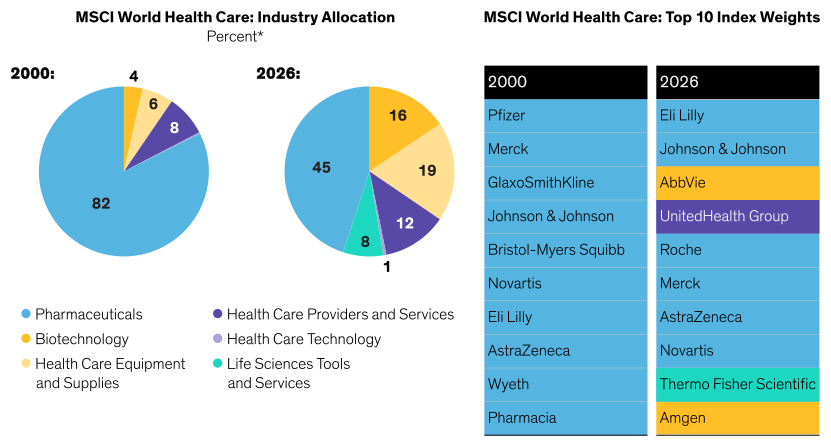
As we see it, identifying healthcare leaders early is key. Often, the most exciting companies only become index constituents after they reach a substantial market cap, when most of their early growth has already occurred.
Some of today’s biggest healthcare names held small index positions—or none at all—while they were building pipelines, refining technologies and establishing market share. Active management can seek to identify similar companies earlier, when their opportunities may be less widely appreciated. Examples include Argenx, which develops antibody-based therapies for rare and severe autoimmune diseases, and Vertex Pharmaceuticals, a market leader in cystic fibrosis treatments. Each spent years innovating and gaining recognition in their respective markets before securing spots in major healthcare indices.
Innovation increasingly extends beyond drug development. Advances in medical technology, diagnostic testing and surgical equipment are creating new growth opportunities and AI is increasingly being introduced in commercial tools across the sector. For instance, Edwards Lifesciences, which makes devices for structural heart diseases, has expanded its business to minimally invasive valves that can improve longevity and quality of life for more patients. Halozyme Therapeutics, a biotech company that has developed drug-delivery technologies to support pharmaceutical clients, has yet to be included in the MSCI World Health Care Index.
Active Strategies Can Create Advantages
In our view, active management can add value to healthcare allocations in several ways:
- responding to changing company outlooks—for example, adjusting exposure as fundamentals shift, rather than maintaining static index weights that typically only change after share prices move;
- identifying emerging leaders earlier, particularly companies gaining traction before they enter benchmarks; and
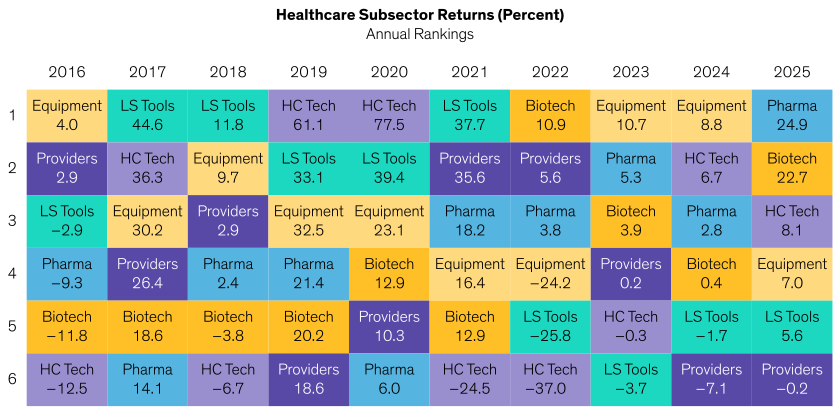
- selecting stocks within subsectors, where index exposure may favor the largest or most established names rather than those best positioned to benefit from changing competitive dynamics and long-term industry trends.
Active healthcare fund managers can pair selective exposure to established large-cap companies with overweight positions in smaller, potentially faster-growing companies.
Large pharmaceutical companies with quality businesses certainly have a place in any healthcare portfolio. But an active approach can look beyond headline index weights to identify firms with durable fundamentals and diverse business models. In a sector that continues to reinvent itself, we believe that flexibility can create powerful advantages for long-term investors.