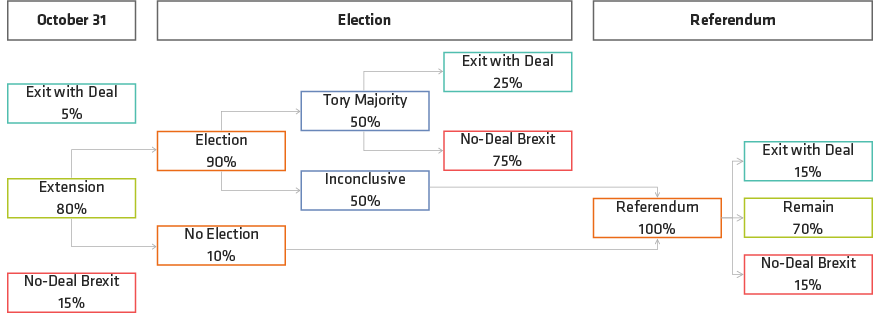
With Parliament in control of the Brexit process, a further extension of Article 50 is by far the most likely outcome. We now put the probability of an extension at 80% (up from 50% at the end of July). We’ve also lowered the probability of a deal by October 31 from 15% to 5%, and reduced the probability of a no-deal Brexit from 35% to 15%.
Assuming the EU agrees to extend Article 50, the UK is likely to move quickly towards a general election (this may well be a precondition for an extension). The outcome of that election is likely to fall one of two ways: If the Conservative Party wins, the UK will almost certainly leave the EU early next year, probably without a transitional deal. But if the Conservative Party loses, a second Brexit referendum looks inevitable.
The odds of a second referendum would be heavily stacked in favor of either remain or an exit with a deal (soft Brexit). That’s not because of a radical shift in public opinion since June 2016, but because a pro-remain Parliament would find it hard to resist changes that would bias the result in that direction—including lowering the voting age and allowing EU nationals living in the UK to vote.
Focus on the Inevitable Election
The key event to focus on is therefore not the October 31 deadline but the election that will surely follow. According to recent opinion polls, the Conservative Party has an average lead of almost 10 points over the Labour Party. In normal times, that would translate into a healthy majority for Boris Johnson.
But these are not normal times: several factors make an early election too close to call. For one thing, it’s difficult to translate current vote shares into seats in the UK’s heavily distorted first-past-the-post system. In addition, not all polls give the Conservatives a commanding lead (it varies between zero and 15%, depending on the poll) and tactical voting by pro-remain parties could have an important impact. Finally, Conservative support could collapse if Johnson fails to deliver on his promise to deliver Brexit on October 31.
The probability of a no-deal Brexit is likely to fluctuate wildly in coming months. In the run up to October 31, we think it remains low at just 15% (Display).