Signals Are Only the Starting Point
Many systematic bond strategies use familiar categories of predictive factors, such as value, momentum and quality. These factors, including proprietary ones, can help identify securities with a higher probability of outperforming a benchmark. But factor labels alone tell investors very little about the strength of a strategy.
In our view, successful systematic investing depends on how those factors are researched, tested, combined and implemented. A value signal, for example, may look compelling in isolation. But if it is based on weak data, overlaps with other risks or cannot be traded cost-effectively, it may not add much value in practice.
That’s why we believe investors should look beyond the presence of factors and ask harder questions: How deep is the manager’s data history? How often are factors tested? How are new factors added? How are outdated factors removed? And how does the manager avoid relying too heavily on signals that worked in the past but may not work in the future?
Factor Efficacy Changes
One reason repeatability is hard is that markets change. Factor efficacy can evolve over time. A systematic process that does not adapt can become anchored to stale relationships.
In our view, that makes dynamic factor research essential. A strong systematic platform should be able to evaluate whether factor efficacy is changing, adjust factor weights when appropriate, test potential new sources of alpha and continually incorporate new research findings into its factor set. The goal is not to chase every short-term market shift but to maintain a disciplined process that can evolve as data relationships change.
A Ranked List Is Not a Portfolio
Even strong signals do not automatically create a strong portfolio. In systematic fixed income, the model may rank bonds by expected attractiveness, but portfolio construction determines how those ideas are translated into actual holdings.
That step is critical. A portfolio needs to manage exposure to duration, credit-spread risk, issuer risk, industry risk and turnover. It also needs to avoid unintended concentrations arising from bottom-up security selection. Without those controls, a strategy that appears to be generating security-selection alpha may actually be taking hidden factor or beta risk.
In our view, this is one of the biggest differences among systematic managers. The question is not just whether managers can identify attractive securities, but whether they can build portfolios that capture those insights while staying aligned with their strategies’ risk budgets and client objectives.
Implementation Can Make or Break Alpha
Fixed-income markets are not frictionless. Bonds do not trade like large-cap stocks. Pricing can be less transparent, liquidity can be uneven and transaction costs can erode small expected-return advantages.
That makes implementation central to systematic fixed income. A factor may look powerful before trading costs. But if the securities are hard to source, expensive to trade or likely to require excessive turnover, the expected alpha may disappear before it reaches the portfolio.
In our view, effective systematic managers need strong liquidity discovery, transaction-cost modeling and execution capabilities. These capabilities help determine not only which bonds look attractive, but which bonds can be traded efficiently enough to justify the position.
For example, our proprietary trading simulation platform, abSimulator, helps evaluate how transaction costs may affect investment outcomes before investment decisions are made. That can provide a more realistic view of whether a source of alpha is likely to survive contact with real-world markets.
That point is especially important in fixed income because many systematic alphas are incremental. The strategy’s strength comes from many small decisions that compound across a broad opportunity set. Implementation quality can determine how much of that potential survives.
Governance Separates Discipline from Data Mining
Systematic investing can sound mechanical, but strong governance is essential. Models need oversight. Data need quality controls. Factor research needs a process for testing whether relationships are robust, economically sensible and implementable.
In our view, governance helps separate a disciplined systematic process from a collection of back-tested signals. Investors should understand who reviews model outputs, how changes are approved, how factor performance is monitored and how the manager checks whether results are coming from intended sources.
This matters because systematic strategies can be vulnerable to overfitting, stale data relationships and unintended exposures if the research process isn’t well controlled. A thoughtful governance framework may help keep the strategy focused on repeatable, explainable sources of alpha rather than short-term patterns that may not persist.
What Investors Should Ask
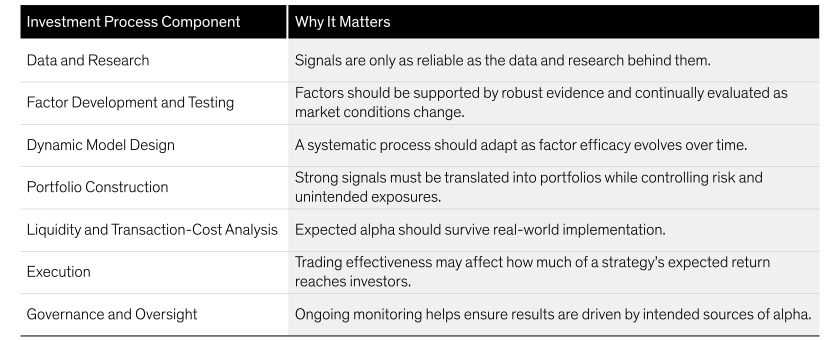
When evaluating systematic bond managers, investors may want to look beyond performance or factor lists. In our view, the better question is whether the manager has the full alpha-production chain in place.
That means asking:
- Are the factors supported by robust data and research?
- Can the model adapt as factor efficacy changes?
- Does portfolio construction control unintended risks?
- Are liquidity and transaction costs built into the process?
- Is there clear governance around model changes and factor evaluation?
- Can the manager explain where alpha came from and whether it came from intended sources?
These questions are relevant across a wide range of systematic fixed-income strategies. While mandates may differ, the underlying challenge remains the same: consistently translating signals into portfolio outcomes.
In our view, repeatable bond alpha takes more than good signals. It takes data depth, research discipline, portfolio-construction rigor, implementation skill and governance. For investors, understanding that full engine may be the best way to separate durable systematic strategies from those that struggle to deliver on their promise.