Can Semiconductor Makers Navigate Rising Water Risks?

30 July 2026
3 min read

Sara Rosner | Director—Responsible Investing Research

Dr. Michael Puma | Director and Research Scientist—Columbia University Earth Institute

Henna Nordqvist, CFA | Corporate Credit Analyst—Fixed Income

James Russo | Portfolio Manager—US Strategic Core Equities; Senior Research Analyst—Strategic Core Equities

Water scarcity and purity are critical risks for semiconductor makers in the AI era.

As companies race to capitalize on the AI boom, water security is emerging as a material risk across the value chain. While data centers attract headlines, semiconductor fabrication remains one of the value chain’s most water-intensive activities, requiring reliable supplies of high-purity water. As a result, managing water risk is becoming a strategic capability for semiconductor companies. 

Clean Water’s Pivotal Role in Semiconductor Production

Chip manufacturing is highly water intensive, particularly during wafer fabrication. Producing advanced semiconductors requires large volumes of ultra-pure water, which cannot always be sourced directly from municipal systems, especially during droughts. 

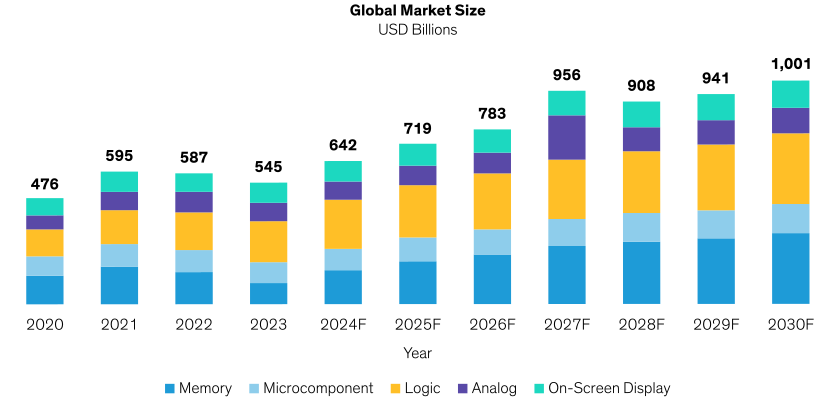
Meanwhile, AI-driven demand for chips is expected to propel the semiconductor industry to a market size of at least $1 trillion by 2030 (Display), with a recent McKinsey analysis putting the industry’s 2030 size at $1.6 trillion and BofA at $2.7 trillion.

Global Semiconductor Market Expected to Top $1 Trillion by 2030
Memory, micro, logic, analog and on-screen display chip demand will all contribute to soaring market revenues.

Historical analysis does not guarantee future results.
As of September 30, 2024
Source: Columbia Business School Climate Knowledge Initiative, company reports, PwC and AllianceBernstein (AB)

While China, Taiwan and Japan remain manufacturing leaders, US production is poised to grow as reshoring accelerates under the CHIPS and Science Act of 2022. 

The Impact of Water Stress on Semiconductor Makers 

As fabrication capacity expands, the semiconductor industry’s global water withdrawal is on track to rise from roughly 260 billion gallons a year today to around 390–455 billion by 2030, and to double by the mid-2030s. Without meaningful mitigation efforts, manufacturers in water-stressed regions could face growing operational and financial risks. The challenge is urgent, as roughly 40% of existing fabrication facilities are based in watersheds either experiencing or prone to severe water stress.  

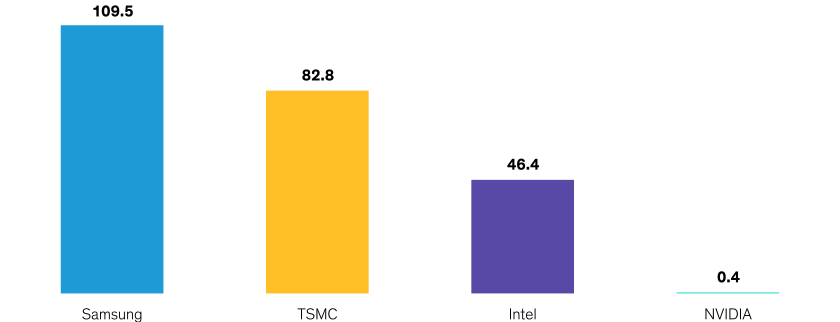
Water demand is already staggering. Taiwan Semiconductor Manufacturing (TSMC), Samsung Electronics and Intel are among the top consumers, with annual withdrawals in the billions of liters (Display). NVIDIA’s direct water footprint is much smaller because it outsources fabrication. However, it’s still vulnerable to associated supply chain risks, in our view. 

Water Use to Make Microchips Is High and Varies by Company
Annual Water Withdrawal by Leading Semiconductor Companies (Billions of Liters)
Samsung, TSMC, Intel and NVIDIA will consume the most water for their chip fabrication by far.

Historical analysis does not guarantee future results.
Withdrawal disclosures and methodology vary by company.
As of December 31, 2025
Source: Columbia Business School Climate Knowledge Initiative, company reports and AB

Further, as AI adoption accelerates, rising electricity demand may place additional pressure on water resources in some regions, compounding existing challenges for semiconductor manufacturers. As a result, water stewardship is becoming a differentiator across the semiconductor industry. 

How Chipmakers Address Water Risks 

Whether too much, too little or too contaminated, water risks come in different forms but are inherently local, requiring equally localized solutions. 

In 2021, TSMC faced government-imposed water restrictions during Taiwan's worst drought in a half century. To sustain operations, the company trucked water to key fabrication centers along with strict conservation controls. Today, it’s investing for long-term resilience at its new operations in the dry American southwest, including a 15-acre water reclamation plant in Arizona to support sustainable growth. 

Samsung Electronics is pursuing a different path, targeting a return to 2021 water-withdrawal levels by 2030. Central to that effort is expanding water reuse by treating and recycling production water, thereby reducing dependence on new water withdrawals. Pilot projects at its Giheung and Hwaseong facilities aim to reuse 120,000 metric tons daily by 2029. 

NVIDIA water consumption appears comparatively small, but it operates a “fabless” business model, outsourcing chip fabrication to partners like TSMC and Samsung. Yet, the underlying water risks remain embedded via its partners. 

Taken together, these examples suggest that managing water risk is becoming a strategic capability rather than a compliance exercise. 

What Strong Water Stewardship Looks Like 

In our view, the companies best positioned for future growth may be those that can adapt their operations and supply chains to local water constraints. Ultimately, strong water stewardship may support better long-term company performance. 

Most investors rely on company disclosures to assess water risk, but disclosures alone rarely tell the full story. We believe that evaluating water resilience requires a broader framework that goes beyond reported metrics. We look for evidence that companies are investing in water-reuse systems, reducing freshwater withdrawals, disclosing meaningful performance metrics, engaging with community stakeholders, understanding local watershed conditions and integrating those considerations into capital-allocation decisions. This deeper analysis can help investors assess whether companies are effectively managing water-related risks and positioning their operations for long-term resilience.

As part of this analysis, we see active engagement* as critical, not only between investors and chipmakers but between the firms and the communities that share their limited water resources. Engagement can help investors distinguish between companies that are proactively managing water risks and those that may be underestimating them. Discussions around reuse targets, reclamation investment, disclosure practices and site-level water planning provide important insight into a company’s ability to navigate future water constraints. 

Water availability and quality are critical inputs to semiconductor manufacturing and, ultimately, profitability. As AI-driven demand accelerates, investors may benefit from looking beyond production growth alone to evaluate whether companies will have the water resources needed to support that growth. As we see it, the industry’s leaders will be those that can secure, manage and diversify water resources most effectively, turning a growing resource challenge into a competitive edge. 

The authors would like to thank Maxwell Lulavy, Responsible Investing Research Analyst at AB, for his significant contributions to the research behind this blog.


*AllianceBernstein (AB) engages issuers where it believes the engagement is in the best financial interest of its clients.

The views expressed herein do not constitute research, investment advice or trade recommendations, do not necessarily represent the views of all AB portfolio-management teams and are subject to change over time.

References to specific securities discussed are for illustrative purposes only and should not to be considered recommendations by AllianceBernstein L.P. It should not be assumed that investments in the securities mentioned have necessarily been or will necessarily be profitable.


About the Authors