
Thematic Equity Investing in a World of Disruption and Realignment

25 June 2026
5 min read

The evolving nature of disruption is creating new innovators and market leaders. 

Transformative new technologies and geopolitical tensions have become powerful disruptive forces, redefining business models, global supply chains and the economy. These seismic shifts are upending competitive dynamics across industries and drawing trillions of dollars in capital flows that we believe are reshaping the sources of long-term equity returns.

But investing in transformation isn’t as simple as buying companies exposed to the latest trend. To identify tomorrow’s winners, we believe thematic investors must understand how disruption unfolds and apply a disciplined stock-selection process grounded in fundamental analysis and prudent risk management. 

What Are Disruptors and Why Invest in Them?

Amid this transformation, a new breed of disruptive firms is emerging. Today’s disruptors range from emerging high-growth companies harnessing innovation to challenge the status quo, to profitable incumbents whose offerings address expanding end-markets. Although many such firms are associated with the AI revolution, disruptors can be found in any sector or industry. 

Disruptive innovation in a fully digitized modern world is right at your doorstep, and the pace of adoption is accelerating (Display). More often than not, however, transformative innovation tends to be non-linear, and both the magnitude and duration of exponential growth are often underestimated by consensus estimates. This gap between expectations and reality creates an important source of alpha potential for active investors because stock movements tend to follow positive earnings surprises and upward revisions. 

In the Digital Age, Disruptive Innovation Is at Your Doorstep
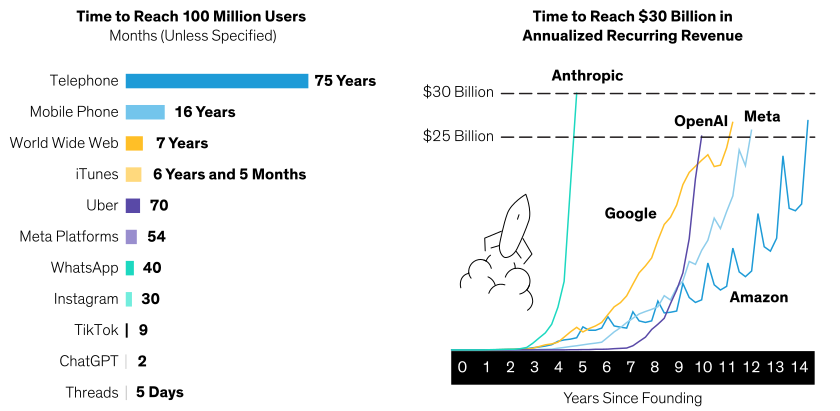
Visual showing newer disruptors requiring less time to generate subscription and revenue benchmarks than firms in past years.

Historical analysis does not guarantee future results. 
Annualized recurring revenue (ARR) estimated using annualized quarterly results when ARR is unavailable.
Left display as of January 2, 2023; right display as of April 12, 2026.
Source: Boston Consulting Group, FactSet, ITU, Statista, UBS, company reports and AllianceBernstein (AB)

How Innovation Evolves Over Time

But investing in innovation requires rigorous fundamental analysis and prudent risk management—perhaps even more so than other areas in the market. The key is capturing future leaders just as they reach the inflection of the “innovation S-curve,” where a company experiences a period of rapid adoption that consistently exceeds expectations (Display). Ultimately, not every fast-growing company can secure durable long-term profitability. 

Key to Disruption: Rapid Adoption and Growth
Innovation S-Curve Stages
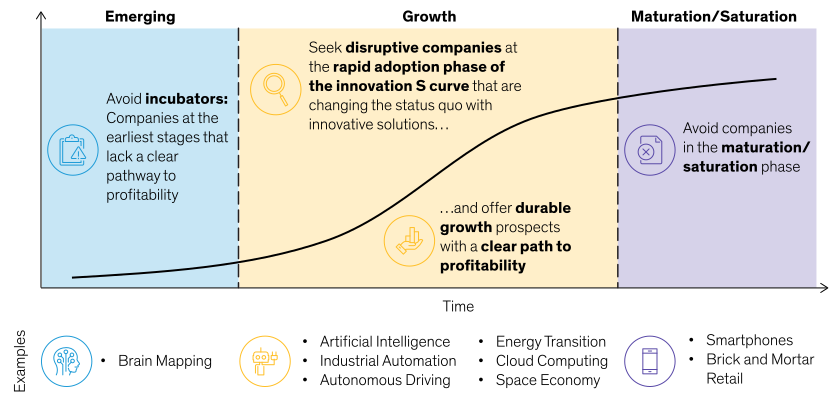
Innovation s-curve and its three phases of growth: emerging, growth, and maturation. Disruptors shown in growth phase.

For illustrative purposes only. 
As of May 31, 2026 
Source: AB

During periods of rapid innovation, barriers to entry fall, leveling the playing field and allowing new entrants to scale quickly. As a result, long-term winners can’t simply be identified by short-term success. On the other end of the spectrum during paradigm shifts, emerging leaders often challenge what were once perceived to be stable, defensible incumbents. These incumbent firms may have enjoyed impressive track records but could be well past the rapid adoption and growth stage. Companies that tend to endure are those with large, addressable markets, defensible long-term competitive moats and management teams with exceptional execution capabilities. 

This is precisely why leadership tends to change over time and why benchmarks, which reflect the past, fail to capture future leaders. Throughout the history of technology, we’ve seen the same pattern: when new architectures are adopted, business models still matter. Today’s hyperscalers have invested massive amounts of cash into AI infrastructure, but history shows that builders don’t necessarily monetize their investments. At the dawn of the internet, telecom and cable providers poured billions of dollars into web infrastructure. Yet, it was nascent, less-capitalized tech firms that captured the most value from this infrastructure through the creation of new business models (Display). 

Technology Market Leadership Changes in Every Paradigm Shift
Average Market Capitalization of 10 Largest Technology Stocks (USD Billions)
Visual showing different companies leading four paradigm shifts: Mainframe, PCs and Internet, Smartphones, Cloud and AI.

For illustrative purposes only. 
Alphabet Inc. became the parent company of Google in 2015. Facebook changed its corporate name to Meta Platforms in 2021.
As of May 31, 2026 
Source:  FactSet and AB

Many headlines around disruption have centered on the scale of the AI build-out, leading some to question the longevity of the AI trade. As sentiment shifts around capital spending and near-term earnings expectations, the key question for investors is which companies can convert adoption into durable revenues, margins and profit pools over time. In our view, it’s too simplistic to label the AI revolution as a bubble; we believe the AI application discovery process has only just begun. Based on numbers we’ve seen thus far from large-language-model (LLM) companies, AI is perhaps one of the fastest-adopted technologies, and it has already begun disrupting legacy business models. 

Disruptors Go Beyond Technology

But disruption is more than just a technology story. Multi-themed strategies are particularly relevant in the current environment because new leaders are emerging across both new and established industries. 

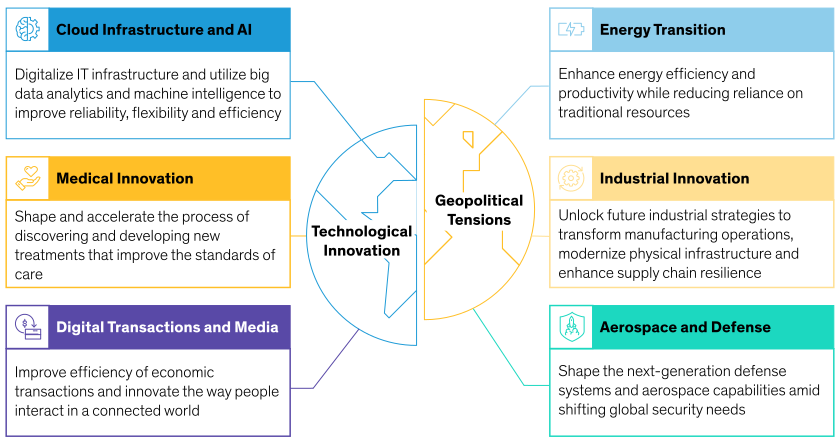
A case in point: in the digital age, physical assets still matter. In fact, we’re currently in such a capital-intensive part of the cycle that the capabilities of the physical world are constraining development of the digital world. Critical infrastructure that supports power delivery, automation and global trade networks has been woefully underbuilt. As a result, the opportunity set extends beyond information technology into aerospace and defense, industrial and medical innovation, and the energy transition (Display), offering more sources of return potential.

Two Main Forces Provide a Secular Trend for Disruptive Innovators
For illustrative purposes only. 
As of May 31, 2026 
Source: AB

How Can Equity Investors Capture the Power of Thematic Investing?

In our view, investors looking to capture the power of disruption through thematic investing should follow a three-pronged strategy: 

1. Take a multi-themed approach focused on sustainable earnings growth

   A multi-themed approach can help capture a wider range of return streams while reducing concentration risk. Disruptive innovation is happening across all sectors, and there are ample opportunities beyond hyperscalers and chipmakers.

2. Consider active management

•   Active, thematic management can identify high-conviction themes, balance established leaders with emerging innovators and manage both valuation and concentration risk.

   The goal is not simply to chase change but to convert disruption into a more thoughtful and resilient equity allocation. We believe that can be achieved by following earnings revisions because the best investments tend to be stocks with underestimated growth potential.  Similarly, investors must pay close attention to business models to determine whether a hot stock is just a fleeting trend or part of a larger structural shift. A long-term competitive moat and defensible pricing power and profit pool are key considerations. 

3. Avoid overreliance on legacy defensiveness

•   Even business models long viewed as defensive can be disrupted—sometimes very quickly. 

•  This makes the case for reassessing “safe” areas of the market through a forward-looking lens, rather than relying on historical labels.

Why Benchmarks May Miss Future Leaders

In our view, investors hoping to identify disruptors before they take off may be disappointed by benchmark-hugging passive strategies. 

During periods of disruption, strategies that track benchmark indices often miss future innovators. That’s because many of these indices are backward looking—they’re constructed using historical data. Typically, companies that have already risen in value are assigned higher weights in the index, while those that have underperformed are assigned lower weights. As a result, a backward-looking strategy fails to account for future disruption at the moment of inflection. We believe an active, thematic approach is better suited to identifying the most innovative companies well before they’re reflected in passive benchmarks. 

In a market dominated by disruptors, investors can ill afford to rely on yesterday’s winners. The next leaders may emerge from many corners of the market, but finding them requires a fundamental, research-driven approach. For investors willing to look beyond benchmarks, thematic investing can be a powerful way to capture lasting growth in a transformational era.

The views expressed herein do not constitute research, investment advice or trade recommendations, do not necessarily represent the views of all AB portfolio-management teams and are subject to change over time.

References to specific securities are presented to illustrate the application of our investment philosophy only and are not to be considered recommendations by AllianceBernstein L.P.


About the Authors