
2026 Credit Outlook: Growing Divergence Amid AI’s Big Build-Out

09 January 2026
5 min read

The credit markets could see increased dispersion in 2026—amplified by AI’s infrastructure build-out.

The credit markets begin 2026 on solid ground, buoyed by resilient corporate fundamentals, elevated yields and relatively low default rates. But investors face headwinds in tight credit spreads, and we expect increased bond-market dispersion—amplified by a large-scale build-out of artificial intelligence (AI) infrastructure. In our view, picking tomorrow’s winners in this evolving landscape will make credit selection more important than ever.

The AI Building Boom Has Begun

AI’s golden age has yet to arrive, but the expansion phase has already begun, with myriad implications for fixed-income investors. Hyperscalers—large cloud-service and infrastructure providers—are in a race to fund training superclusters and globally distributed inference capacity. The stakes—and the cash burn—are enormous. Fortunately, these technology behemoths have robust cash flows and strong balance sheets that make it possible to tap the investment-grade bond market for a portion of this funding. Hyperscalers also fill a need for higher-quality fixed-income assets, helping to balance supply with demand.

As infrastructure providers ramp up spending on data centers, energy infrastructure and networks, we expect to see investment-grade supply expand significantly in 2026—albeit at manageable levels within the public markets. Consider that the five major hyperscalers—Amazon, Alphabet Inc., Apple, Meta Platforms and Microsoft—comprise nearly 20% of the broader equity market but only 3.5% of public investment-grade debt. That’s due not only to the scale of the investment-grade bond universe but also to the growing role of private credit in offering niche funding solutions that the public markets can’t—or won’t—provide. Moreover, some AI-adjacent expenditures in power generation and grid connectivity are occurring outside the domain of hyperscalers.

We view credit growth tied to AI, particularly in power and grid investments, as both an opportunity and a potential source of friction. With private credit shouldering more of the funding load, we don’t expect the public credit markets to be swamped with new issuance over the coming year. That should reduce the burden on the public investment-grade market.

Still, risks remain in the form of overbuilding, uncertain demand and stranded assets. Fortunately, these haven’t escaped the market’s watchful eye. Large-cap tech issuers have lagged the broader investment-grade market modestly in recent months as investors scrutinize the AI build-out. In our view, that’s not stress; it’s the market beginning to price in uncertainty, which we view as healthy.

Dispersion Could Take Many Forms

We see 2026 as a divergence year marked by softening corporate fundamentals and higher dispersion, which could be amplified by AI. The investment-grade universe—increasingly populated by well-capitalized hyperscalers—has seen many more upgrades than downgrades in recent years (Display).  

The Investment-Grade Market Has Recently Seen More Upgrades than Downgrades
Bloomberg US Corporate Index: Ratings Changes
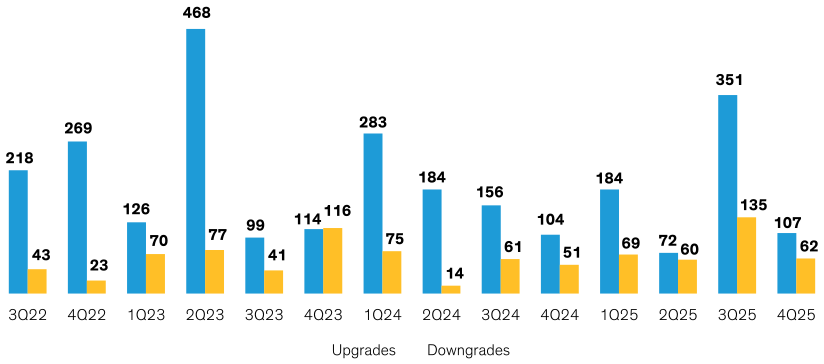
Bar chart showing investment-grade upgrades outpacing downgrades since the third quarter of 2022

Historical analysis does not guarantee future results.
As of December 31, 2025
Source: J.P. Morgan and AllianceBernstein (AB)

Conversely, weakening fundamentals may be felt in more levered capital structures, including single-B and CCC-rated cohorts. Across the rest of the high-yield universe, we’re cautious about possible changes to leverage policies for capital allocation purposes or for more aggressive M&A activity. In our view, the market isn’t pricing this risk appropriately, making higher-rated credit more attractive to us. We think the sweet spot in 2026 will center on BBBs and BBs—a crossover zone between investment grade and high yield.

Owing to elevated yields and much lower default risk, BB-rated bonds were steady performers over the past year—a trend we expect to continue in 2026. For investors wary of high yield, BBBs may be an appealing surrogate. In fact, many BBBs currently offer BB-like yields or better, putting investors in the enviable position of getting compensated more for assuming less risk—particularly in the US (Display).

With Spread Differentials Falling, BBBs Look Attractive
Relative Spread: BB vs.BBB (Basis Points)
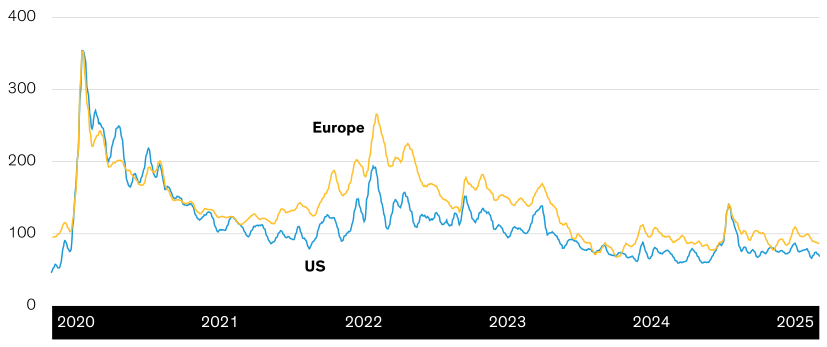
Bar chart showing the spread differential between BBs and BBBs falling in both the US and Europe since 2020

Historical analysis does not guarantee future results.
US relative spread represented by the difference in spread between BB-rated bonds in the Bloomberg US High Yield Corporate Index and BBB-rated bonds in the Bloomberg US Corporate Index. Europe relative spread represented by the difference in spread between BB-rated bonds in the Bloomberg Pan-Euro High Yield Corporate Index and BBB-rated bonds in the Bloomberg Pan-Euro Corporate Index.
Through December 31, 2025
Source: Bloomberg and AB

However, we expect to see growing dispersion even within BBBs, so investors should focus on credits with downgrade risk already baked into valuations. Our credit research suggests relatively limited fallen-angel risk at the index level. But market pricing implies a more cautious view, with a noticeable number of securities trading like downgrade candidates.

Comfort in the Belly (of the Curve)

AI-linked capex also carries yield-curve implications. Large global technology platforms issued more than $100 billion in investment-grade bonds in 2025, with roughly half of that issuance in maturities longer than 10 years. Given current valuations, we’re concerned about the effects this supply surge could have on longer-term investment-grade spreads, as well as the effect of higher US deficit spending on longer-dated US Treasuries.

While recent steepening in the US Treasury yield curve might tempt investors to extend longer, we believe intermediate-term maturities deserve a closer look. In our analysis, the belly of the curve looks attractive on three fronts—relative value, yields and spreads (Display). Simply put, this is where we believe investors will be best compensated for risk.

Yield and Spread Compensation Are Attractive in the Belly of the Curve
Yield and Spread Difference Between Long and Intermediate Maturities
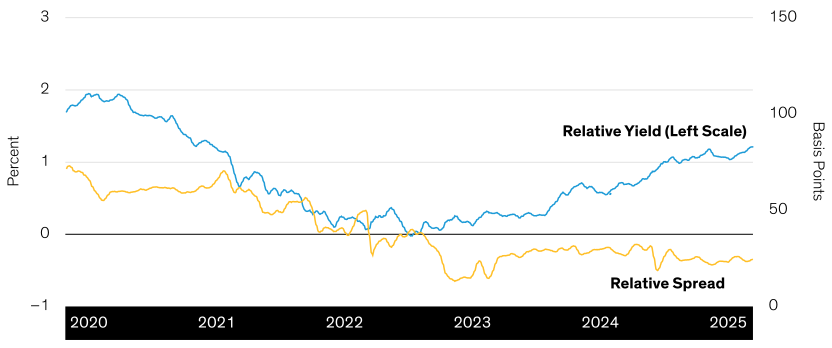
Line chart showing the yield and spread differential between long and intermediate bonds down since 2020

Historical analysis does not guarantee future results.
Relative yield defined as the yield difference between the Bloomberg US Corporate Long Index and the Bloomberg US Corporate Intermediate Index. Relative spread defined as the spread difference between the Bloomberg US Corporate Long Index and the Bloomberg US Corporate Intermediate Index.
Through December 31, 2025
Source: Bloomberg and AB

At first blush, the fly in the ointment is tight credit spreads, which could create headwinds to credit returns. But we don’t believe narrow spreads should deter investors from owning credit. A good share of the tightness is in the long end of the curve, and spreads tend to stay range bound once they tighten (Display). Moreover, across investment grade and high yield, yields remain historically elevated, which should provide cushion against rate volatility, with existing coupon income doing much of the heavy lifting.

Tight Spreads Can Persist for Long Periods
Bloomberg Global Aggregate Index: Spread (Basis Points)
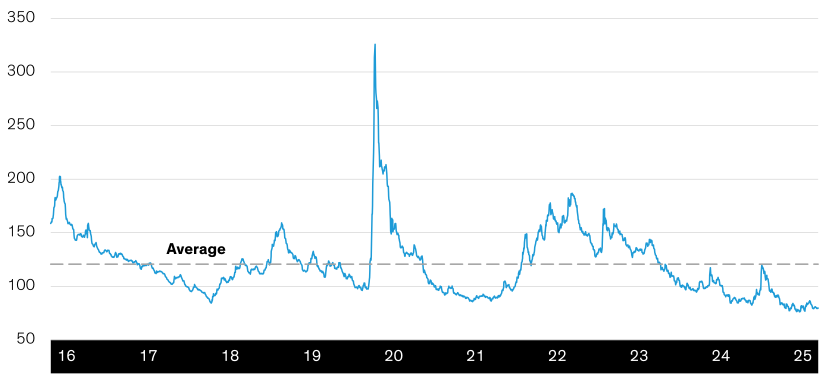
Line showing global credit spreads hovering near their long-term average since 2020, except for the 2020 pandemic

Historical analysis does not guarantee future results.
Through December 31, 2025
Source: Bloomberg and AB

The market’s animal spirits could also play a role over the coming year. Potential deregulation and an uptick in M&A activity could portend risks, but M&A is starting from a low baseline, and we still view the current funding mix as creditor-friendly.

Hyperscalers are creating what appears to be a durable supply pipeline, but it’s too early to deem AI a smashing success or a bubble about to burst. The reality on the ground is more nuanced, with both opportunities and concerns. Fortunately, parts of the market already reflect these concerns, and we expect bouts of volatility in 2026 to create attractive entry points for investors who can lean into those dislocations. With the emerging AI epoch still evolving, we expect the coming year to require patience—and thoughtful credit selection—until AI’s potential is more fully realized.

The views expressed herein do not constitute research, investment advice or trade recommendations, do not necessarily represent the views of all AB portfolio-management teams and are subject to change over time.


About the Authors