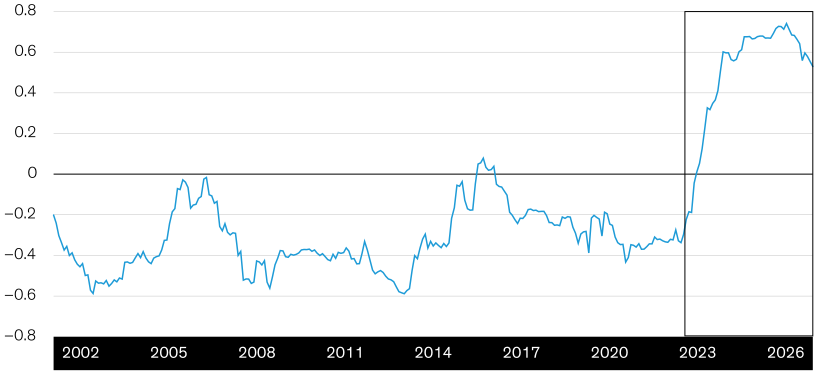
Equity Avenues for Playing Defense in Income Strategies
Of course, stocks bring important growth potential to income strategies, but it’s an asset class that’s broad and versatile enough to play multiple roles—namely defense. Including certain equity strategies in a multi-asset portfolio may enable investors to take advantage of their tilt toward factors that have historically been resilient in down markets.
Stocks with lower betas, such as utilities and consumer staples, tend to be less sensitive to the swings of the overall equity market. Then there are quality equity strategies focused on companies with strong balance sheets, stable earnings and high profitability. Dividend-paying stocks may provide a cushion, too, though the focus should be on more than the highest yielders.
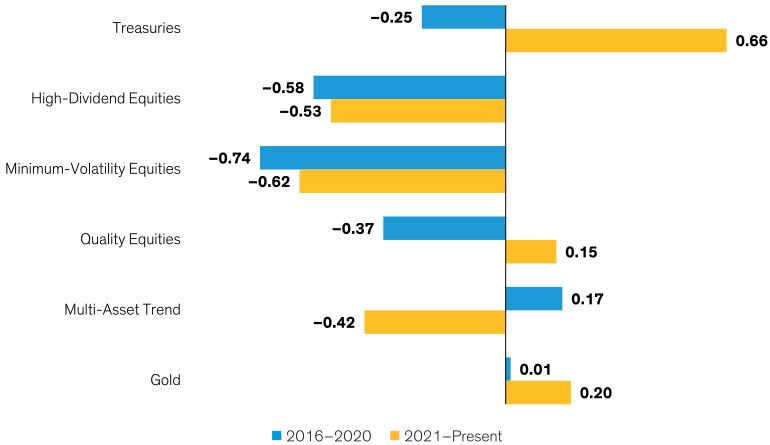
Historically, these equity cohorts have tended to hold up more effectively than the broad market when the bear inevitably arrives. For example, they proved their mettle in the 2022 sell-off: both low-volatility and high-dividend stocks fell by much less than the broad equity market and even Treasuries, providing an important source of ballast for multi-asset portfolios.
Getting “Real” About Diversifiers—Including Gold Exposure
Of course, there are tools for diversification and defense beyond stocks. Inflation always lurks as a potential threat to eat away at real, or inflation-adjusted returns, so Treasury Inflation-Protected Securities (TIPS) may be valuable cogs. TIPS’ principal value adjusts based on the inflation rate: if inflation rises, investors receive income payments based on a larger principal amount and get a higher face value at maturity. That design can help investors preserve their purchasing power.
Gold—in measured amounts—may also bolster defense. It produces no yield, which raises the bar for its inclusion in an income-focused strategy. But gold has something else going for it: Its price has shown almost no relationship to equity returns historically. And it has tended to hold its value, or even gain when investors seek safe havens in tumultuous times, such as inflation spikes or geopolitical shocks. We saw an example in early 2022, when Russia invaded Ukraine—stocks fell and inflation expectations jumped, while gold prices spiked.
Tactical Asset Allocation as a Flexible Shock Absorber
Thoughtful strategic design is vital in multi-asset income strategies, but so is the ability to adapt as market conditions change. Tactical asset allocation strategies seek to use market signals or views to time investment decisions—often with the goal of mitigating downside and guarding against events that may be infrequent but pose the risk of large losses.
A tactical allocation component can monitor a portfolio’s overall volatility and its exposure to broad equity and interest-rate movements, and use hedging approaches to efficiently adjust exposures as market volatility and asset relationships change. Trend-following strategies are one of the tools in the set. Using sophisticated signals, they seek to buy rising assets and sell falling assets, based on the notion that momentum tends to make prices move in lasting trends.
Historically speaking, these strategies have been effective during crisis periods, reducing risk when markets are reeling and adding risk when markets are regaining their footing. Trend-following allocations bring important flexibility and serve as a type of shock absorber, using signals or macro indicators to adjust allocations as they seek to navigate downturns more nimbly.
From a big-picture view, the tools described here aren’t an exhaustive list. But they do highlight the array of available building blocks. Which ones are needed and in what combinations? There is no one-size-fits-all answer. A lot depends on an investor’s outlook and risk tolerance, and no single tool is fully effective all the time. But as we see it, they enable a layered defense that may boost the chances that a multi-asset income strategy stays on track and is able to weather unexpected storms.