
Software’s Big Sell-Off: Structural Risk or Narrative Noise?

05 March 2026
5 min read

AI concerns are forcing a rapid reset of software stocks. But disruption rarely unfolds as fast as markets expect.

Software stocks have suffered a rude awakening amid fears that artificial intelligence (AI) will upend the industry. While the outlook is highly uncertain, the indiscriminate market response may be conflating structurally exposed software businesses with more durable companies.

That distinction defines the challenge for investors. AI is raising real doubts about software business models that cannot be ignored. But not all software firms are alike. Some will buckle, while others will survive—and may even thrive—in an AI-driven world.

We believe the market is pricing in disruption as if it’s universal and immediate. Yet technology regime shifts are never so simple. The task now is to identify where disruption is likely to reshape economics and where fears may be running ahead of fundamentals.

Could AI Agents Redefine an Industry?

Since ChatGPT launched, software stocks have been under scrutiny. In recent months, the release of AI coding models Claude Opus 4.5 and Claude Cowork reinforced fears that increasingly capable AI agents—which are being massively deployed (Display)—could commoditize software by reducing development costs and lowering barriers to entry. The MSCI World Software & Services Index tumbled by more than 20% this year through the end of February.

Rapid Deployment of AI Agents Has Spooked Software Stocks
Bar chart shows AI agent use by domain, alongside a line chart of software stocks underperforming global technology stocks.

Past performance does not guarantee future results.
BI: business intelligence; CRM: customer relationship management
*Based on post shared by Anthropic on X on February 18, 2026
†Indexed to 100, from January 1, 2021, through February 28, 2026
Source: Anthropic, MSCI and AllianceBernstein (AB)

The market is signaling that every software company is at risk—a dramatic change for an industry that has enjoyed positive sentiment for years. Investors have lost conviction in the durability of economic characteristics that historically defined high-quality software businesses, making it nearly impossible to forecast the terminal value of software shares.

The Bear Case: Disruption Could Hit Profit Pools

Profitability concerns are hard to disprove. If AI agents can autonomously execute complex workflows, customers may no longer need full software applications. As a result, traditional user interfaces would lose relevance while switching costs fall and pricing power erodes. More broadly, if AI lowers barriers to entry across large portions of the software ecosystem, supply will rise faster than demand. Increased competition would pressure pricing, margins and returns on capital for incumbents—especially those relying on seat based or feature-driven pricing models.

These risks cannot be dismissed. That said, truly autonomous agents capable of managing complex, regulated, enterprise scale workflows remain limited today to areas like coding assistance and customer service. So the long term trajectory is uncertain, and the timing of economic impact remains unclear.

Not All Firms Face the Same Risks

Disruptive impacts won’t be distributed equally across the broad software industry, in our view. Companies providing horizontal application layers—such as customer relations management or workflow automation—are very different to vertical providers of banking systems or retail sales systems, to name a few. Business dynamics differ for infrastructure and cybersecurity firms.

So the key question is: How easy or hard is it to replace certain types of software? Systems of record, for example, aren’t easily displaced because these mission-critical platforms are deeply embedded in organizations with authoritative data sets and compliance frameworks. In contrast, interface apps with low switching costs and limited proprietary data are much easier to replace.

Is the Bear Narrative Running Ahead of Financial Reality?

Nobody really knows where value will accrue across the AI stack (applications, agents, data or infrastructure). This explains why the market has pushed up the discount rate applied to software stocks across the board, which has dragged down valuations (Display). Share prices have fallen despite little sign of operational stress in customer behavior, retention metrics or reported financials.

Software Valuations Have Plunged But Still Trade at a Premium to the Market
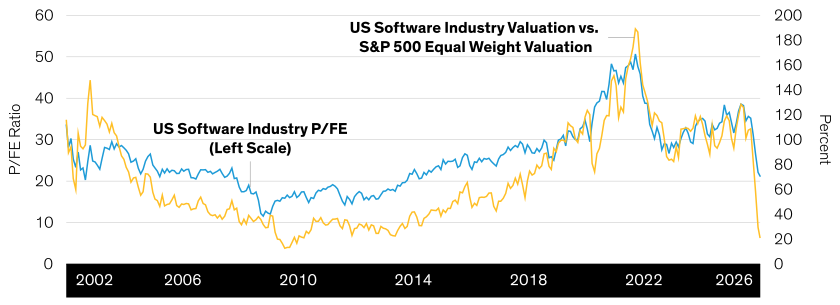
Line charts compare US software industry valuations with the S&P 500, showing sharp declines but continued premium pricing.Line charts compare US software industry valuations with the S&P 500, showing sharp declines but continued premium pricing.

Past performance does not guarantee future results.
US software industry based on a market-cap weighted ETF that tracks the S&P 500 software industry. Valuations are based on forecast earnings for the next 12 months.
Through February 27, 2026
Source: Goldman Sachs and S&P

That said, today’s benign fundamentals may be misleading. Since AI disruption is a structural risk, it wouldn’t show in current company metrics. Firms with solid margins and revenue growth today might look healthy even though pricing and competitive threats loom large.

Another unknown: How will competition intensify among software incumbents as advances in AI coding lower the cost and time required to expand into adjacent categories? This will blur the lines between traditional software domains and erode natural barriers that protect legacy positions.

Financial Transparency Matters: Mind the GAAP

In the search for evidence of AI-driven weakness, accounting transparency will be prized. We expect the market to have less tolerance for non-generally accepted accounting principles (GAAP) metrics that adjust earnings by removing stock-based compensation costs.

Structural disruption concerns will compel investors to place greater emphasis on near-term GAAP profitability and traditional valuation metrics. Although GAAP status didn’t protect software stocks in the recent sell-off, we think margin discipline and earnings quality will matter more over time.

Three Things to Watch

The software industry is no stranger to disruption. Well before AI, software was repeatedly redefined by the internet, cloud computing and software as a service (SaaS). To separate winners from losers as AI progresses, investors should focus a playbook on:

  1. Durable competitive moats: Mission-critical software that delivers clear economic value should still command pricing power in a more competitive landscape. Software companies that own authoritative enterprise datasets will be better placed to defend their competitive advantages. And customers will be more reluctant to pay high costs to replace software that is horizontally integrated across an organization.

  2. Clear signs of monetizing AI activity: Software firms must show that AI is helping grow their revenue. Some platforms will benefit if AI agents boost transaction volume (more tickets, approvals and workflows), so look for evidence that AI is bolstering core platforms rather than disintermediating them. In contrast, business models that rely on static seat pricing look vulnerable.

  3. Earnings quality and business model resilience: Businesses with high gross customer retention rates and products embedded in core workflows can defend earnings. Coherent AI strategies have become table stakes for software companies, and proven GAAP-based profitability profiles—which are hard to find right now—will be essential. Distressed valuations could open opportunities in resilient companies that have been tarred with the same brush in the indiscriminate sell-off.

At this juncture in the AI-software story, there’s good reason to be cautious. Structural risk to the software sector is real. History shows that transformative technological disruption takes time to play out, but the magnitude of its impact is often greater than initially expected.

With this in mind, we believe investors shouldn’t be guided by doomsday scenarios or near-term volatility.

In volatile markets, investors tend to shoot first and ask questions later. But that’s not a long-term strategy. As we see it, equity portfolio teams rooted in deep research must ask questions every day to determine where the narrative noise is overdone and how to position appropriately in a software industry facing major disruptive forces. By actively assessing industry developments and the impact on individual companies, disciplined investors can balance patience with conviction while carefully adding exposure in select software stocks that look overly sold and may be primed for recovery.

The authors wish to thank Senior Research Analysts Jay Pilkerton, Pradeep Ramani and Jim Russo for their invaluable contributions to this blog.

The views expressed herein do not constitute research, investment advice or trade recommendations, do not necessarily represent the views of all AB portfolio-management teams and are subject to change over time.

MSCI makes no express or implied warranties or representations, and shall have no liability whatsoever with respect to any MSCI data contained herein. The MSCI data may not be further redistributed or used as a basis for other indices or any securities or financial products. This report is not approved, reviewed or produced by MSCI.


About the Authors