Why Choose A Concentrated Equity Fund?


03 December 2020
3 min watch

Portfolio Perspectives: Mark Phelps, Chief Investment Officer for the Global Concentrated Strategy at AllianceBernstein, explains his approach to managing a concentrated equity portfolio and the drivers for consistent growth.

Transcript

Why Concentrated Portfolios?

The Global Concentrated Strategy at AllianceBernstein focuses on a portfolio of approximately 30 stocks. So why do we believe this is the right number of companies to invest in? As you can see from this chart, if you are focusing on finding companies that can grow their earnings in excess of 10% per annum, which is very much the starting point for our investment, then you can see there aren’t many companies that are actually able to do that. 

Fund Focus
ES AllianceBernstein Concentrated Global Equity Fund

Seeking Consistent Earnings Growth from Quality Global Businesses to Drive Long-term Returns

Capital at Risk
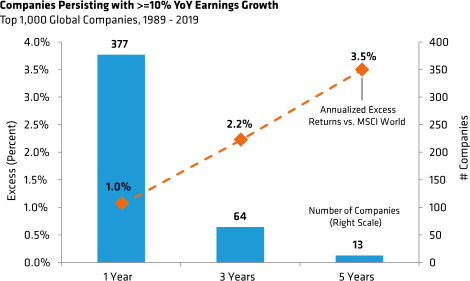
Bar chart with time on the X-axis and two metrics on the Y-axis: number of companies with ≥10% YoY earnings growth, and excess returns.

Past performance does not guarantee future results.
Universe consists of the top 1,000 companies by market cap each year through 2019 with annual rebalancing.
As of 31 December 2019. Source: Center for Research in Security Prices, FactSet, S&P Compustat and AB

This chart shows on the left-hand side that about a third of the largest 1000 companies over the last 40 years, have been able to do 10% growth for a short period of time – in this case one year. But to do it for three years in row, it drops down to 64 companies. 

And to do it for 5 years in a row, which almost always includes a slowdown in economic activity, it drops down to 13 companies.

Companies That Can Grow Consistently Are Rewarded

When people say “Mark why do you invest in a concentrated portfolio?” the answer is there aren’t many companies which can grow consistently but if you can find them, if you can see returns here over the benchmark, they are very valuable.

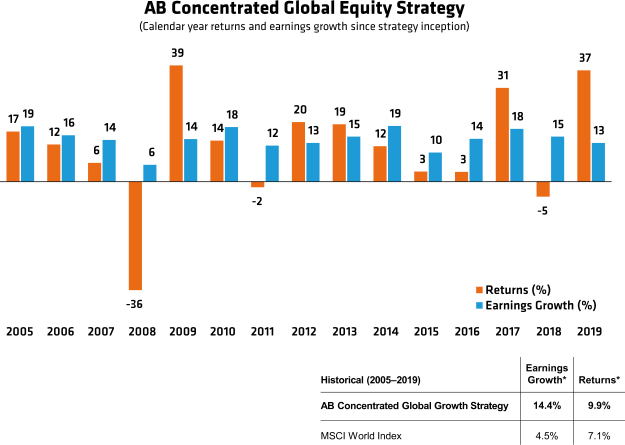
This chart sets out to give you an understanding of how the earnings and profits of growing the portfolio in aggregate, over the last 15 years since I started the portfolio. Well if you look at this chart you can  see that the blue line, which shows you the underlying earnings and profits growth of the whole portfolio, so the 30 companies taken together, has grown pretty consistently above 10% annum. 

Bar chart with time (years, 2005-2019) on the X-axis and returns and earnings growth on the Y-axis; compares AB Con. Global Equity Strategy returns and earnings growth by year.

Past performance does not guarantee future results. The value of investments and the income from them will vary. Your capital is at risk. As of 31 December 2019. Historical earnings compound annual growth rate (CAGR) and annualised returns since inception of the AB Concentrated Global Growth Composite on 1 April 2005. The returns presented above are gross of fees. This is supplemental information to the GIPS-compliance performance and disclosure page. Source: MSCI and AB, see Performance Disclosures.

The returns you can see in orange are much more volatile, but over the long run we believe that the returns will follow the earnings. In the short run of course other things happen, the Financial Crisis or the COVID Pandemic can get in the way, but if we can consistently deliver earnings growth then we think the returns will follow the earnings over time.

What in effect we are doing is trying to manage for ‘e’ earnings believing that ‘p’ performance will follow understanding in the short run, volatility can just get in the way.

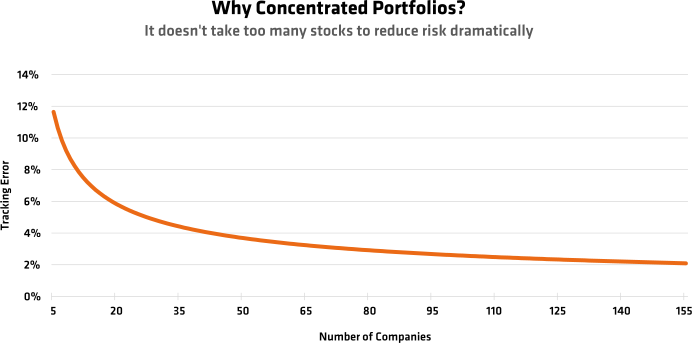
And the final question I am often asked is “Well that’s all very well Mark, but aren’t the underlying volatility risks of a concentrated portfolio significantly higher?”. And what we can see on this chart is that the diversification benefits of adding stock to a portfolio achieve very quickly. 

Historical data for information only. As of 31 December 2019. Analysis based on the forecast MSCI World Index single stock volatility using the GEM LT model from January 2010 through December 2019. Source: MSCI, S&P, AB

You can see here, by the time you are at 20 stocks you have achieved the vast majority of the benefit. By the time you are at 35 you are really adding no value by adding stocks for the sake of it. So from our perspective we are looking to generate the high active share -  that’s differentiation against the benchmark - because we are trying to generate alpha, not just market beta, but alpha from outperformance over the benchmark, over time. 

Past performance is not a guide to future performance. The value of investments, and the income from them, can fall as well as rise and you may not get back the original amount invested. The views expressed herein do not constitute research, investment advice or trade recommendations and do not necessarily represent the views of all AB portfolio management teams. AllianceBernstein Limited is authorised and regulated by the Financial Conduct Authority in the United Kingdom.

The AB Concentrated Global Growth Composite (the “Strategy”), launched on 31 March 2005. Although similar, the performance of the Strategy is not the same as that of the ES AllianceBernstein Concentrated Global Equity Fund.

The ES AllianceBernstein Funds are Sub Funds of ES AllianceBernstein UK OEIC, an open-ended investment company. Equity Trustees Fund Services Ltd is the Authorised Corporate Director (ACD) of the Funds. The Prospectus, KIID, annual and semi-annual reports are available, in English, free of charge from the ACD's website, (www.equitytrustees.com). 

Equities Risk: The value of equity investments may fluctuate in response to the activities and results of individual companies or because of market and economic conditions. These investments may decline over short- or long-term periods.
Focused Fund Risk: Investing in a limited number of issuers, industries, sectors or countries may subject the Fund to greater volatility than one invested in a larger or more diverse array of securities.
Smaller Capitalization Companies Risk: Investment in securities of companies with relatively small market capitalizations may be subject to more abrupt or erratic market movements because the securities are typically traded in lower volume and are subject to greater business risk.
Derivatives Risk: The Fund may include financial derivative instruments. These may be used to obtain, increase or reduce exposure to underlying assets and may create gearing; their use may result in greater fluctuations of the net asset value.
Other Risks Include: Fund turnover risk, emerging-markets risk and OTC derivatives counterparties risk.
These and other risks are described in the Fund’s prospectus.