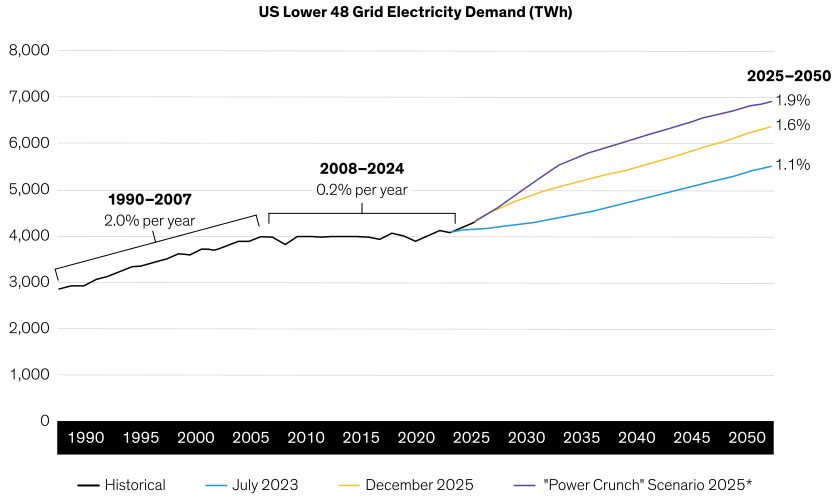
In fact, we expect falling renewable power costs to expand the opportunity set for investors on both sides of the Atlantic Ocean.
US Policy: Still Cloudy, but Getting Clearer
In the US, the energy sector is adjusting to a new landscape of higher tariffs, the phaseout of federal tax credits for solar and wind generation, and stricter sourcing rules for projects using technology from foreign countries, including China.
But these policy shifts haven’t stopped activity. Rather, they’ve reshaped project timelines and increased the need for capital—developments that have led to improved terms and more negotiating leverage for lenders.
We think policy uncertainty has largely passed. Many developers are pushing to meet the July 4, 2026, deadline to begin construction to remain eligible for US federal tax-credit incentives. Developers who had delayed financing in 2025 are also ramping up activity, creating openings for lenders with disciplined underwriting capabilities and loan-structuring expertise.
Modernizing the Grid Powers Financing Opportunities
The opportunity set is likely to stretch beyond new construction. The need to modernize existing infrastructure and make an aging grid more reliable will also be top of mind, as will boosting transmission and energy-storage capacity. State incentives and decarbonization goals should add support.
Meanwhile, the utility-scale battery storage needed to smooth out the availability of power from intermittent generation sources remains supported by tax incentives, as do nuclear and geothermal power.
In our view, investors should be bracing for a multiyear opportunity in energy financing that is likely to favor lenders that can structure deals with strong return potential strengthened by terms designed to mitigate downside risk.
Renewables Remain Economically Viable
Will higher tariffs and stricter sourcing rules create speed bumps? Some, perhaps. But we don’t think this changes the broader landscape.
Even without federal support, solar and wind are the cheapest power sources in most markets, undercutting fossil fuels, and have accounted for the bulk of new US power generation over the last decade. In 2025, roughly 90% of new US electricity capacity came from solar, wind and storage, and the cost curves for these underlying technologies continue to improve.
These are powerful tailwinds for investment. And as demand for power and capital needs increase, we think private lenders will be best placed to price risk appropriately and capture returns. Investment hurdles for future projects that can’t take advantage of tax credits may be higher, but if they’re priced properly, we expect them to be attractive.
Full Speed Ahead in Europe’s Energy Market
In Europe, where national energy policy is a tailwind for development, the investment opportunity remains attractive. Across the European Union last year, combined wind and solar overtook fossil fuels as the main source of electricity generation.
Declining costs and government incentives to promote clean energy should continue to provide opportunities for investment. Energy-security issues should add another layer of support as countries seek to reduce dependence on imported fossil fuels.
As in the US, we expect to see attractive value for investors in developer and asset-portfolio financings with top-tier partners in scalable European markets involving low-tech assets like solar and energy storage
Assessing the Risks of More Complex Loan Execution
Still, evolving incentive frameworks, new compliance requirements, and rising grid and permitting constraints across the US and Europe make projects more complex and increase execution risk. This calls for lenders who can provide capital solutions for borrowers while structuring loans based on an accurate assessment of the risks that can arise across the development and construction lifecycle of complex energy projects.
Overall, we expect 2026 to be an active year across the energy-transition spectrum, from the greenfield development with new projects to operating infrastructure. Recent experience reminds us that there will be policy bumps along the way. But we don’t expect them to stop the energy transition from accelerating. In our view, the need for capital will continue to rise, and private credit will play a key role in providing it.