Protecting multi-asset portfolios from market shifts often involves making dynamic allocation adjustments based on trailing price signals…in other words, what has already happened. But when defensive strategies rely too much on trend-following signals, such as trailing price momentum and volatility, they may not be able to see around corners as well as they should.
Narrowly focused strategies are drawing more scrutiny, especially after many defensive-leaning portfolios struggled in September’s market downturn. The sell-off was an eye-opening episode of how portfolios that are unprepared can turn from defensive to defenseless very quickly. Markets may have recovered since the sell-off, but when strategies designed to cushion portfolios from downturns don’t deliver, it’s time to ask why.
Would broadening the stream of risk-reduction signals make a difference? We think so.
Putting Surprises to Work—to Avoid Surprises
Some signals are less known but can be high impact. For instance, we’ve developed a Macro Surprise Signal (MSS) that captures more than 100 underlying macroeconomic indicators that are tied to a quick recovery. They can be grouped in three broad buckets: employment, output and sentiment. MSS measures the level of surprise for each data release relative to consensus; it turns bullish if surprises are to the upside, for example.
While generally correlated to trend-following signals, MSS can meaningfully diverge from them at times. In May—with the economy still in the throngs of the COVID-19 pandemic and trend-following signals still in deeply negative territory—the MSS signal flashed green as rehiring activity and upticks in manufacturing and services output beat street estimates. Positive surprises are useful, if acted upon thoughtfully. In this instance, MSS would have suggested that investors quickly reposition to capture the unexpected market recovery—well before price-based momentum signals could have.
Portfolio Protection Should Be Strategic, Not Just Opportunistic
Multi-asset portfolios can use many tools to manage risk and return, from traditional asset classes, beta diversifiers, and alternatives to timing strategies and options. Some of these tools are strategic investments and others are directional signals that inform dynamic portfolio construction and asset allocation. And to defend effectively, we believe strategic decision-making is as important as opportunistic adjustments.
Among the practically thousands of helpful signals and indicators, our research has shown that a select few have proven especially effective at playing defense. Some of these tools are elementary but effective, such as extending duration on certain fixed-income assets.
Equally important—with a much wider net—are defensive equities. These include minimum-volatility stocks, which tend to have less extreme price swings, and high-quality stocks—fundamentally strong and often undervalued companies. These equity and fixed-income strategies provide defensive cash flows in equity-centric strategies.
In addition, a constant but select allocation to Out of the Money (OTM) put options may help: options tend to be expensive, but they’re among the best in playing defense during sudden market shocks.
Some Signals Work Best When They Work Together
Individually, any of these telling signals capture historical momentum and volatility, but they tend to work best when applied strategically and in unison.
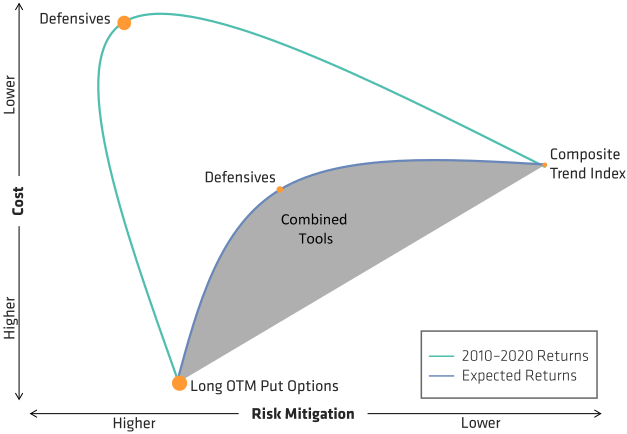
For example, we considered the 10-year risk-return results of three tools: long OTM put options and defensives, as defined above, alongside a composite trend index comprising broad indicators from three leading banks. Each tool experienced a distinct outcome during the period (Display, green line), but defensives stood out, offering the highest protection for the lowest cost over the last decade.
However, we expect this to change. As is always the case, the next 10 years will not be like the last 10. We expect returns from defensives to be much lower, given the low-interest-rate environment and the risk of renewed inflation due to monetary and fiscal policy stimulus. Even based on conservative return expectations for defensives, our research suggests that the same three risk-mitigation tools could work incrementally better in concert, given this outlook (Display, blue line).