Europe’s bank-led lending model is evolving. That’s good news for insurance investors.
Banks in Europe still dominate commercial real estate lending. But tighter regulatory capital requirements and balance-sheet constraints have been steadily pushing activity into private markets, echoing a more advanced transition from public to private financing in the United States. The shift is still in its early stages. But we believe it will transform the investment landscape and the opportunity set for insurers.
Fixed-income investments dominate most European insurers’ asset allocations, with corporate credit often playing a starring role. Privately originated commercial real estate debt has the potential to diversify that exposure. Rather than primarily relying on the earnings power of a corporate issuer, the debt is supported by contractual rental income, property cash flows and the value of the underlying real assets—the apartment buildings, data centers or warehouses that underpin the loans. Both floating-rate and fixed-rate loans are possible.
But commercial real estate’s value to insurers is functional as much as financial. Its appeal lies not only in the returns it generates but in the way it can help insurers solve portfolio construction challenges. This includes the ability to match assets to liabilities, diversify exposure to corporate earnings and increase regulatory capital efficiency.
A Capital Efficient Opportunity
Demand for real estate debt over the last few years hasn’t been limited to insurers. That’s partly because a rise in the base rates used to price loans has increased real estate debt’s ability to generate equity-like returns without equity risk. That’s an attractive proposition for many institutional investors. But it’s a temporary quirk in pricing that won’t last forever.
In this case, it also misses the point. For insurance investors, it’s real estate’s return on risk capital—not its absolute return—that matters most. Satisfying both of those objectives is important. But in most market environments, the key consideration for insurers isn’t which asset offers the highest yield, but which one offers the best return after accounting for credit risk and regulatory capital requirements.
Commercial real estate loans do this remarkably well. Senior loans are typically backed by strong collateral and come with conservative loan-to-value ratios, robust cash-flow coverage and favorable regulatory treatment under Europe’s Solvency II regulatory regime. Many can be treated as having investment-grade risk characteristics even though no public rating exists and attract capital charges similar to investment-grade bonds.
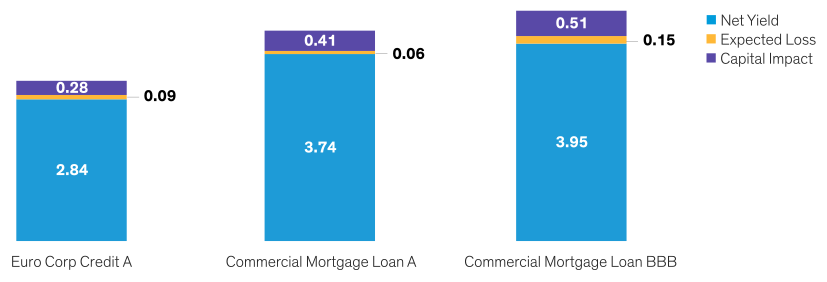
Some loans come with the potential to retain a larger share of their yield advantage even after allowing for expected losses and the cost of capital. As the following Display illustrates, loans with internal ratings that correspond to A and BBB generated higher yields than A-rated corporate credit. The additional income compensated insurers for the higher capital burden, underscoring why commercial real estate debt can act as an attractive complement to investment-grade corporate bonds.