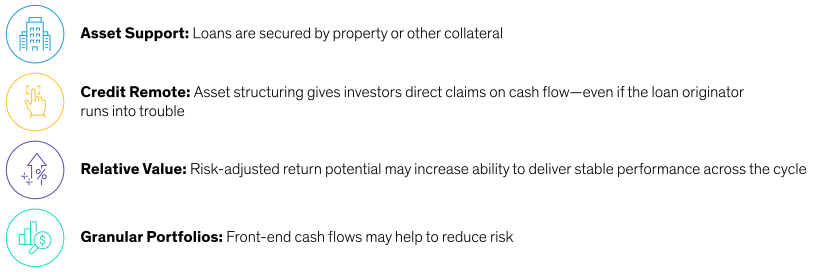
For example, if an auto financing company fails, asset-based investors would still receive cash flows from any loans they own, which sit in a separate legal entity. And the cars would continue to serve as collateral.
Tapping into a Varied Opportunity Set
The opportunity set is vast, particularly in the United States and Europe, where private asset-based credit is funding multiple forms of consumer spending and helping to address structural housing shortages.
The flexibility of the asset class provides an array of tools with which managers can shape cash flows from a wide range of income-generating assets into steady and diversified income streams with low correlation to other strategies—and to each other. The goal is to engineer a portfolio that generates a steady, curated set of cash flows throughout an economic cycle.
Access to various types of lending allows managers to tilt exposure across the span of the cycle as growth, credit availability and borrower behavior changes. This might mean leaning into subprime auto loans early in the cycle when access to credit is expanding but tilting toward residential mortgages and other seasoned assets in the later stages.
A Strategy Adaptable to the Economic Cycle
Most investments are backed by amortizing assets with relatively short average-weighted lives. That’s important, because it removes the need to try to call the economic cycle before committing capital. Even in the late stages of a credit cycle, conditions typically weaken gradually.
This doesn’t mean that lenders ignore the cycle entirely. But the granularity and short-dated nature of these loans have the potential to act as a built-in buffer, allowing underwriting criteria to be adjusted quickly in a constant feedback loop.
For example, a pool of consumer loans originated in March may be underwritten with return expectations based on the performance of thousands of similar existing loans. If the economic outlook changes in April enough to alter likely performance, the underwriting standards lenders apply to the next pool of loans can be adapted. This enables continued investment throughout the cycle, and the short-term nature of most loans means they repay quickly.
In our view, this makes asset-based lending a strong complement to the direct-lending strategies that dominate many private credit allocations. Most privately originated loans to middle-market companies come with five-to-seven-year maturities designed to match the typical hold periods of the borrowers’ private-equity owners. It isn’t uncommon for several loans to require refinancing at or around the same time.
Control Through Deal Structuring
Other types of deal structuring can also play important roles. For example, portfolios are often structured to be overcollateralized. This means the total value of the cash flow the underlying loans generate is greater than the amount of debt issued against those assets.
Incentive structures for the originator also help to reduce risk. A transaction might be built so that the originators of a pool of auto loans only receive some or all of their fees after investors have received interest and principal. Another might require the originator to absorb losses first, a potentially valuable feature in the later stages of an economic cycle.
On the other hand, a lower-risk pool of assets, such as seasoned prime residential mortgages with low loan-to-value ratios, might provide an opportunity for investors to lean in the other direction by taking an equity position in the capital structure to boost return potential.
None of this means asset-based finance is immune to volatility or losses. But the granular nature of lending and the levers managers can pull to generate continuous amortizing cash flows may generate strong return potential in all market environments while diversifying exposure to other forms of public and private credit.
By focusing on how cash flows are created and prioritized, asset-based strategies allow investors to think about diversification as a design exercise, not just an allocation choice.