
Harmonizing Portfolio Exposures: Cross-Asset Insights for 2026

08 December 2025
7 min read

Our heads of fixed income, equities and alternatives provide broad insights for investors in the new year.

Investors across asset classes are facing an unusual dilemma going into the new year. Returns across asset classes have been quite strong, but multiple uncertanties continue to cloud financial markets amid a shaky global economic outlook and ongoing policy volatility. These conditions warrant a thorough look at the sources of returns in an overall allocation and within asset classes.

The good news is there are strategic solutions to some of the biggest challenges. Equity investors are seeing real signs of recovery across the global landscape that can help resolve some of the ongoing tension in a highly concentrated, artificial intelligence (AI)–driven US market. In fixed income, diversifying the sources of duration and striking a balance across rates and credit will be essential for positioning in the dynamic environment. In private credit, investors should expect wider performance variation as the asset class matures. We think sector expertise, platform depth and proven ability to underwrite complexity will help to separate the wheat from the chaff.

Fixed Income: Reinforcing the Foundation

Fixed income enters 2026 from a position of strength. Returns in 2025 have been solid across sectors, supported by decelerating growth, easing inflation and monetary easing by most major central banks. The themes that shaped our constructive outlook entering 2025—higher starting yields, slowing global growth and a range of opportunities across both rate and credit markets—continue to define the landscape as we head into 2026.

In our view, that argues for keeping bonds firmly anchored within overall portfolios—and that means holding duration. But where investors take that duration matters. For instance, leaning too heavily on US duration may concentrate exposure in the same dynamics that contributed to heightened volatility in 2025—tariff-policy volatility, large fiscal deficits, dollar weakness and the debate over US exceptionalism—at a time when global markets offer increasingly differentiated and compelling opportunities. A globally diversified approach to duration—including euro-area government bonds and UK gilts, where we expect yields to fall further—may offer a sturdier foundation.

How investors hold that duration also matters. Government bonds remain the purest source of interest-rate sensitivity and remain essential for liquidity. But investors can also take duration through securitized markets such as agency mortgage-backed securities, which provide both duration and incremental yield. Curve positioning, too, is a lever that shapes how portfolios respond as the rate environment evolves. Together, these choices broaden the toolkit without relying on a single source of duration.

Of course, duration isn’t the whole story. As we see it, a balanced posture across rates and credit provides a sturdier mix of resilience and income. Investors’ broad risk appetite has kept credit spreads near cyclical lows, but we think yield levels are a more reliable guide to forward returns than spreads alone. And yields remain compelling across many credit-sensitive sectors. That said, the range of potential outcomes has widened, making selectivity key, in our view.

But being selective doesn’t mean avoiding below-investment-grade debt. In fact, we believe high-yield corporate bonds can play a special role for investors who are rebalancing after this year’s strong equity run. Historically, high-yield bonds have delivered returns comparable to equities but with meaningfully less volatility—and have generally outperformed equities in periods of below-trend growth (Display). In our view, that makes high yield a credible complement for investors aiming to temper equity volatility without materially sacrificing return potential.

High Yield Has Outperformed Equities When Growth Is Below Trend
Returns Across Different Growth Environments: January 1983–September 2025 (Percent)
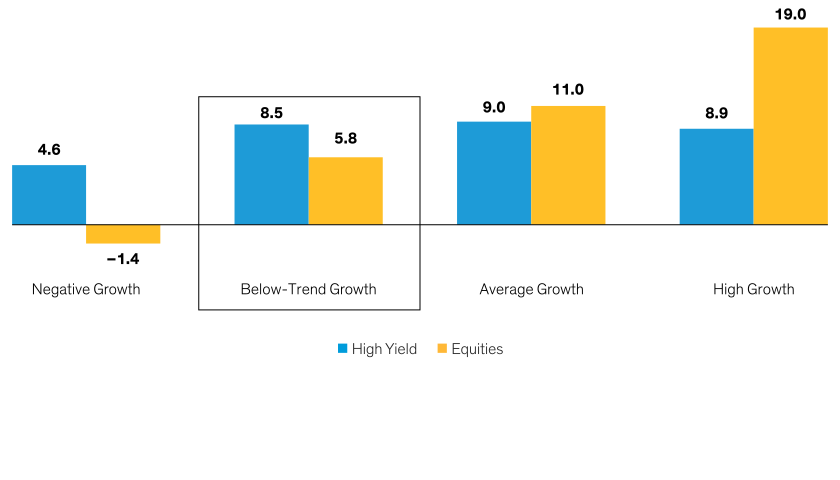
Bar chart shows returns across different growth environment from 1983 to 2025 for high-yield bonds and equities.

Historical analysis does not guarantee future results.
High yield represented by the Bloomberg US Corporate High Yield Index; equities represented by the S&P 500; negative growth based on GDP YoY growth less than 0%; below-trend growth: 0%–2%; average growth: 2%–3%; and high growth: 3% and above.
As of September 30, 2025
Source: Bloomberg, S&P and AllianceBernstein (AB)

Equities: Rediscovering the Quality Advantage

Equities have delivered strong gains again in 2025, but the drivers of those returns have left equity investors more vulnerable to short-term market stress as the new year begins.

Three trends defined a dramatic year: the April tariff shock and speedy recovery; AI enthusiasm and increasing market concentration; and a broadening of region and style performance alongside the sharp underperformance of quality stocks amid a speculative growth rally (Display). Yet, even as AI–driven technology sectors continued to dominate, our clustering research shows a shift in performance, with a wider array of segments contributing to 2025 market returns across the US, Europe and Asia.

Shifting Patterns in Global Equity Markets Point to Diversification Opportunities
Left chart shows relative performance of global quality stocks and speculative growth stocks vs. MSCI World from 2021-2025. Right chart shows contributions of the largest global equity market clusters to MSCI ACWI returns in 2024 and 2025.

Past performance does not guarantee future results.
*Quality represented by MSCI World Quality Index. Speculative growth stocks are hyper-growers with profitability (free cash flow to assets) and valuation (free cash flow to price) in the bottom 60% (lower profitability and more expensive stocks in quintiles 3–5) and year-over-year sales growth in the top 30%.
†Clusters were derived from the MSCI ACWI universe returns from January 2024 through November 2025 using UMAP for dimensionality reduction followed by hierarchical clustering to obtain 41 clusters. Return contribution is the benchmark-weighted cumulative USD return over each year. Cluster labels were assigned using generative AI based on a range of data, including constituent securities, Barra risk exposures, sector membership and macro factor exposures.
Left chart as of October 1, 2025; Right chart as of October 31, 2025.
Source: Delta One, FTSE Russell, IDC, MSCI, S&P and AB

Most investors know that relying on speculative, high-volatility companies is not a durable strategy for generating lasting wealth, especially in an environment of slowing global economic growth and sticky inflation. So, in 2026, we believe an equity allocation should be structured to curb volatility, take advantage of a broader set of return sources and feature quality companies.

The April shock showed how quickly an extreme spike in volatility can shake investor confidence. It also reminded us why staying invested through market turmoil is the key to benefiting in a recovery. That’s why we think it’s essential to deploy an active agenda aimed at reducing volatility across allocations and within portfolios—especially with market concentration and valuations at historically high levels.

Is the AI trade a bubble? Nobody knows for sure. We do know that earnings misses for the AI–driven mega-caps have sparked sharp downside volatility. History also teaches us that the dominant players in the early stages of a technology revolution might not be the winners of the future. Staying active and risk aware is essential for navigating a concentrated market.

The opportunities outside of the AI cohort are compelling. Broadening exposures across regions, styles and themes can help ensure that sources of returns are truly complementary. During 2025, Europe, China and emerging markets all outperformed the US. Outside of the US, value stocks rebounded and outpaced growth by a wide margin, driven by European defense companies and financials, as well as Japanese corporate governance reforms.

Emerging-market (EM) equities did well, too, and offer durable themes in digital transformation, domestic consumer trends and governance reform, which can help diversify from the US mega-caps. Being active is especially important, as many of the largest EM companies are also exposed to AI–driven dynamics.

In an environment of weakening global economic tailwinds and a persistently high cost of capital, equity portfolios should prioritize companies that can sustain earnings growth independent of macro conditions. This is why we believe quality companies should anchor equity strategies today. Many of these businesses are found in the US, which continues to offer structural advantages despite ongoing debates around US exceptionalism. After a period of notable underperformance, quality companies with durable earnings now trade at attractive valuations, offering compelling long-term return potential that can weather a more turbulent market environment.

Private Credit: Depth of Experience Matters

Investors once turned to private credit primarily for its ability to generate excess return. When it was a $150-billion niche asset class some 15 years ago, it did so primarily through an illiquidity premium—the added return investors demand for holding assets that can’t be sold quickly. Today, the estimated size of the addressable market hovers around $20 trillion—and it’s growing. The pool of private lenders is deeper, too. We expect that to bring wider variation in performance and a renewed focus on lender skill.

In 2026, we expect excess return generation to be closely correlated with experience—particularly the ability to structure loans that solve complicated problems for borrowers in operationally complex markets. Often, that can mean partnering with originators rather than competing with them. In the $6-trillion-and-growing asset-based finance market, for example, we expect a steady stream of opportunities to purchase seasoned residential and consumer loans or enter forward flow arrangements with originators for new ones that meet predetermined credit criteria. Slower economic growth and an uptick in consumer delinquency rates will favor investors with demonstrated sourcing and underwriting capabilities.

Increased global demand for travel and a shortage of aircraft should combine to benefit aircraft leasing strategies and managers with expertise in this market (Display). Meanwhile, global energy demand continues to soar, driven in large part by the need for AI data centers. We expect that to favor an all-of-the-above approach to energy procurement that will include solar and utility battery storage capabilities—and one that will favor capital providers who know their way around this operationally complex market.

Aging Aircraft: Shortages Suppress Natural Replacement Rate
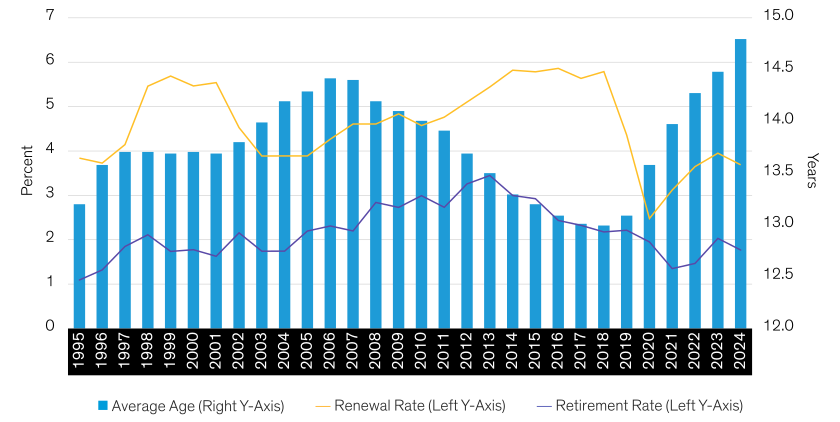
Bar chart shows the average age, renewal rates and retirement rates of global aircraft from 1995 to 2024.

Renewal rate measures the proportion of an airline's fleet that is being replaced with newer models over a specific period of time. Retirement rate is the rate at which aircraft are removed from service, usually expressed as a percentage of the total fleet per year.
As of December 31, 2024
Source: Cirium and International Air Transport Association

Additional interest-rate declines may provide a tailwind for middle-market direct lending in the year ahead. Eventually, we expect to see an increase in exit activity among private equity investors, which should bolster opportunity for direct lenders to finance new acquisitions. We also see openings to provide financing solutions, including net asset value lending, to help private equity investors meet their liquidity needs.

In some US cities, municipal incentives and property value resets have aligned to justify the cost of converting unwanted offices into apartments. We see this as the early “green shoots” in the commercial real estate market. And if borrowing costs continue to ease, we expect to see more in the year ahead, particularly for commercial real estate lenders with the knowledge to finance potentially complex conversion projects.

The views expressed herein do not constitute research, investment advice or trade recommendations, do not necessarily represent the views of all AB portfolio-management teams and are subject to change over time.

MSCI makes no express or implied warranties or representations, and shall have no liability whatsoever with respect to any MSCI data contained herein.

The MSCI data may not be further redistributed or used as a basis for other indices or any securities or financial products. This report is not approved, reviewed or produced by MSCI.


About the Authors