Private Assets and a Liquidity Spectrum
Asset owners’ needs and a structural change in capital raising are boosting allocations to private assets. Allocations will likely rise further, given the need for real returns and diversification beyond public markets. Asset managers will likely need to both source private investments and help investors combine public and private assets thoughtfully. We see liquidity as the real limitation to private allocations, given the less liquid nature of current portfolios and more fragile liquidity in public markets.
We think investors will increasingly view liquidity as a spectrum, favoring assets that return cash within a few years or with predefined liquidity events, such as debt, over longer-horizon assets such as private equity. The lion’s share of capital allocated to private markets over the past decade has been to equity, but we expect allocations to broaden to other segments—including debt. The task for strategic asset allocators and the asset-management industry is to thoughtfully allocate across these different risk types.
The Rise of Insurance/Asset-Management Partnerships
Allocations will likely also need to be redesigned for pension plans—the result of longer lifespans and a reduced role for government bonds as diversifiers. From a macro standpoint and irrespective of other industry dynamics, insurers seem likely to become more important as providers of long-term capital; one manifestation of this will likely be more strategic partnerships with asset managers with expertise in generating long-term real returns.
Separately, return streams are needed to address a higher-inflation environment and longevity risk, implying more demand for solutions such as variable annuities and life insurance. Given the macro environment we’ve laid out, solutions with variable outcomes could become more attractive than fixed annuities. We think that this collective solution set will become key in planning for longer retirements, and we would expect more opportunities for joint action by insurers and asset managers.
Tackling the Contemporary Retirement Problem
A less friendly investment landscape and growing longevity are also challenges for defined contribution plans, where individuals shoulder a greater burden to save for retirements that may last decades. The asset-management industry has a key role in addressing the issue.
As we see it, traditional target-date glide paths need rethinking for a more difficult investment outlook. Avenues include higher equity exposure to build savings, diversification into areas such as private assets, reduced long-term bond exposure, an intensified focus on income and a potential shift in benchmarks—perhaps incorporating the need to outpace inflation. Ultimately, these shifts recognize that retirement saving is an active decision; there seems to be no such thing as a passive glide path or allocation.
The Need for Active, Market Concentration and the Active Opportunity Set
With asset-class returns expected to fall short of recent decades, alpha has the potential to play a greater role in allocation. Concentrated markets have challenged long-only active managers, but we still hear investor support for active. High valuations and lower expected growth also imply lower returns from broad, passive index exposures, so alpha could be a larger share of returns. In our view, a broad range of alpha-generation tools is critical, spanning public and private, quantitative and fundamental, and time horizons. Portable alpha strategies offer the potential to source alpha from markets that might not be large portfolio allocations.
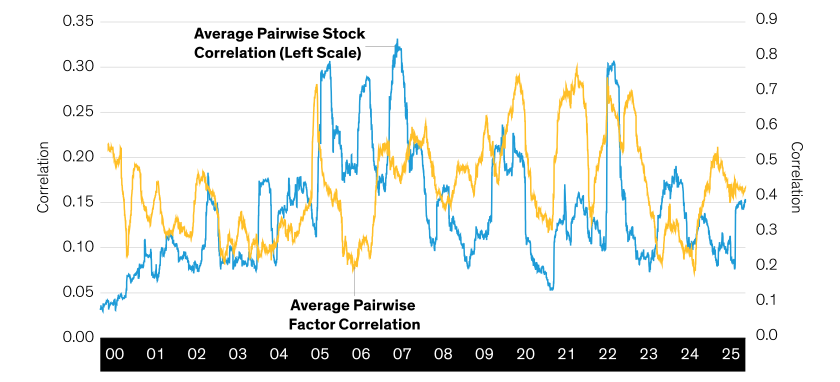
Several reasons are behind the secular shift to passive, including poor after-fee performance, robust beta returns and an investor focus on minimizing headline fees instead of maximizing realized net-of-fee returns. Less-generous returns ahead and a more nuanced view of fees should help the case for active, but alpha has to be persistent. Based on our research, idiosyncratic alpha—stripped of simple, persistent factor exposures—is more likely to be lasting. Market concentration remains a tactical challenge, but other aspects of market structure are more benign, including low correlations among stocks and factors (Display).