
US Healthcare: Attractive Valuation for a Structural Growth Opportunity

10 May 2025
3 min read

What You Need to Know

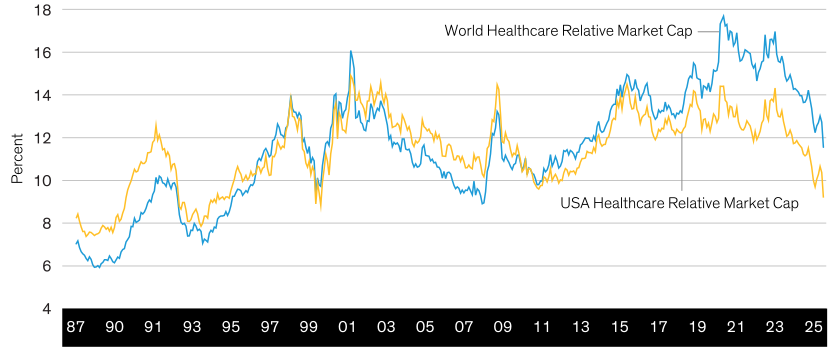
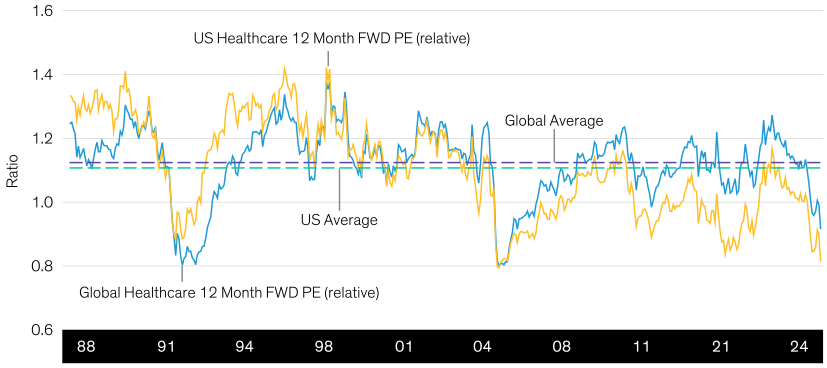
US healthcare offers an attractively valued entry point for a strategic overweight allocation. This is despite considerable short-term uncertainty about the evolution of US policy. The sector is trading near historical lows globally; in the US, it is now trading at the deepest discount to the broader market in nearly 40 years based on relative forward price-earnings (PE) multiples. Its share of the broader market is at its lowest in 15 years.

While we acknowledge significant policy uncertainty in the sector, we believe that the current valuation, sustained outflows in recent years—and our view that investor sentiment already reflects significant risks—should limit the potential downside.

Meanwhile, we think healthcare offers strong structural growth prospects: it stands to benefit from the effects of an aging population and a growing need for social care as well as the potential benefits of greater long-term AI adoption. It also has a strong track record of delivering earnings growth at above market rates.

In the short-term, we think that a healthcare allocation can also play a stabilizing role amid macroeconomic uncertainty, given its defensive nature and history of resilience in previous equity market drawdowns.

In our view, the macroeconomic and market environment in the coming years will be defined by the mega forces of demographics, deglobalization, a delayed energy transition and mounting public debt. Their impact points to an environment of structurally lower growth as well as higher and more volatile inflation, which in turn leads us to expect lower equity returns and higher market volatility than over the last 15 years. There is an open question: How much can AI offset some of these challenges, particularly through a broad-based productivity increase?

We believe that our outlook warrants a strategic overweight in the US healthcare sector. In the near term, there is uncertainty from US President Donald Trump’s recently announced desire to force US drug prices down to align with the lowest international reference price. To what extent this can be implemented remains to be seen. However, at the same time, the sector could play an important role in diversifying away from heavy market concentration in tech as well as in stabilizing portfolios during market drawdowns. In the longer run, healthcare should be a structural beneficiary of an aging US population, with its pricing power enabling sustained real earnings growth—even in a world of structurally higher inflation. We also view the sector as one of the clearest potential AI beneficiaries. Multiple possible applications could increase productivity and cut drug-development costs, improve research and development (R&D) efficiency and effectiveness, and drive better customer services and care.

While we acknowledge considerable policy uncertainty surrounding US healthcare in particular, the current sector valuation and investors’ positioning should limit the potential downside and provide an attractive entry point.

US healthcare’s share of the overall equity market has fallen to its lowest in 15 years, currently standing at only 10% (Display 1). Today’s negative sentiment toward the sector is also evident in its current valuation (Display 2) with the 12-month forward-PE multiple of US healthcare versus the market at an all-time low discount of 20%. Globally, the picture is similar, with healthcare trading significantly below the historical average valuation.

US Healthcare Relative Market Share is Near Historical Lows

Past performance does not guarantee future results.
As of May 12, 2025
Source: LSEG Data & Analytics, FactSet, IBES and AllianceBernstein (AB)

US and Global Healthcare Trade at a Discount to the Broader Market

Current analysis does not guarantee future results.
As of May 12, 2025
Source: FactSet and AB

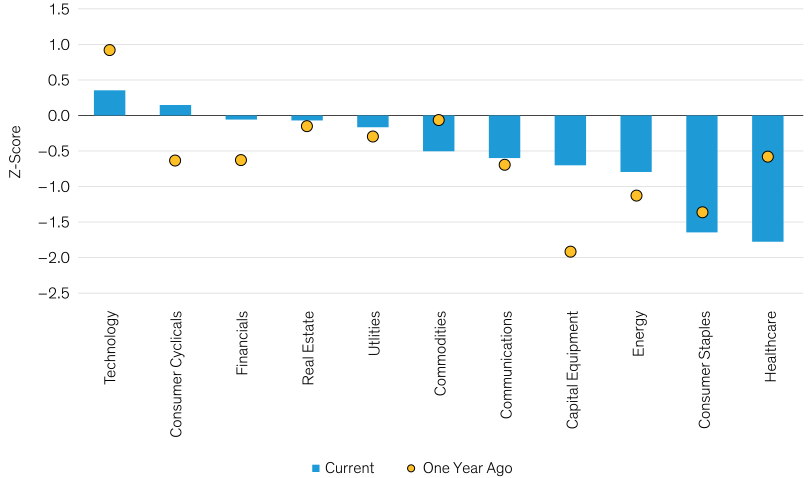
To put US healthcare into the context of the rest of the US market (Display 3), it is currently the cheapest sector on a relative basis, after a significant de-rating over the last year. 

US Healthcare is the Cheapest Sector in the Market
12-Month Forward Per Relative to the Market (Z-score)
US Healthcare is the Cheapest Sector in the Market

Current analysis does not guarantee future results.
As of May 12, 2025
Source: Factset and AB

Outside of the Global Financial Crisis and COVID-19 pandemic, mid-1993 and the end of 2016 were the only other periods that saw similar healthcare discounts to the broader market. Both episodes were also characterized by significant policy uncertainty for the industry.

The views expressed herein do not constitute research, investment advice or trade recommendations, do not necessarily represent the views of all AB portfolio-management teams and are subject to change over time.


About the Authors