
Why Today’s Heightened Dispersion Suits a Systematic Approach

27 March 2026
4 min read

When bond markets exhibit wide credit-spread dispersion, look to a systematic approach to generate alpha.

Today’s credit markets look deceptively dull: while average spreads are tight, dispersion across issuers is unusually wide. That combination reshapes where returns come from. The lesson for investors? Adapt to prevailing market conditions: when credit beta is scarce, it’s time to focus on alpha from security selection. These are the environments where systematic approaches shine brightest.

Credit Markets Point to a Shift in Return Drivers

Currently, we see the range of likely economic outcomes narrowing globally and credit spreads remaining tight. While the backdrop for fixed-income markets still looks encouraging, we think now is not the time to seek alpha through big bets on credit.

Meanwhile, several factors are combining to heighten credit-spread dispersion and make individual credit selection more important—especially in sectors impacted by AI competitive disruption, cash burn or resource demands. That’s why we think dispersion of issuer returns will likely increase across credit sectors, creating a timely opportunity for generating alpha through security selection.

We think the best way to capture these opportunities is through an investment strategy that focuses on bottom-up security selection—such as systematic fixed-income investing. Because a systematic approach relies on different performance drivers, it typically generates return streams that are complementary to traditional fixed-income strategies, making it a good bond-portfolio diversifier. But in a security-selector’s market, systematic strategies can come into their own.

Looking Closer to Reveal Hidden Opportunity

At the beta level, average credit spreads are important for determining how well bond-market risks are being compensated. But in terms of prospective alpha from security selection, spread on its own isn’t predictive.

For example, in mid-2014, US high-yield spreads were tightly grouped around their mean; by contrast, issuer spreads are widely dispersed today—even though average spreads were similar in both periods (Display).

By Itself, Average Credit Spread Doesn’t Tell the Full Story
Bloomberg US High Yield Index: Spreads (Basis Points)
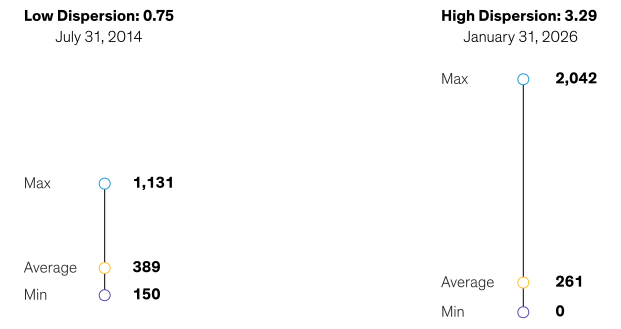
Comparing US HY in 2014 with 2026, average spreads were comparable, but the minimum-maximum range was far wider in 2026.

For illustrative purposes only
Max, min and average reflect all option-adjusted spreads (OAS) in the index on the dates shown, adjusted to remove 2.5% from each tail. Dispersion is measured as the standard deviation of OAS divided by the average OAS.
As of January 31, 2026
Source: Bloomberg and AllianceBernstein (AB)

We can capture the full picture of dispersion with a single number, measured by dividing an index’s standard deviation of spread by its average spread. In 2014, credit-spread dispersion for the Bloomberg US High Yield Index was low at only 0.75, resulting in slim pickings for active security selectors. Today, the equivalent number is 3.29, more than four times the 2014 level and ripe for active credit selection.

When we extend this analysis over the past dozen years, today’s investment challenge—and opportunity—comes into focus: average high-yield spreads sit near period lows, even as dispersion stands among the widest levels observed outside crisis regimes (Display). 

Average Spreads Are Tight, but Dispersion Is Historically High Today
Bloomberg US High Yield Index: Monthly Average Spread and Dispersion
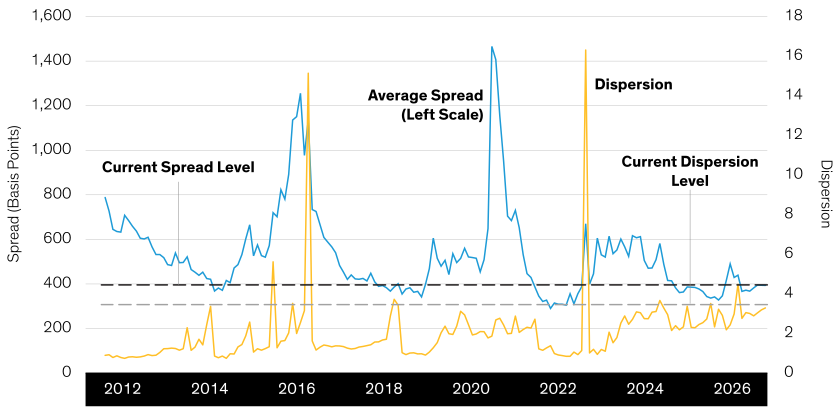
Currently, average spreads sit near historically low levels, but dispersion is unusually elevated (excluding crisis periods).

Historical and current analyses do not guarantee future results.
Spreads are option-adjusted. Dispersion is measured as the standard deviation of the index’s OAS divided by its average OAS.
Through January 31, 2026
Source: Bloomberg and AB

And while investment-grade spread dispersion is less pronounced, we expect it too to trend wider this year, especially among BBB credits, due to softening fundamentals, amplified by AI.

How Spread Dispersion Translates into Alpha

Tight average spreads suggest that credit beta may be relatively hard to come by these days. Our analysis of starting average spread levels and average excess return versus Treasuries over the subsequent year shows that excess returns dipped following periods of narrow spreads (Display).

Credit Beta: Average Spread Is Predictive of Average Excess Return
Bloomberg US High Yield Index: 12-Month Rolling Average Spread and Forward Excess Return
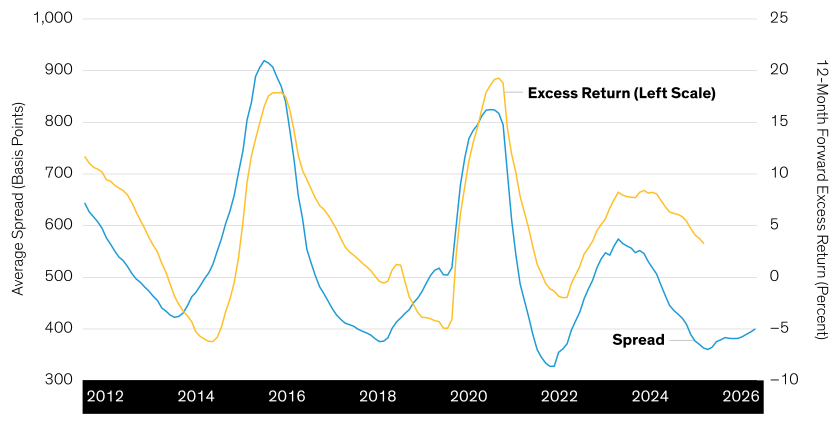
From 2012 through 2026 to date, higher 12-month rolling average spreads have preceded higher excess returns.

Historical and current analyses do not guarantee future results.
Spreads are option-adjusted. Excess return is the 12-month rolling average of the excess returns of each individual bond in the index over each bond’s duration-matched Treasury.
Through January 31, 2026
Source: Bloomberg and AB

Similarly, history shows that when spreads are tight, alpha accounts for a larger share of traditional active manager return (Display).

Managers Derive Larger Share of Return from Alpha When Spreads Are Tight
Share of eVestment High-Yield Manager Return (Percent): December 31, 2011–December 31, 2024
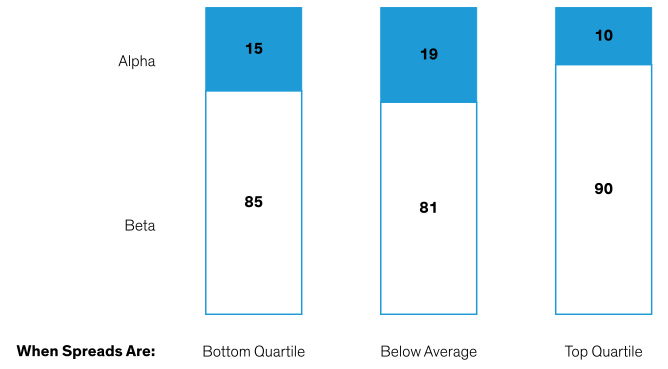
From 2011 through 2024, when spreads were tight a larger share of US HY managers’ returns came from alpha rather than beta.

Historical analysis does not guarantee future results.
Spreads are option-adjusted spreads of the Bloomberg US High Yield Index; average is 428 bps, bottom quartile is below 338 bps, and top quartile is above 492 bps. Manager universe: eVestment US High Yield
As of December 31, 2024
Source: eVestment and AB

Choosing the Right Tool for the Job

Given today’s narrow credit spreads, we believe we may be entering a more fruitful period for active credit selection. Focusing on security selection requires a highly specialized approach, such as systematic investing.

Systematic strategies harness predictive factors with demonstrable links to outperformance to generate investment decisions. A quantitative process scores and ranks each bond in the market based on its alignment with these predictive factors and seeks to generate alpha by picking high-scoring bonds. The essence of systematic strategies is therefore generating alpha from security selection.

This methodology contrasts with traditional active approaches, which typically favor bigger bets spread across fewer variables, such as duration timing, credit-market exposure and sector tilts (Display). And in our analysis, in an environment like today’s, an accumulation of tiny bets—such as those applied across hundreds of securities by systematic approaches—may be more successful than a single large bet.

Systematic Fixed Income Differs from Other Solutions
Systematic Strategies Prioritize Security Selection While Most Traditional Active Strategies Prioritize Beta
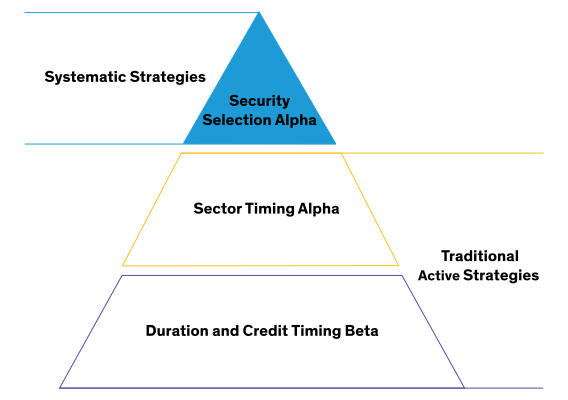
A diagram contrasts systematic strategies’ focus on security selection with traditional approaches’ focus on timing and beta.

For illustrative purposes only
As of December 31, 2025
Source: AB

Complementary Return Streams in a Security-Selector’s Market

What’s more, because systematic approaches depend on different performance drivers, their returns will likely differ from—and complement—traditional active strategies.

The active returns from security selection in systematic strategies are by design largely uncorrelated both with the benchmark and with important risk premia. As a result, these strategies can be effective diversifiers in a fixed-income portfolio.

We expect advanced systematic strategies to deliver strong relative returns in different market environments, and to provide returns complementary to traditional active strategies. But we expect these strategies to shine brightest when credit beta is scarce and potential alpha from security selection is high.

The views expressed herein do not constitute research, investment advice or trade recommendations, do not necessarily represent the views of all AB portfolio-management teams and are subject to change over time.


About the Authors