
Pursue Your Income Goals with Actively Managed ETFs
The Importance of Being Active in High Yield
Navigate volatility, seize opportunities, and build resilient fixed-income portfolios.
We believe active high-yield strategies are equipped with the flexibility to adjust to market shifts, uncover value, and manage risk more effectively than passive strategies.
Are you maximizing your fixed income potential?

Get Expert Income Advice
Connect with our team to see firsthand how active high-yield investing can elevate your clients’ fixed income portfolios.
Active Management is a
Competitive Advantage
Choose an active strategy aligned with your investment goals..
AB’s High-Yield ETFs: Smarter Income Solutions
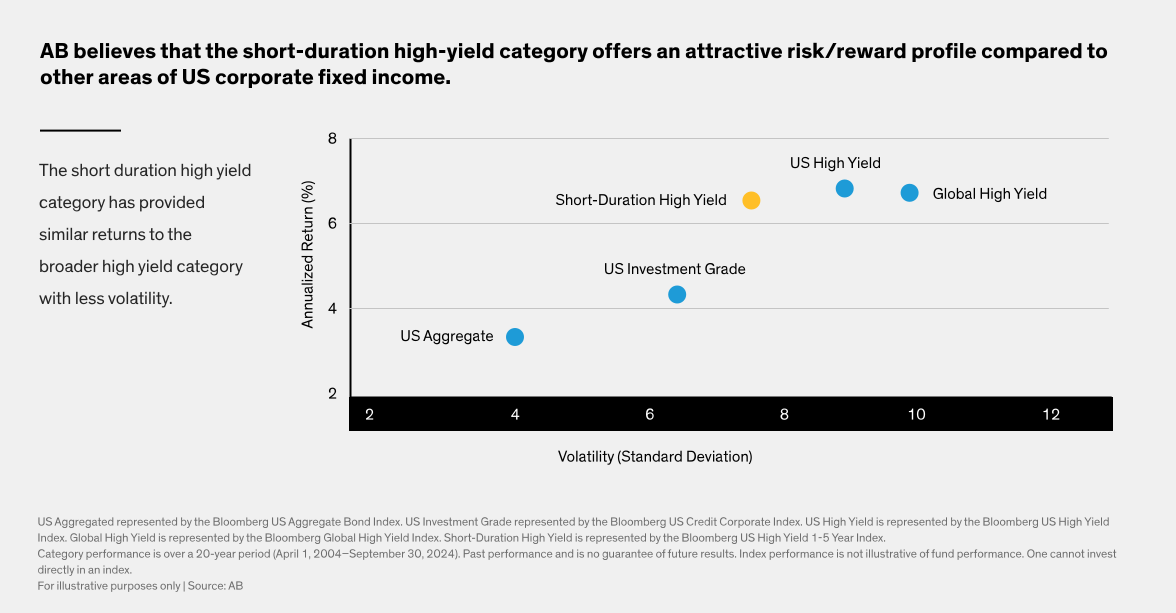
AB’s Short Duration High Yield ETF (NYSE: SYFI) and AB High Yield ETF (NYSE: HYFI) seek to provide attractive income while aiming for less volatility than traditional high-yield approaches. Our active strategies are designed to capitalize on opportunities in the U.S. high-yield bond market.
-
Short-Duration High Yield
-
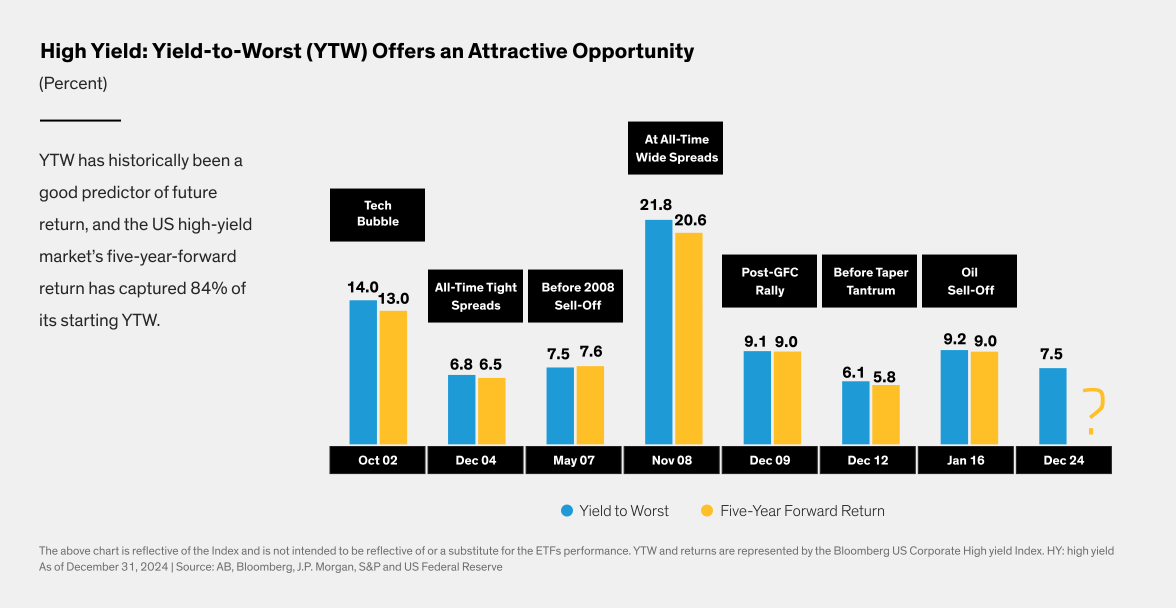
High Yield: Yield-to-Worst
- Short-Duration High Yield
- High Yield: Yield-to-Worst

Our Fixed Income Team is Commited to Delivering Better Investment Outcomes for Our Clients.

Broad Fixed-Income Sector Capabilities

Shared Insights That Drive Alpha

Repeatable and Scallable Process

Efficiency of the Investment Process

Stay informed on Active High-Yield Investing
Embrace the Active Advantage
Empower your clients’ portfolios with AB’s actively managed investment solutions offering high income, stability, and adaptability in a shifting market.
Thank You
Yield to worst is a measure of the lowest possible yield that can be received on a bond that fully operates within the terms of its contract without defaulting.
Duration can measure the sensitivity of a bond’s or fixed-income portfolio’s price to changes in interest rates.
The Bloomberg US Corporate High Yield Bond Index measures the USD-denominated, high-yield, fixed-rate corporate bond market. Securities are classified as high yield if the middle rating of Moody’s, Fitch and S&P is Ba1/BB+/BB+ or below.
The Bloomberg US High Yield 1-5 Year Index measures the USD-denominated, high-yield, fixed-rate bond market, rated BB or B by S&P or the equivalent rating by Fitch or Moody's. The Bloomberg U.S. High Yield (1-5 Year) (BB/B) Index measures that part of the market with maturities of five years or less.
Risks to Consider
Investing in ETFs involves risk and there is no guarantee of principal.
Investors should consider the investment objectives, risks, charges and expenses of the Fund/Portfolio carefully before investing. For copies of our prospectus or summary prospectus, which contain this and other information, visit our Literature Center or contact your AB representative. Please read the prospectus and/or summary prospectus carefully before investing.
Shares of the ETF may be bought or sold throughout the day at their market price on the exchange on which they are listed. The market price of an ETF’s shares may be at, above or below the ETF’s net asset value (“NAV”) and will fluctuate with changes in the NAV and with supply and demand in the market for the shares. Shares of the ETF may only be redeemed directly with the ETF at NAV by Authorized Participants, in very large creation units. There can be no guarantee that an active trading market for the Fund’s shares will develop or be maintained, or that their listing will continue or remain unchanged. Buying or selling the Fund’s shares on an exchange may require the payment of brokerage commissions, and frequent trading may incur brokerage costs that detract significantly from investment returns.
Below-Investment-Grade Securities Risk: Investments in fixed-income securities with lower ratings (a.k.a. junk bonds) are subject to a higher probability that an issuer will default or fail to meet its payment obligations. These securities may be subject to greater price volatility due to such factors as specific municipal or corporate developments and negative performance of the junk bond market generally and may be more difficult to trade than other types of securities.
Credit Risk: A bond’s credit rating reflects the issuer’s ability to make timely payments of interest or principal—the lower the rating, the higher the risk of default. If the issuer’s financial strength deteriorates, the issuer’s rating may be lowered and the bond’s value may decline.
Derivatives Risk: Derivatives may be more sensitive to changes in market conditions and may amplify risks.
Foreign (Non-US) Investment Risk: Investments in securities of non-US issuers may involve more risk than those of US issuers. These securities may fluctuate more widely in price and may be more difficult to trade than domestic securities due to adverse market, economic, political, regulatory or other factors.
Inflation Risk: Prices for goods and services tend to rise over time, which may erode the purchasing power of investments.
Investment Securities Risk: To the extent the Fund invests in other funds, shareholders will bear layers of asset-based expenses, which could reduce returns.
Leverage Risk: To the extent the Fund uses leveraging techniques, its NAV may be more volatile because leverage tends to exaggerate the effect of changes in interest rates and any increase or decrease in the value of the Fund’s investments.
Management Risk: The Fund is subject to management risk because it is an actively-managed ETF. The Adviser will apply its investment techniques and risk analyses in making investment decisions, but there is no guarantee that its techniques will produce the intended results. Some of these techniques may incorporate, or rely upon, quantitative models, but there is no guarantee that these models will generate accurate forecasts, reduce risk or otherwise perform as expected.
Market Risk: The market values of the portfolio’s holdings rise and fall from day to day, so investments may lose value.
AllianceBernstein L.P. (AB) is the investment Advisor for the Fund.
Distributed by Foreside Fund Services, LLC. Foreside is not affiliated with AllianceBernstein.
Prior to close of business on 5/12/2023, the Fund operated as an open-end mutual fund. The Fund has an identical investment objective and substantially similar investment strategies and investment risk profiles to those of the predecessor mutual fund. The NAV returns include returns of the Advisor Share Class of the predecessor mutual fund prior to the Fund’s commencement of operations. Performance for the Fund’s shares has not been adjusted to reflect the Fund shares’ lower expenses compared to those of the predecessor mutual fund’s Advisor Share Class. Had the predecessor fund been structured as an exchange-traded fund, its performance may have differed. Please refer to the current prospectus for further information. Performance prior to 7/27/16 reflects the AB High Yield Portfolio, a series of AB Pooling Portfolios that was reorganized into the Fund and is the surviving entity in the reorganization. Performance for those periods would have been lower if such an accounting survivor had operated at the Fund’s current expense levels. Prior to 4/30/21, the Fund was called the AB FlexFee High Yield Portfolio. Data prior to 4/30/21 relate to the AB FlexFee High Yield Portfolio.