Better performance requires more than just focusing on pretax returns or minimizing tax expenses.
Improving after tax returns is rarely as simple as boosting pretax returns or reducing tax expenses. It’s actually quite a bit more involved than that. As we see it, maximizing after-tax performance requires an “all of the above” approach, applying a range of techniques in a holistic way.
For investors, improving the path of returns via better up-down capture may drive better outcomes. Sources can be incorporating better building blocks, assembling them more efficiently and adding alpha to enhance market returns. For investors with assets in taxable accounts, a sometimes-forgotten alpha source can be boosting after-tax returns—and that means reducing the tax bite.
On the surface of it, the math of after-tax return is simple. Take your returns before taxes, subtract the tax expenses you owe and there you have it. But that seeming simplicity often leads people to narrow their focus to two variables: 1) boosting returns before taxes and 2) reducing tax expenses. But as always seems the case with taxes, it’s not that simple.
The After-Tax Return Equation Is More Complicated
There seems to be a never-ending stream of research into the ways investors can boost pretax returns, often by analyzing new data sets using new techniques, seeking to find patterns to unlock higher pretax returns. But those improvements aren’t a lock to flow through to the after-tax bottom line.
In fact, they might lead to steeper tax expenses—and the tax on short-term capital gains is a major culprit. Strategies designed to exploit high-frequency data sets are very likely to buy and sell securities quickly. That rapid turnover can create short-term capital gains taxed at a higher rate. The challenge with boosting pretax returns is to find a strategy that boosts returns enough to offset extra taxes.
The other variable in keeping more after taxes is to reduce tax expenses by taking advantage of opportunities in the tax code, and there’s an impressive inventory of tools to work with, spanning investment types, trading strategy and even investment vehicles.
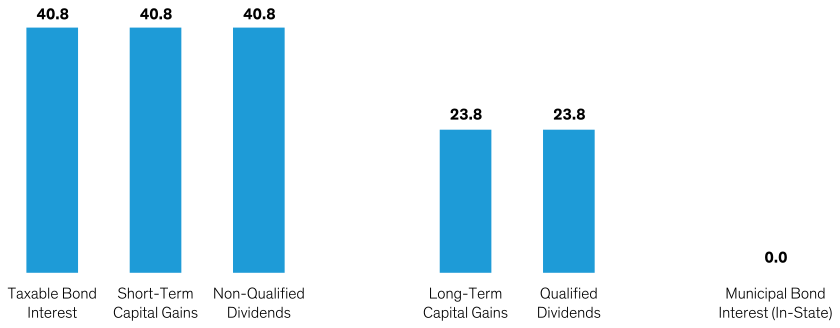
Invest in municipal bonds. Muni bonds have a built-in tax advantage versus taxable bonds, such as corporate debt. Interest income from muni bonds isn’t subject to federal income taxes, and if the bonds are issued in an investors’ home state, state taxes may not apply either. Taxable bonds, on the other hand, are subject to federal income taxes and most of them to state income taxes, too (Display).
Reduce portfolio turnover by holding investments longer. Less buying and selling reduce taxable transactions, and investments held for more than a year face a lower capital gains tax rate when sold. The top federal long-term capital gains tax rate is 20% (23.8% including the Medicare surtax); for short-term gains, it’s a whopping 37% (40.8% including the Medicare surtax). Likewise, qualified stock dividends (that meet a holding-period test) are taxed at the long-term capital gains rate; non-qualified dividends face a much higher tax rate—the same as short-term capital gains.