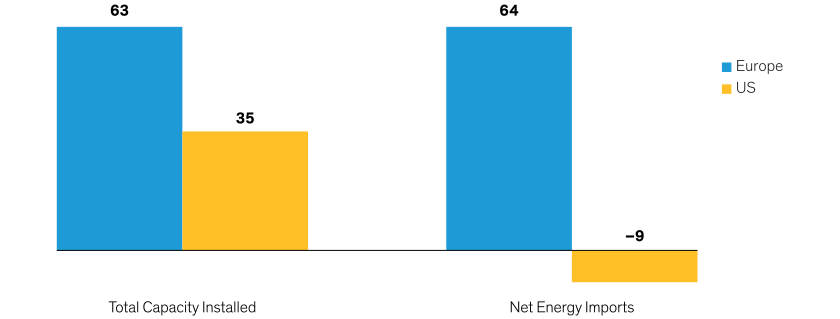
For Europe, imported natural gas typically fills the gap. But the war in Iran and the closure of the Strait of Hormuz have pushed gas prices higher and driven up electricity bills. A similar power price pike followed the start of the Russia-Ukraine war in 2022.
This matters because European electricity prices are set by the most expensive energy source needed to meet demand—usually natural gas. When gas prices rise, electricity bills go up, even if the power was generated by wind farms. As European Commission president Ursula von der Leyen put it recently, the EU has spent an additional €24 billion on energy imports since the Iran war started “without receiving a single extra molecule of energy.”
Satisfying a Long-Term Need
At the policy level, governments are doubling down on efforts to reduce dependence on energy imports and boost domestic renewable power development. This includes plans to accelerate the shift to homegrown energy as a replacement for imported gas, oil and other fossil fuels. These efforts stand to complement other ambitious EU decarbonization goals.
EU policy also calls for maximizing the use of existing renewable energy infrastructure and working with industry leaders and project developers to secure new financing. In the words of Philip Lane, the chief economist of the European Central Bank, “a green transition leading to lower dependence on fossil fuel sources could have a triple dividend: cutting greenhouse gas emissions, reducing the impact of global energy shocks on inflation and increasing energy security.”
Private Credit Steps In
It won’t come cheaply, though. The European Commission says it will need an estimated €660 billion in annual investment through 2030 and another €695 billion per year over the subsequent decade to meet its decarbonization targets. That’s nearly three times the annual investment average between 2011 and 2020 and more than public budgets or traditional banks can provide on their own. At the same time, tighter capital rules are accelerating European banks’ retreat from many types of lending, including long-dated project finance.
We expect the recent geopolitical instability to accelerate government and private capital investment into renewable energy and storage solutions, broadening the long-term investment thesis beyond climate policy to include national security priorities, durable demand growth and the need for a reliable domestic energy supply.
For experienced lenders, this should create openings to finance projects that increase renewable energy capacity and energy security while potentially delivering strong returns driven by elevated power prices.
For investors, benefits may include:
- Strong near term cash flows and structural demand tied to elevated power prices and energy security priorities
- Higher pricing and better loan structures driven by today’s high cost of capital
- Contracted revenues linked to inflation, which may limit erosion of real returns
- Attractive risk-adjusted return potential tied to resilient demand and policy support
In the years ahead, we expect to see opportunities to provide flexible credit solutions for renewable and energy transition assets at key points in their lifecycles. This may include construction and late-stage development financing and structured solutions for solar, battery storage and other established renewable asset types.
Investment structures can involve lending directly against European solar and battery storage assets and their contracted revenues as well as providing financing to parent companies that own a portfolio of renewable assets.
For lenders with deep knowledge of renewable energy assets and strong underwriting skills, the ability to provide mezzanine—or junior-level—financing may be particularly attractive for its increased return potential.
Underwriting Experience Matters
Financing the renewable energy space can be complicated, making underwriting expertise critically important. That includes the ability to underwrite loans with conservative leverage, contracted revenues and robust covenants.
Equally important is a lender’s ability to identify and focus on projects with clearly defined timelines for long-term takeout and stabilization, which comes when the asset is connected to the grid and generating steady revenue under a long-term contract. As we see it, lenders must have a deep understanding of what are often complex financing arrangements.
Sourcing expertise also matters. While the EU sets general targets and directives, countries implement them differently. Permitting timelines, grid connection processes, tax treatment and other rules vary from country to country.
Reducing Exposure to Cycles
Solar and wind projects and battery storage facilities are typically set up as stand-alone legal entitles, with repayment supported by dedicated cash flows that are often governed by long term contracts, including power purchase agreements or regulated frameworks.
As a result, cash flows tend to be predictable over extended periods and may incorporate inflation linkage or other contractual protections that reduce exposure to economic cycles.
We expect geopolitical instability and more frequent energy shocks to speed up sovereign and private capital investment into renewable energy and storage capacity across Europe—even after current hostilities fade.
That should broaden the long-term investment case beyond climate policy to national security priorities, durable demand growth and the need for a reliable, low-cost domestic energy supply. For investors, we think private credit offers an attractive way to tap into the shift to renewable power and its potential benefits.