Dimensioning Today's Middle Market Lending Opportunity
November 21 2018
2 min read

What You Need to Know

Middle market private credit offers attractive characteristics and historically strong returns. But not every manager is alike; investors need to take a careful look at a manager’s approach, process and track record before tapping this segment.

200,000+
Businesses in the US middle market as of December
84%
Average recovery rate on middle market senior loans from 1995 through 2017
0.34
Correlation between middle market loans and S&P 500 Index since 2000

Broader Adoption of Alternatives

As an asset class, middle market private credit has delivered consistently attractive investment characteristics, helping many investors diversify their public market exposure while adding higher yields in a low-return environment.

Historically, only institutions and certain investors could access illiquid alternative assets such as private credit. But new factors, including the advent of technology that modernizes subscription and reporting processes, as well as the greater willingness of investors to withstand illiquidity in exchange for incremental return, have led to the broader adoption of alternatives among individual investors.

New vehicle structures are being launched to serve this segment from a regulatory perspective, and financial technology firms are streamlining back-end operations. We believe that this is a paradigm shift that’s here to stay and continue to redefine the universe of investors.

To fully understand the middle market opportunity, we need to start with a brief history.

A Funding Gap Opens the Door to the Middle Market

The middle market is a vital part of the US economy, with more than 200,000 businesses and nearly 50 million jobs—about one third of the private sector jobs in the country. In the wake of the global financial crisis, new regulations mandated that banks increase their capital levels and tighten underwriting standards.

As a result, they pulled back from a variety of precrisis businesses, including middle market lending. This accelerated the trend of reallocating resources away from middle market lending businesses, which had started amid the consolidation in the banking sector that emerged in the 1990s. The ensuing shortfall of available credit for businesses hungry to expand created a gap that opened the door for nonbank lenders to step in, bringing alternative lenders much closer to middle market borrowers.

What Makes Middle Market Loans So Compelling?

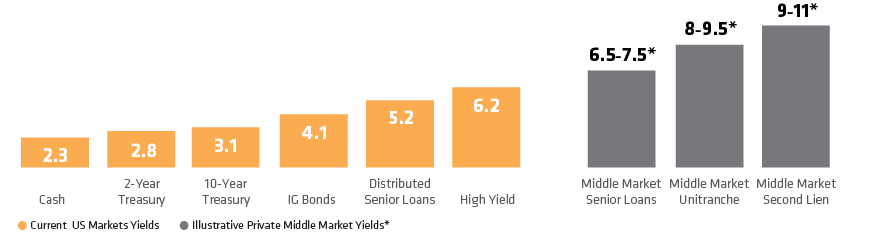
Attractive Income: Middle market loans are less liquid than public fixed-income instruments, so they carry a significant yield premium. As of September 30, 2018, high-yield bonds yielded 6.2%. By comparison, middle market senior loan yields ranged from 6.5% to 7.5%, while yields on middle market second lien loans ranged from 9% to 11%. (Display).

Middle Market Private Credit Has Historically Generated Strong Yields Relative to Other Fixed-Income Asset Classes Due to a Significant Illiquidity Premium (Percent)

As of September 30, 2018
For illustrative purposes only. Cash is represented by 1-MO. USD LIBOR, 2-Yr. Treasury by Bloomberg US Generic Government 2-Yr. Yield, 10-Yr. Treasury by Bloomberg US Generic Government 10-Yr. Yield, investment-grade (IG) bonds by Bloomberg Barclays US Corporate Investment Grade, distributed senior loans by S&P/LSTA US Leveraged Loan 100 and high yield by the Bloomberg Barclays US Corporate HY 2% Issuer Cap. 2-Yr. Treasury and distributed senior loans yields represented by yield to maturity. IG bonds and high yield yields represented by yield to worst. An investor cannot invest directly in an index or directly in these types of underlying corporate loans.
*Yields are hypothetical and based upon historical data forecasts. There can be no assurances that any target return objectives will be met. Assumes pricing of LIBOR +400–450, 2.0% 1-Mo. LIBOR, 98–99 OID for middle market (MM) senior loans; LIBOR +500–700, 2.0% 1 Mo. LIBOR, 98–99 OID (Original Issue Discount) for MM unitranche and Libor +650–800, 2.0% 1-Mo. LIBOR, 98–99 OID for MM second lien. Assumes a 3-year average life.
Source: Bloomberg, Bloomberg Barclays, St. Louis Federal Reserve, S&P/Loan Syndication & Trading Association (LSTA), Thomason Reuters LPC and AllianceBernstein (AB)

The benefit of this yield premium is amplified by middle market loans’ floating-rate structures: In public markets, investors who want to reduce interest-rate risk have to reduce duration, typically giving up yield in the process. Likewise, investors who want more yield must add duration—and interest-rate risk. Middle market loans are floating rate and higher yielding, so investors can boost yields without increasing duration.

Past performance, historical and current analyses, and expectations do not guarantee future results. There can be no assurance that any investment objectives will be achieved. The information contained here reflects the views of AllianceBernstein L.P. or its affiliates and sources it believes are reliable as of the date of this publication. AllianceBernstein L.P. makes no representations or warranties concerning the accuracy of any data. There is no guarantee that any projection, forecast or opinion in this material will be realized. Past performance does not guarantee future results. The views expressed here may change at any time after the date of this publication. This document is for informational purposes only and does not constitute investment advice. AllianceBernstein L.P. does not provide tax, legal or accounting advice. It does not take an investor’s personal investment objectives or financial situation into account; investors should discuss their individual circumstances with appropriate professionals before making any decisions. This information should not be construed as sales or marketing material or an offer or solicitation for the purchase or sale of any financial instrument, product or service sponsored by AB or its affiliates.

The views expressed herein do not constitute research, investment advice, or trade recommendations and do not necessarily represent the views of all AB portfolio-management teams.

MSCI makes no express or implied warranties or representations, and shall have no liability whatsoever with respect to any MSCI data contained herein. The MSCI data may not be further redistributed or used as a basis for other indices or any securities or financial products. This report is not approved, reviewed or produced by MSCI.