Harnessing Yield—and Growth—in Multi-Asset Income

10 February 2026
4 min read

Multi-asset investors should use a diversified toolkit to generate income efficiently.

Income investors face a promising landscape today. But we think income investing should be more than simply combining the highest yielders in each asset class, which could create unintended risks. In our view, an efficient multi-asset approach can help find the right balance between income, growth and diversification.

Highest Yield Often Means Highest Risk

The extra income earned from tilting to the highest-yielding parts of the market can introduce disproportionate risks—including lower quality, reduced growth potential, higher volatility, illiquidity and vulnerability in market downturns.

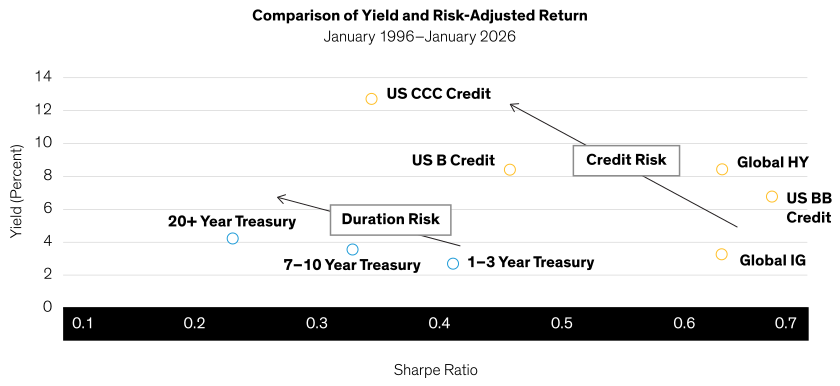
In fixed-income markets, for example, segments with the highest yield have had poorer risk-adjusted returns (Display). Income investors’ best strategy, we believe, is to choose asset classes with relatively attractive yields, but not the most risk. In corporate bonds, that means investing across global high-yield bond markets—without concentrating in the riskiest ultra-high-yield tier. And it means choosing bonds with lower interest-rate risk (duration), typically shorter-term bonds with the fewest years to maturity.

With Income Investing, Return Matters, Too
In a chart plotting yield versus Sharpe ratio, the highest-yielding sector US CCC credit has one of the lowest Sharpe ratios.

Past performance does not guarantee future results.
20+ year Treasury shown as Bloomberg US Treasury 20+ year, 7–10 year Treasury as Bloomberg US Treasury 7–10 Year, 1–3 year Treasury as Bloomberg 1–3 Year, US CCC Credit as Bloomberg Caa US High Yield, US B Credit as Bloomberg B US High Yield, US BB Credit as Bloomberg Ba US High Yield, Global HY as Bloomberg Global High Yield, Global IG Corp as Bloomberg Global Aggregate Corporate. Sharpe ratios are calculated in excess of 1–3 million USD cash.
As of January 31, 2026
Source: Bloomberg, MSCI and AllianceBernstein (AB)

The same goes for equities. Income investors shouldn’t leave equity markets out of the equation, because they offer tremendous growth potential in the age of artificial intelligence. But zeroing in on the highest-dividend yields has tended to sacrifice total return by ruling out stocks with higher earnings growth and performance potential.

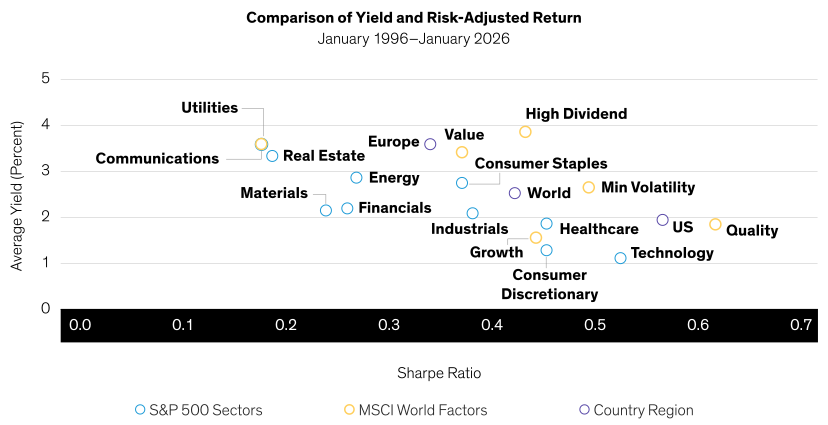
Strategies such as high quality and growth have offered only moderate yields—but have provided the outsize returns investors needed to help grow the real, or inflation-adjusted, value of their portfolios (Display). On the other side of the coin, many stocks with abnormally high yields are priced that way because of weak fundamentals or declining prospects that could lead to inferior risk-adjusted performance.

Within Equities, Quality Stocks and Growth Sectors Have Been Leaders
Like Fixed Income, Investing Based Only on Yield Has Hurt Risk-Adjusted Returns
Likewise, quality and growth strategies typically have lower yields, and high dividend has a middling Sharpe ratio.

Past performance does not guarantee future results.
S&P 500 sectors represented by respective sector indices, MSCI World Factor Indices represented by respective factor indices. Sharpe ratios are calculated in excess of 1–3 million USD cash.
As of January 31, 2026
Source: Bloomberg, MSCI and AB

Diversified Income Strategies Can Be More Resilient

In contrast to chasing the highest-yielding segments, a diversified approach has the potential to earn attractive yield without concentrating in the riskiest credits or hurting capital values. The proof point? In 2025, a global multi-asset income strategy (mixing equities, high-yield and treasury bonds) returned 13%—outperforming both high-yield and investment-grade bonds while delivering a yield of close to 4%.

Diversified approaches may also mitigate the hidden fragilities that can make larger losses more likely, helping prevent portfolio setbacks that are hard to recover from.

A stark example was the COVID-19 market crash in early 2020. Most traditional asset classes tumbled, but many high-yielding asset classes fared worse. For example, dividend-focused equity indices trailed the broad market (particularly during its recovery), even though high-dividend stocks tend to be defensive value names that can weather bear markets. But the unique nature of the shock hit the highest-yielding stocks the hardest: many firms in energy, real estate and other high-yield sectors faced dividend cuts or severe price declines, far worse than the overall market. In fixed income, lower-rated credit (high-yield bonds, loans) faced the same liquidity crunch and price plunge, even as higher-grade bonds benefited from a flight to quality.

In a nutshell, investors who had “reached for yield” by tilting toward the highest-yielding parts of the credit market or high-dividend equities were punished with larger drawdowns than a more carefully balanced allocation. What’s more, portfolios balanced with quality bonds and broad equities—including quality and growth stocks—recovered faster.

Balancing Yield with Growth, Quality and Liquidity

We think it’s vital that income-seeking investors avoid stretching for yield and ensure their portfolios have enough quality and liquidity alongside growth potential.

On the quality front, a high-dividend equity strategy should incorporate factors such as profitability and dividend sustainability. These help avoid “dividend traps”—companies with alluring yields but deteriorating businesses. Research shows that the highest-yielding stocks tend to be less profitable with higher leverage; dividend strategies that blend yield with quality metrics end up with slightly lower yields but more reliable income. The takeaway? Prefer a moderate yield from a strong borrower (or company) over a very high yield from a shaky issuer.

Liquidity is vital, too. That means limiting exposure to thinly traded securities or those prone to freezing up in crises. The “reach for yield” often leads investors into less-liquid areas, and illiquidity can compound their losses when they rush to the exits. In our view, a sound multi-asset income portfolio keeps a balance—harvesting yield from diverse sources but tempering overall risk by including high-quality bonds, resilient equities and cash buffers.

The Big Picture: Efficiency Pays in Income Investing

An overemphasis on higher-yielding assets may be counterproductive once risk is accounted for. Data show that a diversified, quality-conscious approach may deliver comparable yield with more robust characteristics and better total return potential. It’s a classic case of not putting all of your eggs in one high-yield basket. In today’s volatile investment environment, investors should remember that yield is only one component of total return—and chasing it blindly can undermine the very goal of a stable income stream.
The views expressed herein do not constitute research, investment advice or trade recommendations, do not necessarily represent the views of all AB portfolio-management teams and are subject to change over time.


About the Authors