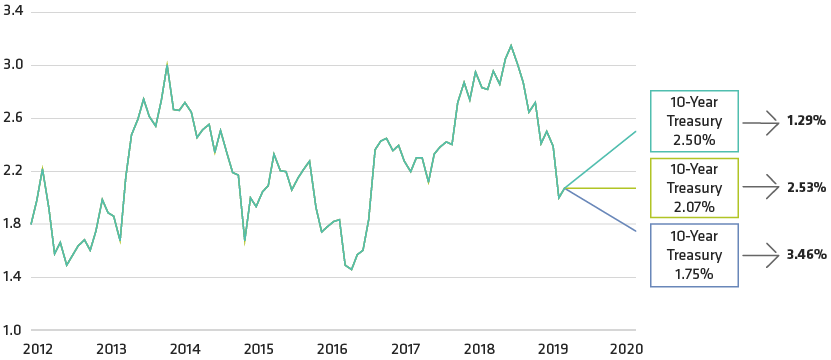
With central bank easing on the horizon, rising rates are less of a concern for many investors now than they were a few months ago. However, should the Federal Reserve change its stance again, it’s worth noting that municipal bonds held steady even when rates were rising quickly. Intermediate-duration municipal bonds have held their value as the Fed hiked rates seven times between July 2016, when 10-year yields touched a low of 1.37%, and November 2018, when they topped out at 3.24%.
2. Be Ready to Pivot
That said, investors will benefit from the flexibility to move into other types of bonds at the appropriate times.
Consider the relationship between US Treasuries and municipals. For example, after taxes, 10-year AAA-rated muni bonds yield just 0.31% more than 10-year US Treasuries, compared to the long-term average of 0.94%. Indeed, long-duration munis are almost as expensive as they’ve ever been. Over time we would expect US Treasuries to outperform munis when spreads inevitably revert to the mean, and owning them now would dampen volatility—which is, after all, the goal of a muni bond portfolio.
At a time when yields are low and supply is extremely limited, the flexibility to own mid-grade and higher-yielding bonds is also a boon to muni investors. The expanding economy has bolstered muni credit fundamentals. For example, during this summer’s budget season, 28 states reported that they’d collected more than they expected in taxes, and state rainy day funds reached an all-time high of 7.5% as a share of general fund spending.
Finally, being able to change maturity structures as the yield curve changes shape may also be a boon to investors in the months ahead. At the moment, the yield curve is flatter than usual, so it generally makes sense for investors to be somewhat concentrated in intermediate-duration bonds. However, should the curve steepen again, it will behoove investors to move into a more barbell-like structure.
3. Don’t Reach Too Far for Yield
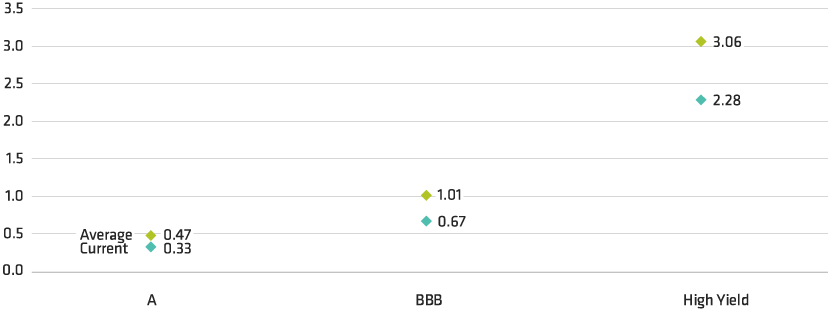
Though investing in higher-yielding bonds can be helpful in a low-yield environment, it’s the wrong time to reach too far out on the yield curve or too far down the credit spectrum.
The yield curve is remarkably flat, and we believe investors aren’t being adequately compensated for taking on additional duration risk. A 10-year, AAA-rated muni bond pays just 38 basis points more than a two-year bond with the same rating, compared to the long-term average spread of 1.33%. And investors can earn 91% of what they would earn on a 30-year bond by investing in a 10-year (Display 2).