NAV Loans: Flexibility for Private Equity When Holding Periods Extend

May 20 2026
5 min read

NAV loans are being used earlier and more intentionally.

For private equity firms, capital flexibility is prized today. Merger-and-acquisition (M&A) activity has cooled, while commodity prices and artificial intelligence (AI)-driven disruption have heated up, creating uncertainty for investors. This makes it more challenging to sell portfolio companies, so private equity firms are holding investments longer. As a result, many firms are turning to net asset value (NAV) loans for capital needs.

NAV loans are secured by the combined value of a private equity fund’s investments in underlying portfolio companies—usually a diverse group of up to 15 businesses. When companies are harder to sell, NAV loans provide capital and liquidity, making it easier for sponsors to invest in strategic initiatives designed to grow a portfolio company. This may increase value and help sponsors avoid selling portfolio companies in challenging market environments.

These loans are nondilutive, so sponsors don’t have to give up ownership to get the capital. What’s more, if the portfolio companies increase in value, that value accrues to LPs —the investors in the private equity fund.

Designed for Private Equity Flexibility, Not Rescue

NAV loans are sometimes mischaracterized as “rescue financing.” We don’t agree with that view. In practice, the loans have evolved into a flexible portfolio-management tool that can be used across market cycles.

In today’s conditions, that flexibility may help bridge extended holding periods by supporting portfolio companies, funding add-on investments or avoiding premature exits. And NAV loans can be used just as effectively across market cycles to pursue new opportunities, double down on high-performing assets or optimize capital efficiency when the macroeconomic environment is strong.

Senior Debt, Strong Covenants: An Effective Combination

NAV lending isn’t new, but it’s growing faster. That’s partly the result of broader market adoption among private equity firms and participation from non-bank lenders such as insurance companies, which see an attractive combination of features. In our view, increased usage also creates openings for private lenders with wide sourcing networks and the ability to underwrite and execute loans with robust covenants.

For investors in private credit, we see this as an opportunity to add a complementary investment-grade asset to existing allocations. We expect NAV lending growth to accelerate and the global market to expand from about $100 billion today to $350 billion by 2030.

Private Equity Holding Periods Have Grown

Current market conditions make NAV loans a particularly useful tool, in our view. According to Bain & Company, as of late 2025, there were more than 30,000 unsold companies in global private equity portfolios, representing nearly $4 trillion of value.

When including both global buyout funds, which typically acquire controlling stakes in companies, and growth funds that invest minority capital, the unrealized value of portfolio companies was closer to $5 trillion (Display).
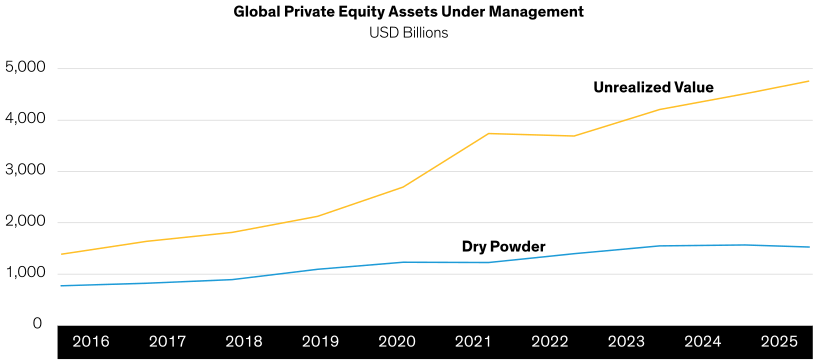
Unrealized Value of Unsold Companies Has Increased

Historical and current analyses do not guarantee future results.
As of September 30, 2025
Source: Preqin

A Long Runway of Opportunities

Looking ahead, we see a long runway of opportunities for NAV lenders. Moderately high interest rates and AI-related disruption look likely to continue extending holding periods of portfolio companies, including those in the software sector.

As a result, private equity sponsors increasingly view NAV financing as a strategic management tool with multiple earlier uses across an investment cycle. NAV loans aren’t typically used to replace investor capital, but they can give private equity sponsors flexibility in how and when they use capital.

Private equity funds typically last from 10 to 12 years. This includes a five-year investment period to acquire attractive companies, then a holding period when managers focus on maximizing profitability through operational improvements, cost reduction and revenue growth. In uncertain times, NAV financing may help sponsors create value.

For example, they can help manage timing mismatches by providing nondilutive capital without exhausting “dry powder”—committed but unused capital. Consider a fund that invests $1.8 billion of $2 billion of committed capital from investors and taps a $200 million NAV loan to finance the rest. It keeps $200 million of dry powder to use later, either to make new investments or support a company that needs it.

This enables private equity to play offense. When unsettled markets cool M&A activity, a sponsor might use NAV financing to bolster the companies it already owns. This could mean adding a complementary healthcare diagnostics firm to an outpatient-services company to enhance clinical coordination, improve patient experiences and increase profit margins.

Demand for NAV Lending Opens Opportunities for Investors

As we see it, NAV lending is likely to become a common tool for more private equity funds. For investors in credit markets, including insurance companies, broader adoption widens the opportunity set, providing access to attractive assets with strong return potential and structuring that may help mitigate downside risk, including:

  • Large Loan-to-Value (LTV) Cushions: NAV loan totals typically range from 5% to 30% of the underlying portfolio value when deals close—a substantial cushion.
  • Diversified and Divisible Collateral: Private equity fund investments are diversified, reducing company-specific risk; a NAV loan may benefit from that diversification, and a successful exit from one company can be used to repay the entire loan.
  • Robust Covenants: These limit how concentrated a fund’s portfolio can become and how high the LTV can grow. If limits are breached, lenders can require that proceeds from exits be used to pay down the loan faster.
  • Investment-Grade Ratings, Strong Return Potential: NAV loans are increasingly structured with investment-grade ratings—typically A to BBB—and are executed today with yields of 300 to 600 basis points over the Secured Overnight Financing Rate.

These attributes seem to make NAV loans a particularly good fit for insurers. US and European regulators treat the loans as credit, not “equity-like exposures,” thanks in part to their credit profile, resulting in low risk-based capital charges.

Over time, we expect these assets to loom larger on investors’ radar. Their senior position in the capital structure, low leverage and direct tie to real businesses have the potential to generate steady and attractive returns while potentially mitigating risk.

With private equity sponsors looking to create value as they hold companies for longer, the need for flexibility grows. We expect NAV lending to provide a key source of financing while expanding diversification and return potential for income oriented investors navigating an uncertain environment.

The views expressed herein do not constitute research, investment advice or trade recommendations, do not necessarily represent the views of all AB portfolio-management teams and are subject to change over time.


About the Authors