Plan Sponsors Speak with Action

26 October 2018
3 min read

What You Need to Know

When the Pension Protection Act (PPA) was passed in 2006, target-date funds (TDFs) became the default option of choice for plan sponsors. Funds offered by recordkeepers—known as proprietary funds—quickly gained the lion’s share of industry assets. Today, the top three target-date providers are asset managers who also provide recordkeeping services. But the target-date landscape has been changing rapidly, and so have plan sponsors' preferences.

Joint research conducted by AllianceBernstein (AB) and BrightScope in 2017 showed that fewer plan sponsors were using their recordkeepers’ proprietary TDFs—and that more plan sponsors were choosing nonproprietary TDFs from other managers. The two firms revisited the data for 2015 (the most recent year for which data are available)—data spanning more than 7,800 401(k) plans and representing $2.4 trillion in assets and 27.9 million participants—to see if the trends continued.

What We Found

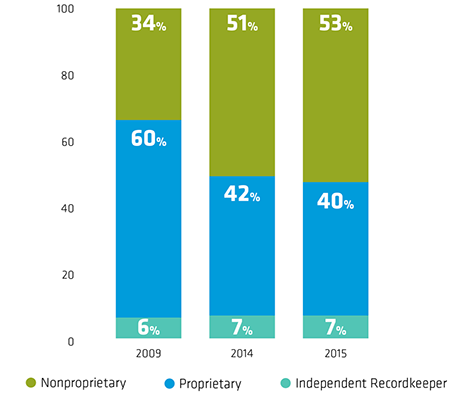
1. Recordkeepers’ proprietary TDF share has declined by 20% since 2009, as the use of nonproprietary TDFs has increased by 19%. Both of These numbers are up from the last study.

Recordkeepers’ Target-Date Assets (Percent)
1. Recordkeepers’ proprietary TDF share has declined by 20% since 2009, as the use of nonproprietary TDFs has increased by 19%. Both of These numbers are up from the last study.
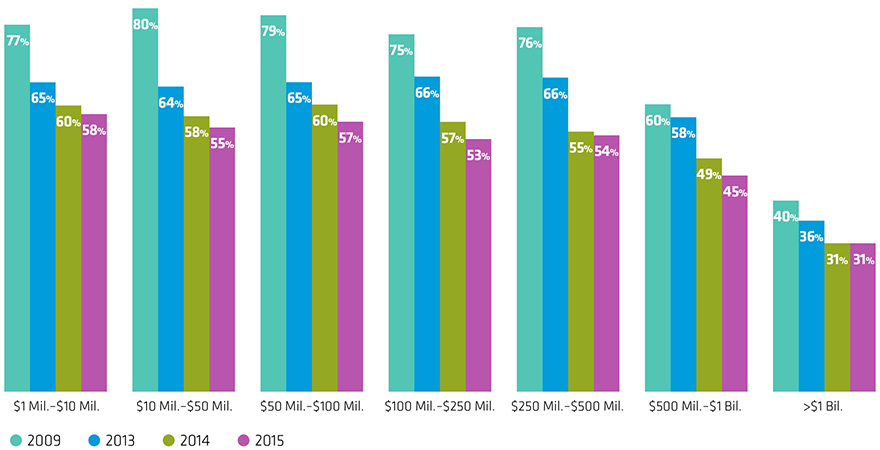
2. More smaller plans (53%) use record keeper proprietary TDFs. Usage among large1 plans is much lower (31%), because “unbundling” of target-date decisions from plan administration decisions is more common.

Assets by Plan Size (Percent)
2. More smaller plans (53%) use record keeper proprietary TDFs. Usage among large1 plans is much lower (31%), because “unbundling” of target-date decisions from plan administration decisions is more common.
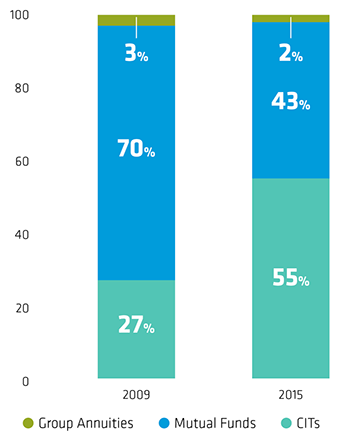
3. The use of collective investment trusts (CITs) in TDFs has jumped since 2009, with some recordkeepers using CITs or passively managed TDFs to reduce fees and keep their proprietary share.

Target-Date Assets by Vehicle (Percent)
3. The use of collective investment trusts (CITs) in TDFs has jumped since 2009, with some recordkeepers using CITs or passively managed TDFs to reduce fees and keep their proprietary share.

What Does the Future Hold for TDFs?

The target-date marketplace continues to change, with growing emphasis on the fiduciary role of plan sponsors, consultants and advisors.

With more choices than ever before, many plan sponsors are decoupling their choice of recordkeeper from their target-date-solution choice. Plan sponsors are seeking the best possible outcomes for plan participants—by keeping them on a path toward being more financially prepared for retirement. Better quality portfolio management, lower fees and solid investment performance all help—and plan sponsors are now looking at a broader set of options before making a decision.


Innovate Your Target-Date

It's time to rethink retirement and innovate target-date solutions to help investors reach their goals.

1Small plans are defined as $100 million—$250 million and large plans as $1 billion and higher.

Research Methodology

The data set in this report covers a total of 7,801 401(k) plans with $2.4 trillion in assets and 27.9 million participants in 2015. All data were gathered from Form 5500 and its Schedule of Assets for 401(k) plans with more than 100 participants and $1 million in assets.

The data sample includes all 401(k) plans for which BrightScope has investment lineup information and an assigned recordkeeper for each year from 2009 through 2015. Recordkeepers were assigned to plans based on Form 5500 Schedule C provider codes. If multiple providers were listed, the recordkeeper that receives the highest fee is assumed to be the plan’s recordkeeper.

BrightScope re-created this analysis in a similar manner as was done previously, excluding such recordkeepers as State Street, Hartford Financial and Lincoln Financial. For 2015, Empower, Putnam and Great-West are all considered proprietary to one another on all outputs as a result of an October 2014 merger. New York Life funds are proprietary to John Hancock as the result of an April 2015 acquisition.

Because we looked at plans that fit the criteria as of a specific query run date and viewed them over the course of a defined time frame, the plan set may differ slightly from the original report published.

White-label target-date funds are included in the data, and the asset manager may not be apparent, such as in, “AT&T Target Retirement 2040.”

The information contained here reflects the views of AllianceBernstein L.P. or its affiliates and sources it believes are reliable as of the date of this publication. AllianceBernstein L.P. makes no representations or warranties concerning the accuracy of any data. There is no guarantee that any projection, forecast or opinion in this material will be realized. Past performance does not guarantee future results. The views expressed here may change at any time after the date of this publication. This document is for informational purposes only and does not constitute investment advice. AllianceBernstein L.P. does not provide tax, legal or accounting advice. It does not take an investor’s personal investment objectives or financial situation into account; investors should discuss their individual circumstances with appropriate professionals before making any decisions. This information should not be construed as sales or marketing material or an offer of solicitation for the purchase or sale of, any financial instrument, product or service sponsored by AB or its affiliates.