Tackling Retirement Income

Expert Roundtable

10 May 2021
13 min read

With interest in retirement income solutions growing, defined contribution (DC) plan sponsors have been monitoring the design of available solutions, the needs and preferences of their participants, and regulatory developments around retirement income provision.

We asked two plan sponsors and two experts on the retirement income marketplace to weigh in on key questions, including the impetus for deploying a retirement income solution, the benefits these can bring, legal and regulatory considerations, and the impact of the COVID-19 pandemic.

Q. How did you come to the conclusion that retirement income needed to be a priority? Was it participant-driven? Did the C-suite have a strong view on this need? What were the dynamics?

Suzanne M. Mayer, Chief Benefits Officer and Interim Executive Director at State Universities Retirement System (Illinois): Our participants aren’t eligible for Social Security, so the DC plan would be their primary retirement income source. Before we redesigned the plan in 2020, distribution options were limited: a lump-sum payout or the purchase of an annuity with 100% of the account balance.

More than half of participants cashed out at retirement to manage their own investments or hire someone else to do it. We wanted more flexibility to help participants through wealth accumulation and decumulation. This default option had to be easy and automatic, helping participants maintain a standard of living and retirement security without relinquishing account balances.

Our plan committee included benefits, investments and legal, bringing diverse perspectives. We all wanted the flexibility to meet each participant’s needs, while still focusing on feasible operations and implementation. Our participants are fee-sensitive, so we wanted competitive costs with transparency and clarity, and the benefits of retirement income had to be easy to understand and communicate.

Marco Merz, Head of Defined Contribution, University of California: Until 2016, our DC plan was purely supplemental to the mandatory defined benefit DB plan, with its guaranteed income, for all employees. That year, we changed our primary retirement benefit option for new hires. Savings Choice, a pure DC benefit, became available as a DB alternative. Since then, a meaningful subset of the new hire population has opted for Savings Choice, forgoing access to our DB plan and guaranteed income. That was the catalyst for us to start looking at retirement income options.

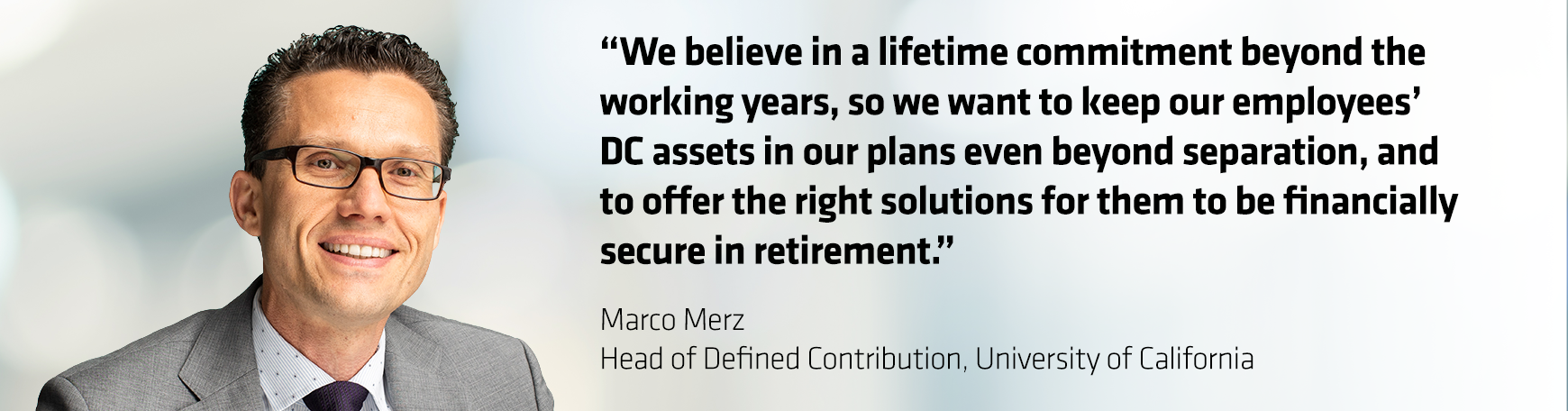
The university is inherently paternalistic, viewing its people very much as a family. We believe in a lifetime commitment beyond the working years, so we want to keep our employees’ DC assets in our plans even beyond separation, and to offer the right solutions for them to be financially secure in retirement. Because of that philosophy, we had a very high-level buy-in for some type of retirement income solution—almost an implicit mandate—all the way up to the Board of Regents and our CIO.

We also saw an immediate buy-in from our diverse stakeholder base, specifically our academic senate, which represents our faculty. The members very much wanted those choosing DC accounts to have access to retirement income, so from the senate’s perspective it was a must.

Q. What aspects of retirement income solutions and preconceived notions did you have to get more comfortable with or explore more deeply as you considered adoption and implementation?

Suzanne M. Mayer: We knew a retirement income solution was critical, because we want our DC plan to feel DB-like and bring that to life for participants. We did need to get more comfortable with some of the mechanics, including implementation, cost and control.

The uptake in our legacy annuity offerings was low—in our view, participants were uncomfortable with the irrevocability. We wanted to default them into an income solution that didn’t have the irrevocable nature, and we still offer a fixed annuity for those wanting to go that route. We gave a lot of thought to cost. A retirement income solution isn’t an apples-to-apples comparison to other core lineup investments—it’s a different service. There’s also a perception that annuities are expensive: all annuities have a cost, but we ultimately wanted a transparent and explicit cost structure.

Finally, we wanted participants to make informed decisions, so we spent a lot of time and effort communicating and educating. Materials had to be simple and clear, explaining why this retirement income solution was being offered versus a more standard option. And we continue to refine our plan communications.

Marco Merz: One of the biggest aspects as we pursued the annuitization route was getting comfortable with the irrevocable nature. For example, there was substantial discomfort with the original opt-out design, rolling out the retirement income solution without explicit consent from participants—especially with our academic senate and human resources.

So, we listened to our stakeholders and adjusted the product design to an opt-in solution. Our initial goal now is to get our DC participants comfortable with annuitization. We’re leaning on personas our people can relate to, whether it’s a nurse at one of our medical centers, a facilities staff member, a faculty member or a food and beverage employee.

Just because you believe an approach is optimal doesn’t mean everyone is on board. Sometimes you’re ready to move from step one to step two and then discover there are interim steps 1A, 1B and 1C needed to get everyone comfortable. We had philosophical buy-in to do something, but opt-out wasn’t really an option many of our stakeholders were comfortable with at the outset. So, the investment office realized that we cannot be rigid on our journey to get to a final state of our retirement income solution; our mantra became, “Doing something is better than doing nothing.”

Q: Can you offer your perspective on how retirement income conversations are being initiated? How much are you raising the issue versus clients raising it? What are you hearing not only from plan sponsors but also from retirement income providers on the topic?

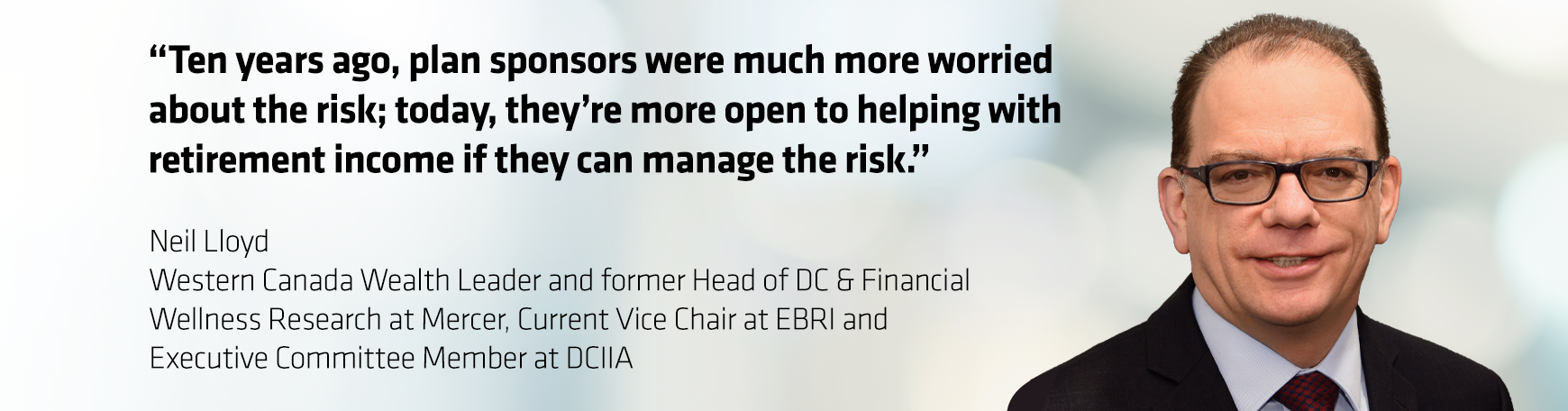
Neil Lloyd, Western Canada Wealth Leader and former Head of DC & Financial Wellness Research at Mercer, current Vice Chair at EBRI and Executive Committee Member at DCIIA: Ten years ago, plan sponsors were much more worried about the risk; today, they’re more open to helping with retirement income if they can manage the risk. We encourage them to think in terms of plan design—what they can do to improve design. The industry can make this topic too complicated—it’s not simple to find the best solutions, but you also don’t need to resolve everything at once.

Neil Lloyd

The more we can simplify retirement income solutions, the more it will, we believe, build momentum. Recordkeeper integration is a factor: can you get a solution on the recordkeeper’s platform? We’re seeing interest in managed accounts from some clients, not because they’re the ideal lifetime income option for everyone, but because they have additional retirement income-type features, including the consideration of an individual’s Social Security benefits and access to retirement planning tools.

Overall, I think that as more plan sponsors begin to deploy retirement income solutions in their plans, and if the process continues to become smoother, we’ll likely see more momentum.

Q: The COVID-19 pandemic and the Coronavirus Aid, Relief, and Economic Security (CARES) Act required a rapid shift to immediate priorities. Broadly speaking, how has the pandemic impacted perceptions, conversations and decisions around retirement income? Do you expect more plans to take steps to adopt such solutions as things return to “normal” post-pandemic?

Neil Lloyd: We thought that the Setting Every Community Up for Retirement Enhancement (SECURE) Act of 2019 would lead to a surge in retirement income discussions, but then the pandemic happened. Meetings tended to be a little bit shorter, focusing on the most pressing needs, such as the CARES Act. The pandemic highlighted that shorter-term issues, such as emergency savings, are critical, too, so retirement income might be competing for client attention. Diversity, equity and inclusion have also become bigger priorities, attracting a lot of questions from clients.

What came through in the COVID-19 pandemic is that participants have both short-term and long-term financial needs. Some employers realized that having a solution that covers short-term financial needs may be the greater priority. But there frankly aren’t a lot of fantastic, universal, elegant solutions to the emergency savings problem.

Financial wellness in general is a discussion item, encompassing issues such as short-term savings and retirement income, but people struggle with what to actually do. We hope that the retirement income topic will come back to the fore, and I think we’re seeing a little bit of it happening already.

Michael P. Kreps, Principal, Groom Law Group: The past year has been very challenging, with many employers pausing efforts to improve their plans. Now that we see light at the end of the tunnel, I expect plan sponsors to revisit in-plan retirement income solutions. They had already been focused on it, and the pandemic’s dramatic impact has made many people more acutely aware of the need for financial security—particularly in retirement.

Q. The direct security of having enough retirement income is obviously a big need for many DC plan participants, but having a solution in place also confers other benefits for participants and for the organization itself. Which ones jump to top of mind—and why?

Neil Lloyd: Keeping more assets in the plan can improve economies of scale and reduce fees for participants. There’s a lot of uncertainty around retirement: how does it impact current workers’ productivity, and how does greater retirement confidence improve it? Clients are also interested in avoiding talent blockages: if older workers don’t feel comfortable retiring, it’s harder for younger workers to advance.

We’re starting to have conversations around retirement flexibility. It may make more sense to gradually phase talented older workers into retirement, if the talent progression and benefit costs can be managed effectively. Importantly, in an environment where there’s a labor or skills shortage, being able to access the skills older workers bring may give a company a competitive advantage.

If flexible retirement becomes a more natural process, that will have an impact on how we plan for retirement as well.

Suzanne M. Mayer: The direct security was big for us. And because participants know they’re getting a certain amount every month, it eased their minds about a looming concern: what’s an appropriate amount of retirement income to withdraw every year without depleting the account?
Suzanne Mayer

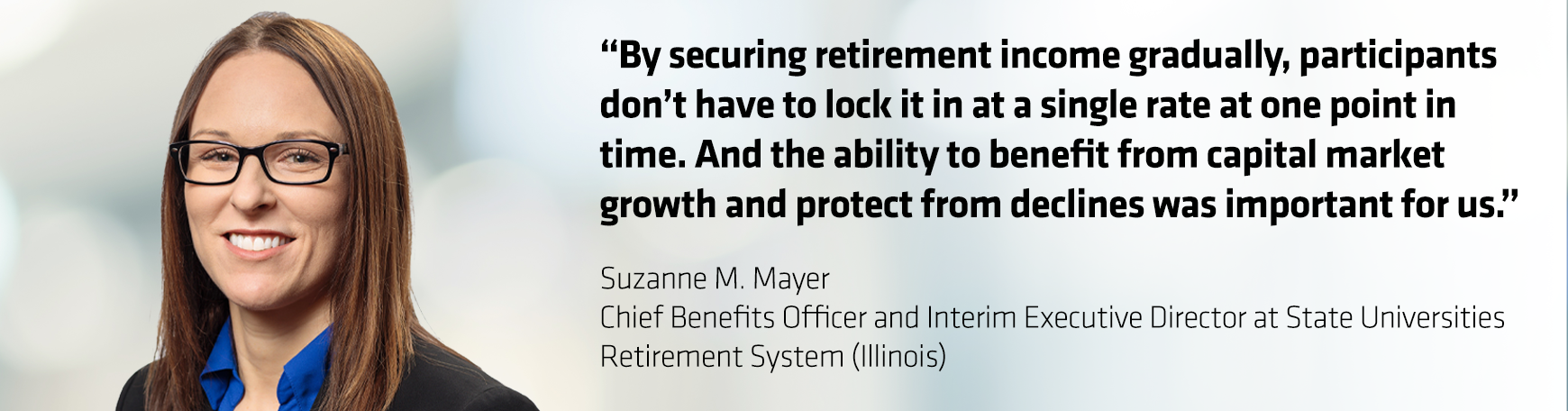
Also, by securing retirement income gradually, participants don’t have to lock it in at a single rate at one point in time. And the ability to benefit from capital market growth and protect from declines was important for us.

Most participants had been leaving the plan at retirement, which we think stemmed from discomfort in giving up access to their entire account balance with a traditional annuity. Certain eligible participants gave up retiree healthcare benefits upon leaving the plan, so flexibility was needed to help them keep control of their account balance and stay in the plan.

Marco Merz: It reinforces the university’s commitment to care for every single participant and give them the tools and resources to live well in retirement. Just because we implemented a DC option doesn’t lessen our commitment to our participants’ financial wellness across the full continuum of life.

Adding a retirement income option to the DC plan allowed us to change the conversation from “Save more” to “This is a journey, and it doesn’t end at retirement.” We used the rollout to talk about retirement and retirement readiness as a whole—and all the benefits and resources we offer. It really created an opportunity to expand and enrich the conversation, which was a big win for us.

It also prompted us to connect a lot of fragmented communication dots and make things clear for participants. Our annual retirement review for participants, for example, looks at the amount of DB benefits participants have, how much they’ve accumulated in DC plans and how it translates into an estimated income stream. We were able to unify all our retirement readiness communication pieces for participants.

Q. With the SECURE Act of 2019 providing a safe harbor for the use of annuities in DC plans, should plan sponsors now feel comfortable adopting in-plan annuity solutions? If so, why? From a legal and regulatory standpoint, should plan sponsors be comfortable using these solutions as qualified default investment alternatives (QDIAs)?

Michael P. Kreps: The safe harbor is a key step toward modernizing DC plans and alleviating legal concerns with in-plan annuities. A big concern was evaluating insurers’ financial soundness, since annuity obligations can last three decades or more. Safe harbor deems that fiduciaries have satisfied their duties for evaluating an insurer’s financial capabilities if they receive specific written representations from the insurer. That should comfort fiduciaries that they won’t be liable if an insurer fails to meet its obligations.

This particularly helps fiduciaries looking to incorporate retirement income into their plans’ defaults. Most fiduciaries with automatic-enrollment plans default participants into QDIAs to benefit from the Pension Protection Act of 2006’s fiduciary safe harbor. The Department of Labor has confirmed that QDIAs (target-date funds, balanced funds and managed accounts) can include certain retirement income features. So, a fiduciary including a retirement income component in a default investment can benefit from two safe harbors: one for the QDIA and one for the annuity.

The SECURE Act did more to encourage retirement income, removing an impediment to in-plan retirement income solutions. Before the SECURE Act, fiduciaries worried that participants investing in such a solution might have to surrender or leave behind their guarantees if the plan moved to a new recordkeeper that didn’t support it. The SECURE Act allows participants to take an in-service distribution and move the retirement income benefit to another eligible plan, including an IRA, if their plan decides to stop offering the investment option. This gives sponsors a fair amount of comfort that they’re not locked into a particular retirement income solution forever.

Q. With more recent support coming from Washington, DC for in-plan retirement income solutions—and annuities specifically—what steps should plan sponsors take to evaluate what to do in their plans? Do you have any advice for them?

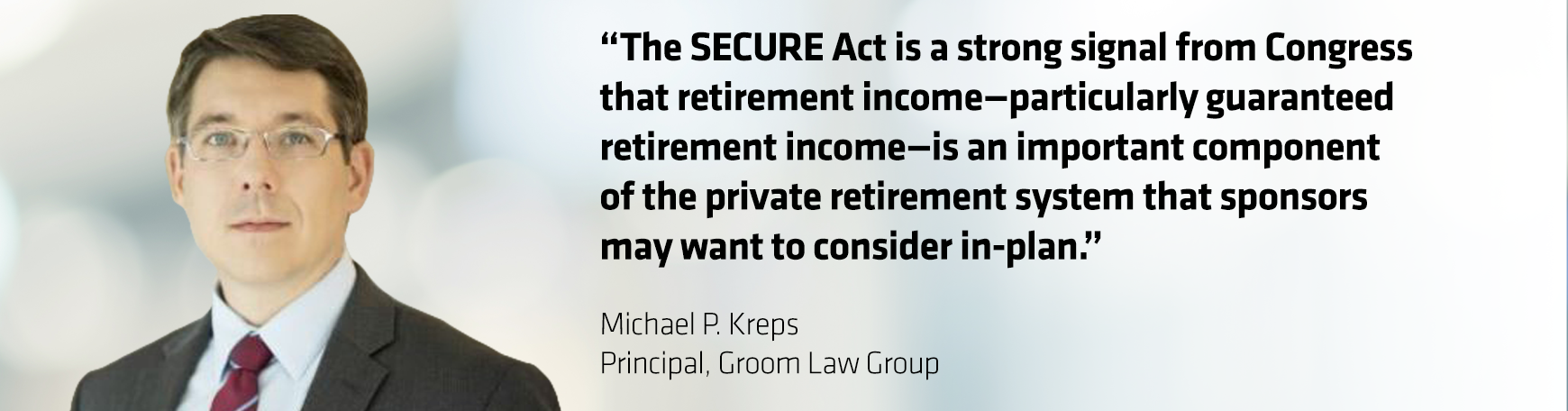
Michael P. Kreps: The SECURE Act is a strong signal from Congress that retirement income—particularly guaranteed retirement income—is an important component of the private retirement system that sponsors may want to consider in-plan.

The key for fiduciaries is to engage in and document a prudent process that considers how the solution meets participants’ needs. Typically, fiduciaries will want to fully understand how the guarantees work, as well as any liquidity limitations. They must also determine that costs are reasonable in light of the benefits, though the SECURE Act clarifies that they don’t necessarily have to select the cheapest option. And fiduciaries should ensure they meet all conditions of the new safe harbor, including receiving the necessary insurer disclosures.

Michael Kreps

It’s all too easy to get hung up on the risks, but there’s now a decade or more of experience with many of the options currently available. Sponsors can and have navigated the legal issues, and the SECURE Act has really made things a lot simpler.

Neil Lloyd: Know what your objectives are. Who are you trying to help? Not all people will get all the way through to retirement within your organization. If many people near retirement have short service and little money in the plan, income solutions won’t help very much. But encouraging them to consolidate previous assets into the plan can help.

If people are all moving out of the target date fund before they get to retirement, the benefits of an integrated income solution will be limited, unless of course that solution leads participants to remain in the target date fund. So, understand who is currently invested in the target date fund near retirement, and/or how can you increase the number of participants who will remain in the target date fund as they approach retirement.

What resources does the recordkeeper have to facilitate an income solution? Does your target date manager offer a retirement income product? Also, don’t forget to do the easy things: encourage consolidation, allowing partial withdrawals. Get some of the simple things in place, and then you can circle back to evaluate income solutions.

“Target date” in a fund’s name refers to the approximate year when a plan participant expects to retire and begin withdrawing from his or her account. Target-date funds gradually adjust their asset allocation, lowering risk as a participant nears retirement. Investments in target-date funds are not guaranteed against loss of principal at any time, and account values can be more or less than the original amount invested—including at the time of the fund’s target date. Also, investing in target-date funds does not guarantee sufficient income in retirement.

The views expressed herein do not constitute research, investment advice or trade recommendations and do not necessarily represent the views of all AB portfolio-management teams. Views are subject to revision over time.