Growing the Ecosystem: Coordinating Across the Capital Stack
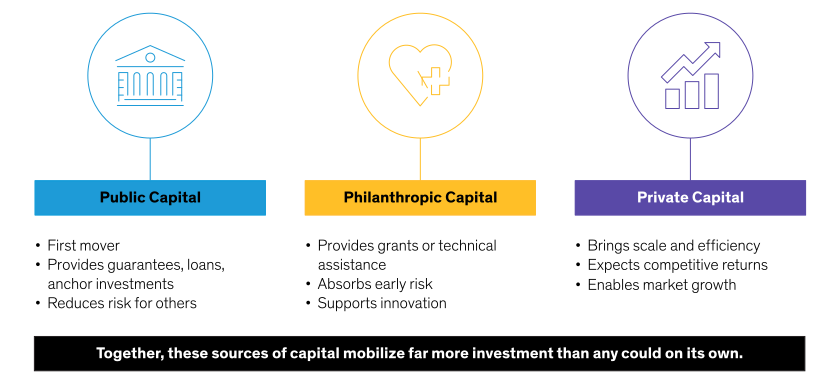
Mobilizing capital at the scale required to close a US$4 trillion gap is no small task. Developing nations must secure financing on manageable terms that can also attract investors—requiring coordination among asset managers, development banks, sovereign governments, rating agencies, philanthropic foundations, insurers and nongovernmental organizations.
Attracting large, durable flows of private capital is especially difficult. Early co-creation among these stakeholders can help produce transparent structures that can be replicated. And catalytic resources brought into the riskiest stages of development can help turn early concepts into viable investment opportunities—building a stronger pipeline for private capital to follow.
A major step toward that kind of coordination came with the inaugural Impact and Blended Finance Conference, held in 2025. Co-hosted by AllianceBernstein, Societe Generale and the Emerging Markets Investors Alliance, the event brought together stakeholders from across the capital stack and served as a model of buy- and sell-side partnership.
Growing the Ecosystem: Creating a Repository
At the conference, Boston Consulting Group and Societe Generale proposed creating a centralized repository to support blended-finance transactions. By aggregating data on funding availability by region, sector and instrument type, such a resource could streamline dealmaking, reduce transaction costs and increase transparency.
A centralized repository could be a major catalyst for expanding blended finance, helping investors deploy capital more efficiently and at greater scale. It could also make catalytic funding easier to access by reducing variability in eligibility, application and reporting requirements that too often slows projects down.
Growing the Ecosystem: Measuring Success
Scaling blended finance requires clear and consistent measures of success. Investors need to understand both the financial outcomes and the environmental or social impact of each transaction. Developing a common set of standards facilitates reliability and comparability. Such a rigorous approach helps reduce the risk of greenwashing—ensuring that capital is flowing to projects with demonstrable impact while also meeting investor economics. Over time, this kind of transparency builds confidence and encourages more investors to participate.
While stronger coordination, a centralized repository and clearer impact metrics are essential for scaling blended finance tomorrow, investors can already find tangible structures they can put capital into today.
Novel Tools for Sustainable Investment
Among the most visible applications of blended finance are innovative bond structures that channel capital directly into sustainability projects. Two examples—debt-for-nature swaps and outcome bonds—show how creative approaches can deliver both measurable impact and competitive returns.
Debt-for-nature swaps allow developing countries to reduce sovereign debt in exchange for investments in conservation. The structures are complex and require coordination among asset managers, multilateral development banks, sovereign governments and conservation organizations. But the benefits are threefold: for countries at risk of default, these arrangements are a cost-effective way of easing debt burdens; proceeds are directed toward critical projects such as protecting rainforests or safeguarding endangered species; and investors may purchase the bonds at attractive valuations.
One recent debt-for-nature swap not only helped conserve 60,000 square kilometers of Ecuadorian marine territory but also delivered yields higher than many US corporate bonds with comparable credit ratings.
Outcome bonds, like debt-for-nature swaps, fund sustainable development but often with more clearly defined goals. These bonds typically appeal to investors focused on a specific theme, such as restoring the population of black rhinos or reforesting the Amazon.
In some cases, coupon payments are adjusted based on project results—providing investors with both measurable impact and principal protection when issued or guaranteed by a highly rated development institution such as the World Bank.
Historically, outcome bonds have had higher yields than other assets of similar credit quality, and their impact is quantifiable: investors know precisely how many trees were planted, how much carbon was sequestered, or how may rhinos were conserved.
Turning Potential into Outcomes
For blended finance to achieve its promise, it must deliver both measurable impact and returns attractive enough to draw mainstream investors.
Catalytic capital plays a critical role in unlocking larger flows of private investment. When catalytic resources de-risk transactions, sustainability-linked instruments can advance global development priorities while also offering compelling returns to investors.
The challenge is vast, but so is the opportunity: blended finance gives investors a chance to participate at the start of a market poised for major growth.