Emerging-Market Equities: A Brief History of Volatility and Recovery

Mar 30, 2026
3 min read

Could heightened uncertainty driven by the Middle East conflict lead to strong return potential?

Emerging-market (EM) equities have been hit hard since the Iran war began, as investors worry about fallout from the conflict. Yet, history suggests that periods of heightened market stress—when volatility is elevated and uncertainty is still being priced—have created favorable entry points for EM investors in the past.

Equity markets have traded anxiously as the US-Israeli attacks on Iran escalated into a regional war in March. Iran shut the Strait of Hormuz, through which roughly a fifth of the world’s oil is shipped, raising fears of a sustained energy shock. Concerns that higher oil prices could fuel inflation, curb growth and undermine earnings pushed global equities lower. The MSCI Emerging Markets Index fell by 11% in US-dollar terms in March after a strong run in 2025 and the first two months of 2026.

Oil Shock Roils Asian Economies

The impact has been most visible across parts of Asia. India, Thailand and the Philippines—which rely heavily on oil transported through the Strait—have taken steps to cushion the blow from higher prices. While some commodity-rich emerging countries such as Brazil may be more insulated from the oil shock, investors fear that EM companies in general look vulnerable to the effects of higher energy costs on growth and profitability.

These uncertainties also help explain the broader rise in market volatility. The VIX Index of US equity market volatility, also known as Wall Street’s fear gauge, has climbed as investors grapple with a widening range of geopolitical and macro outcomes. To understand what this historically has meant for EM investors, we examined EM equity market returns following different month-end VIX levels since 2001.

VIX and EM Equities: A Surprising Rebound Signal

Extreme volatility spikes are rare. Over the past 24 years, the VIX has exceeded 40 at month-end only nine times. Yet, those episodes have tended to coincide with unusually strong subsequent returns for EM equities. When the VIX finished a month above 40, EM stocks surged by more than 60% in the next 12 months on average, comfortably ahead of developed-market peers (Display).

Moments of Extreme Fear Have Prompted Emerging-Market Equity Outperformance
Line chart showing the MSCI Emerging Markets Index rising sharply after the April 2025 VIX peak, highlighting strong recovery as volatility declines.

Past performance and current analysis do not guarantee future results.
*In US-dollar terms.
Left display through March 27, 2026; right display as of February 27, 2026
Source: Bloomberg, Cboe Global Markets, MSCI, S&P and AllianceBernstein (AB)

At first glance, this seems counterintuitive, given EM equities’ reputation for higher risk. In our view, the explanation lies in market psychology. Periods of extreme volatility often reflect an environment in which investors extrapolate worst-case scenarios. When fear peaks, much of the bad news is already priced in, so markets may deliver positive surprises as outcomes often prove less severe than feared.

Today’s environment does not yet suggest extreme market fear. Despite elevated uncertainty, the VIX has so far peaked at 31—at the threshold of levels that have historically signaled the most compelling forward returns for EM equities, and below the April 2025 jump following President Trump’s sweeping tariff announcements. Yet, history suggests that if volatility were to push decisively above 30, the medium-term outlook for EM stocks would become more attractive.

In fact, recent market history is instructive. After tariff fears peaked and pushed the VIX to 52 on April 8, 2025, the MSCI Emerging Markets Index surged by 64% through late February. Even after recent declines, the MSCI Emerging Markets was still up by 46% from last year’s VIX peak through March 27 (Display).

Emerging-Market Stocks Surged Since 2025 VIX Peak
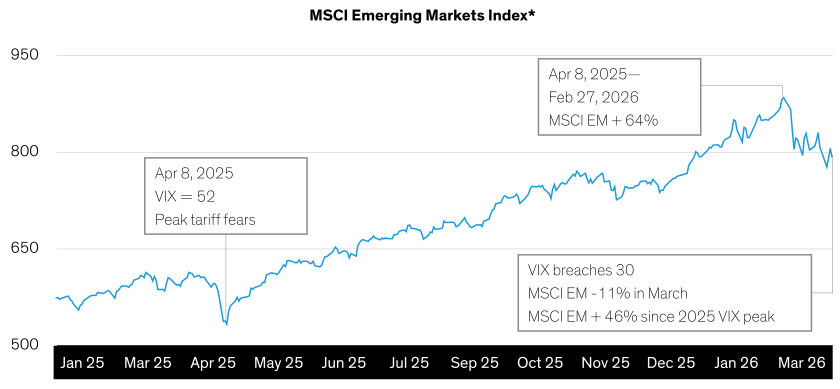
Charts show emerging market equities historically deliver stronger 12 month returns following periods of elevated VIX and market stress.

Past performance does not guarantee future results.
As of March 27, 2026
*Net total return in US dollars.
Source: Bloomberg, MSCI and AB

No one can predict how the Middle East conflict will evolve. The risks are dramatic and the range of outcomes remains wide. But market history also shows that timing inflection points is extraordinarily difficult and staying invested through times of stress is the best way to ensure that investors don’t miss out on a recovery. What’s more, before the war, EM stocks were benefiting from several catalysts for earnings growth from artificial intelligence to governance reform to a weakening US dollar.

For long-term investors, we believe focusing on EM companies with strong fundamentals, quality businesses and the ability to withstand inflationary pressure is a good strategy for capturing the strong return potential that could be unlocked when calmer conditions prevail.

The views expressed herein do not constitute research, investment advice or trade recommendations, do not necessarily represent the views of all AB portfolio-management teams and are subject to change over time.

MSCI makes no express or implied warranties or representations, and shall have no liability whatsoever with respect to any MSCI data contained herein. The MSCI data may not be further redistributed or used as a basis for other indices or any securities or financial products. This report is not approved, reviewed or produced by MSCI.


About the Author