Five Overlooked Themes for Equity Investors in China

Sep 30, 2025
5 min read

Chinese equities deserve closer attention from investors who may have avoided the market amid geopolitical tensions.

Ask an investor what they think about China and you’ll get wildly different responses. For some, China is about geopolitical risk, tariffs and slowing growth. For others, it’s a sleeping giant with untapped potential. As Chinese equities rally this year, we think it’s time to put that debate aside and take a clearheaded look at some compelling investment themes in the world’s second-biggest economy.

Chinese stocks seem to be defying gravity. Despite trade pressures and a tough economy, the MSCI China Index has surged by 31.7% in US-dollar terms this year through September 25. The MSCI Emerging Markets Index, with a 29% weight in China, rallied by 28.1% over the same period. 

Taking a Long View in a Short-Tempered Market

The Chinese market is often driven by short-term sentiment, and this year is no different. Easing US trade rhetoric since April has attracted domestic flows from retail investors, while economic weakness has taken a backseat.

So how should investors with long horizons approach China? Start by identifying trends that will shape the economy and business environment in the coming years—and can overcome short-term concerns.

  1. Innovators with Global Appeal


    Despite restrictions in some “sensitive” industries, China is home to companies with global impact and influence.

    In healthcare, Chinese pharmaceutical firms are increasingly licensing their intellectual property to global drugmakers. With competition intensifying, more multinationals are turning to Chinese researchers to complement their R&D pipelines. These partnerships often generate royalties with less geopolitical sensitivities than industries such as semiconductors, because the drugs’ ownership is global and the end goals are humanitarian.

    China’s cultural export power is also growing. The latest example: Labubu—a character described as China’s Hello Kitty—is going viral worldwide. Created by Hong Kong illustrator Kasing Lung, Labubu has been embraced by celebrities from Rihanna to Blackpink. Pop Mart, the Chinese company that manufactures Labubu, is expected to see its overseas revenue exceed its domestic revenue for the first time in 2025, underscoring how innovative Chinese products can attract global consumers, while redefining a business and its return potential.

  2. Exporters That Don’t Rely on the US


    China’s appeal to investors in the 21st century was rooted in its growing role as a global exporting powerhouse. Now, with US trade slowing, investors have become wary.

    Yet despite the trade war, Chinese exports globally have continued to rise (Display). That’s because exports from China to other emerging market (EM) countries in Latin America and Asia are booming. This diversification of trade flows suggests that companies focused on non-US exports may be an overlooked pocket of opportunity.

    China Continues to Diversify Its Supply Chain
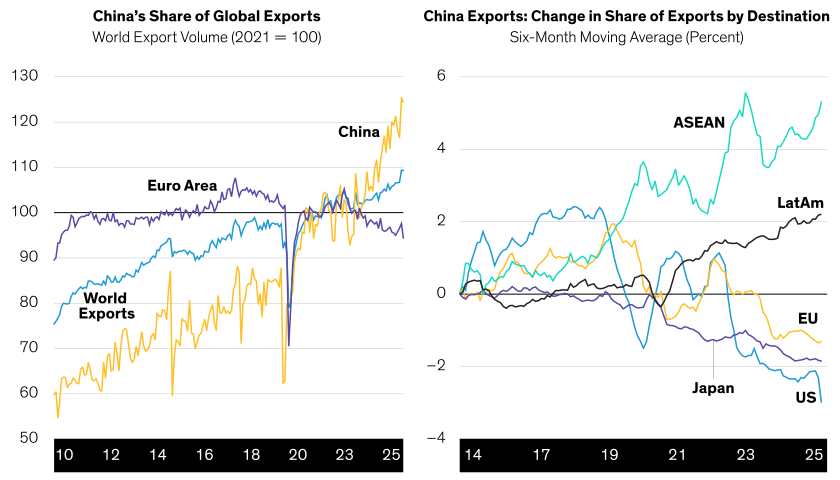
    Left chart shows China’s share of global exports from 2010 through 2025. Right chart shows China’s changing share of exports by destination to developed and emerging market regions.

    Historical analysis does not guarantee future results.
    As of April 30, 2025
    Source: Haver Analytics and AllianceBernstein (AB)

  3. Anti-Involution: Rationalizing Competition

    It’s not a familiar term, but in the Chinese context, “anti-involution” could be transformational. Involution describes excessive competition—whether in education, work or corporate behavior. China’s government has introduced policies to counter this trend, aiming to protect family life, reduce social strain and encourage more sustainable economic growth.

    In 2015, the government launched supply-side reforms to rationalize the upstream steel and coal industries, where state-owned enterprises were hampered by outdated capacity. Now, the anti-involution program is targeting a diverse array of upstream and downstream industries ranging from solar energy and electric vehicles companies to copper miners and pork producers, as a glut of private companies created overcapacity.

    While the policies may not resolve China’s macroeconomic woes, we think they will have positive microeconomic effects as supply cuts help boost prices in profits in targeted industries. These policies have already prompted a decline in manufacturing investment and loans (Display). We think investors who get ahead of the curve can position early in businesses that are poised to benefit from a healthier balance between capacity, profitability and long-term growth.

    “Anti-Involution” Policy Aims to Curb Manufacturing Investment Growth
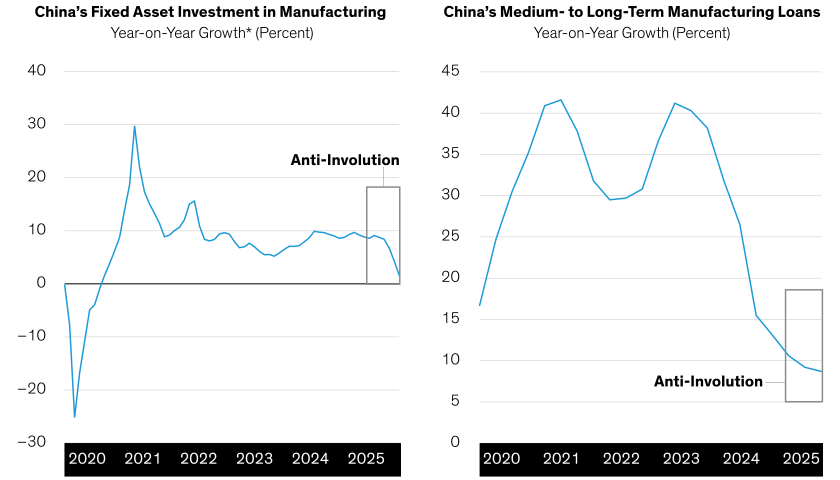
    Left chart shows China’s fixed asset investment in manufacturing from 2020-2025. Right chart shows China’s medium- to long-term manufacturing loans, from 2020-2025.

    Historical analysis does not guarantee future results.
    *Three-month rolling average
    Left display as of August 31, 2025; right display as of June 30, 2025
    Source: CEIC Data, National Financial Regulatory Administration, The Central People’s Government and AB

  4. Domestic-Market-Share Gainers


    While China’s economy may look stagnant, it remains vast and dynamic. Fast-growing industries like fintech, sportswear and energy drinks, have domestic champions that are positioned to capture market share, even in a slower-growth environment.

    Xiaomi may be well known globally for its digital devices, but the company is now moving into electric vehicles at home, building on its strong local consumer brand to challenge formidable incumbents like Tesla and BYD. Other companies that are gaining domestic market share include Midea, a white goods manufacturer, and Bosideng International, an innovator in apparel such as extreme cold gear and ultra-light down jackets. Eastroc Beverage, a Chinese beverage manufacturer, is making a move on Red Bull’s position in the domestic market.

  5. Corporate Governance Reform

    Like in Japan and Korea, China is pushing companies to improve governance and shareholder returns, via the nine-point guidelines unveiled in April 2024.

    Now, profitability, dividends and buybacks are at record highs (Display). And buybacks have become accretive in China, meaning they are boosting earnings per share. While investors are still skeptical, we believe companies that exceed expectations on governance can create upside.

    Chinese Dividends and Buybacks Have Reached Record Highs, Driving Shareholder Returns
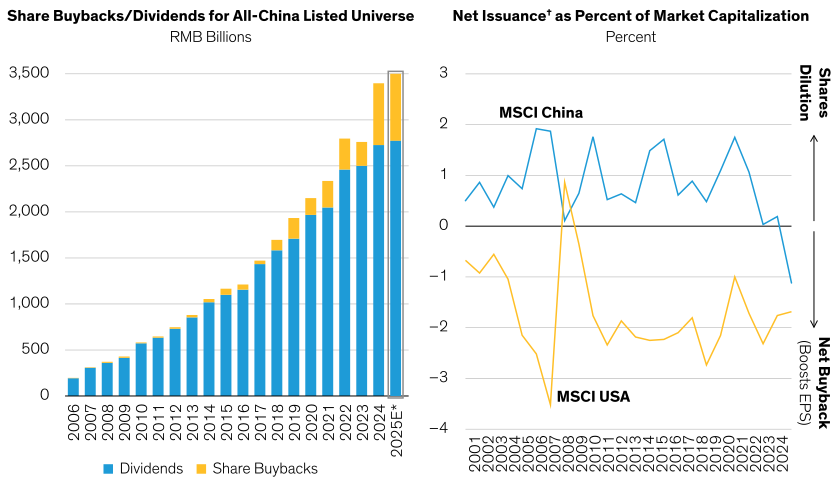
    Left chart shows China’s share buybacks and dividends from 2006 to 2025. Right chart shows net issuance as a percent of market capitalization for Chinese and US equity markets.

    Historical analysis does not guarantee future results.
    EPS: earnings per share
    *Estimates for calendar year 2025. †Net of shares sales and repurchase
    As of May 31, 2025
    Source: Goldman Sachs, Wind and AB

Looking Beyond China

China is often seen as the weakest link in EM . Yet hidden strengths and opportunities abound. In our view, companies that benefit from the trends described above can offer attractive alpha potential because China’s equity markets are inefficient and shares are frequently mispriced.

More broadly, EM equities remain an under-owned and underappreciated asset class, with many compelling stories from AI enablers to India’s reforms. Active managers can find EM companies with improving fundamentals and attractive relative valuations to developed-market peers.

In recent years, many EM investors have become underweight China due to geopolitical concerns and regulatory uncertainty. We think China shouldn’t be viewed in isolation or as a risk to be avoided—but rather as a gateway to understanding the broader EM opportunity set. Investors don’t need to agree on the headline controversies that have tarnished sentiment to acknowledge that China and EM countries offer a rich landscape for diversification and growth of equity allocations.

The views expressed herein do not constitute research, investment advice or trade recommendations, do not necessarily represent the views of all AB portfolio-management teams and are subject to change over time.

MSCI makes no express or implied warranties or representations, and shall have no liability whatsoever with respect to any MSCI data contained herein.

The MSCI data may not be further redistributed or used as a basis for other indices or any securities or financial products. This report is not approved, reviewed or produced by MSCI.

References to specific securities are presented to illustrate the application of our investment philosophy only and are not to be considered recommendations by AB. The specific securities identified and described do not represent all of the securities purchased, sold or recommended for the portfolio, and it should not be assumed that investments in the securities identified were or will be profitable.


About the Authors