In our view, the key is to dig deeper for actionable signals while maintaining liquidity.
Inflation, geopolitical fragmentation and concentrated, AI-driven markets have put a premium on investors’ ability to navigate directional moves across asset classes. We think systematic trend-following strategies can help chart a course. But how they’re designed matters.
Trend following aims to identify and capitalize on discernible patterns across a broad range of markets, whether prices are rising or falling. These systematic strategies, sometimes called managed futures or CTAs, are designed to increase portfolio diversification through their potential to generate returns in both up and down markets .
More Distinctive Signals—Not Just More Asset Classes
For years, though, many managers have sought to enhance trend-following strategies by casting a wider net, hoping that more markets would lead to more opportunities. But there’s a risk to this approach. It may sometimes mean venturing into specialized illiquid markets without doing much to improve diversification.
Managers also often rely solely on structured inputs, such as price and volume, which are easier to analyze systematically across a large universe. We think it’s more effective to diversify the sources of trend alpha by using different types of signals and inputs to enhance returns. In our view, this is preferable to expanding into new and increasingly esoteric markets. These markets may be illiquid and complex—and may not improve diversification or return potential much.
As we see it, an enhanced trend strategy should prioritize the depth of unique and actionable signals—not the breadth of asset classes monitored. In other words, it’s less about alternative markets than it is about alternative inputs.
What a Better Trend-Following Strategy Might Look Like
So, what does a “trend 2.0” approach look like? To start, it should complement a traditional trend approach with broader signals from a more diverse information set. These may include trends that provide a rich set of alternative information, including:
- Macroeconomic trends, including central bank policy shifts, inflation and labor market developments
- Sentiment gleaned from language, such as corporate earnings or news sources, which might suggest shifts in the market’s attitudes about topics such as energy sources or AI
These qualitative inputs are important. They may convey nuance that structured data can’t, capturing intent, tone, framing and emerging themes before prices fully reflect them.
Digging Even Deeper: Deploying Advanced Technologies
Other enhanced trends may also help identify nascent developments bubbling under the surface, including adaptive or nonlinear trends gleaned from advanced technologies:
- Deep learning, an advanced subset of machine learning, uses multilayered neural networks to identify complex patterns in huge datasets. By analyzing attributes like price, volatility and cross-asset relationships, they may uncover trends that elude conventional metrics, like an asset’s moving average. This may inform how much exposure to take in an asset or environment and help detect more complex relationships that may be hard to see.
- Market reaction signals during a trading day include responses to important data releases. These can be used to identify positioning, crowding and changing market behavior, such as a gradual rotation from growth to value stocks.
- Latent market trends may also be valuable diversifiers in strategies with the ability to identify them. For example, changes in short-term interest-rate futures or evidence that companies are gradually moving production closer to home before these changes become visible in corporate results.
These signals may develop over different time horizons and respond to different aspects of the market environment. Together, we think they may help investors identify emerging trends and rely less on any single source of trend returns.
Investors can broaden their information sources, too, with a diverse range of market, economic and behavioral inputs that may help uncover differentiated sources of directional information, while staying focused on scalable, liquid markets.
These may be indicators, such as “carry” signals, designed to benefit from futures-pricing differences. “Event-driven” ones that aim to provide liquidity during market events may also be in the mix. The signals may develop over different time horizons and respond to different aspects of the market environment. Collectively, they may help identify emerging trends and reduce reliance on a single source of trend returns.
Trend Following: Uncorrelated, Not Negatively Correlated
Directional systematic strategies, such as trend following, have the potential to complement equity exposure, particularly during periods of sustained market stress.
But trend following takes patience. Strong performance often comes in bursts, followed by quieter periods with fewer opportunities. The strategy isn’t designed to react instantly to market shocks. Its value, as we see it, is in helping investors capitalize on sustained, established market moves. In other words, broadly uncorrelated to risk assets, not negatively correlated.
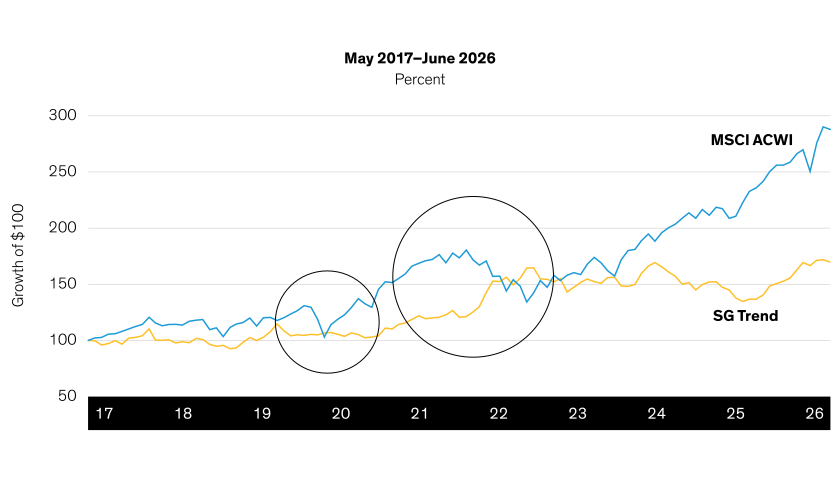
During the global financial crisis (GFC), for example, trend-following managers typically didn’t benefit from the first stages of the broad sell-off. But over time, powerful trends emerged across equities, government bonds, currencies and commodities. Investors able to position for those moves had the opportunity to capture what would be among the most significant market trends in decades. The Société Générale (SG) Trend Index provided ballast during a severe but brief equity sell-off in the early days of COVID-19, helping diversify when inflation battered stocks in 2022 (Display).