The Evolving Nature of Equity Quality in the Age of AI

Jul 17, 2026
4 min read

Investors must determine what the AI capital-spending surge means for long-term business durability.

Quality investing has always been rooted in a simple idea: over time, shares of companies with resilient business models and predictable earnings patterns tend to perform well across different market environments—if they can be had at the right price. Stocks like these have often been integral to long-term defensive equity strategies designed to withstand market volatility.

Today’s market is testing that premise. AI is fueling one of the largest capital spending sprees in recent memory, and for now at least, quality defensive stocks are underperforming. That doesn’t mean quality has lost its relevance. But today’s conditions may require investors to reconsider how to apply traditional definitions of quality.

AI Has Changed the Market’s Quality Lens

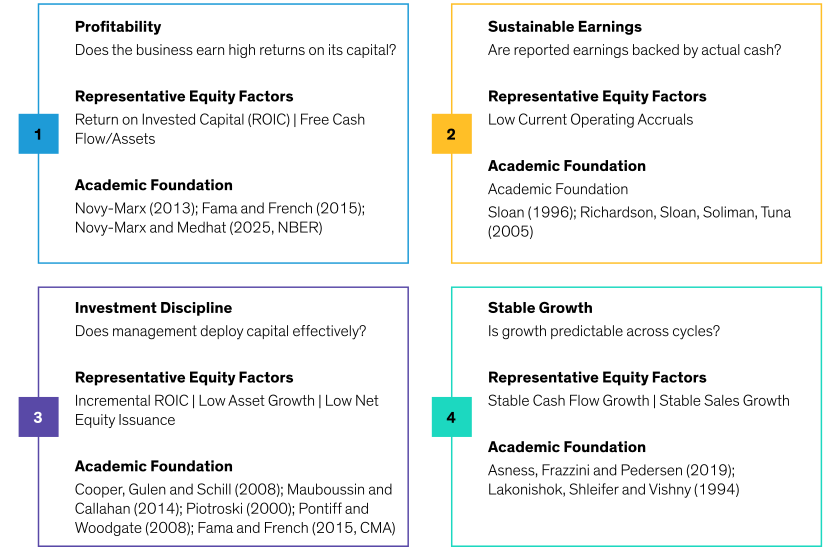
We define quality as businesses that can generate durable long-term returns above their cost of capital. Standout quality business models can be found in an array of industries among profitable firms that deploy capital effectively, allowing them to generate stable growth and sustainable earnings (Display).

The Four Academic Pillars of Quality
Visual showing the four academic pillars of quality: profitability, sustainable earnings, investment discipline, and stable growth.

Historical analysis does not guarantee future results.
Representative equity factors are equity factors that we believe reflect quality businesses.
As of March 31, 2026
Source: Academic reports and AllianceBernstein (AB)

In recent years, quality has become associated with asset-light business models—firms with limited capital intensity in technology and service-oriented industries. Examples include behind-the-scenes payment services firms, workaday telehealth providers and under-the-radar cloud computing concerns—not glamorous but consistent. Well-managed asset-light firms haven’t lost their ability to generate revenue; we believe they’re still compounding earnings as they always have. But in today’s AI-fueled climate, they’ve lost some of their market mojo.

In their place, investors have run up the valuations of hyperscalers as well as chipmakers and asset-heavy firms building data centers and power grids. Asset-heavy firms aren’t typically associated with quality, but we believe the market’s acute focus on AI has created a disconnect between short-term share-price leadership and long-term hallmarks of quality.

As a result, quality stocks have underperformed while speculative growth companies have outperformed. It’s not unusual to see cyclical downdrafts, and historically, quality has rebounded after market disruptions (Display), but how long that will take given the scale of the AI build-out remains to be seen.

Historically, Quality Stocks Have Rebounded After Downturns
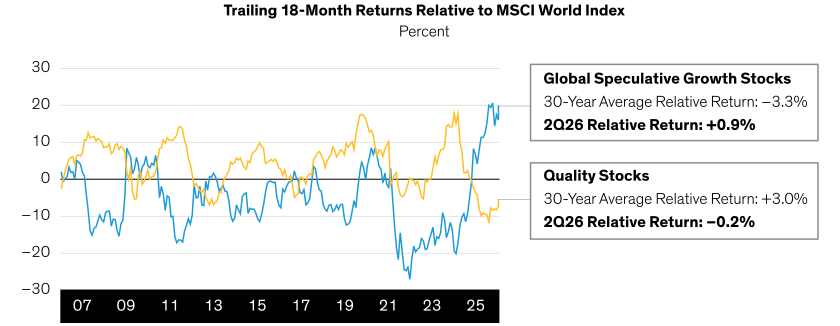
Line chart showing quality stocks at times trailing global speculative stocks since 2007 before eventually rebounding.

Historical analysis does not guarantee future results.
Quality stocks represented by MSCI World Quality. Global speculative growth stocks are hyper-growers with profitability (free cash flow to assets) and valuation (free cash flow to price) in the bottom 60% (lower profitability and more expensive stocks in quintiles 3–5) of the MSCI World and year-over-year sales growth in the top 30% of the MSCI World. 
As of July 1, 2026
Source: Delta One, FTSE Russell, International Data Corporation, MSCI, S&P and AB

For investors, the challenge is to distinguish a cyclical updraft from more lasting structural changes. Today’s market increasingly favors uncertain growth opportunities driven by the promise of AI-driven productivity gains over historical consistency. But even if AI investment continues to rise, we believe its rate of growth will eventually slow. When this deceleration happens, we expect less focus on hyperscaler spending and more on earnings sustainability. After all, AI-fueled capital outlays can lay the groundwork for future earnings growth, but also may erode free cash flows and weaken profitability potential. How each company manages these dynamics will determine whether they succeed or fail in translating the promise of AI into returns for investors.

Over time, we also expect investors to pay more attention to valuations. In our view, growing confidence in AI has left markets priced for a smooth and profitable build-out, leaving little margin for error. This is particularly the case among select technology and industrial firms involved in the production of memory and storage. Even hyperscalers that look attractive fundamentally have yet to prove that they can monetize today’s enormous investments in AI infrastructure.

Adapt the Portfolio, Not the Philosophy

As the nature of quality evolves, we believe it’s possible to expand the opportunity set of a defensive equity portfolio while keeping true to its underlying principles. In our view, that means staying tethered to sound business fundamentals while recognizing that quality names may migrate to different sectors and industries than they have in the past.

For the moment, quality appears to be tilting toward capital-heavy business models, but that doesn’t mean traditional hallmarks of quality are going away. The key for active managers is to determine which asset-heavy firms are riding the tailwinds of cyclical momentum and which are better positioned to reap long-term benefits from AI capex. Similarly, understanding which quality firms have been oversold in the current market can have implications for future returns.

While it can be unsettling to see market leadership narrow around unfamiliar themes, quality companies that continue to generate cash and defend their profit margins still offer compelling long-term potential, in our view. AI’s economic impact is real, and the investment cycle it has unleashed may continue to reshape equity markets for some time to come. Yet no capital-spending cycle moves in a straight line forever. As expectations rise and AI-fueled valuations expand, investors may need to be more selective about which companies can turn enormous investments in AI infrastructure into sustainable profits.

Quality hasn’t disappeared as an objective for equity investors, but its scope may be changing in a market defined more by once-in-a-generation structural shifts. With patience, discipline and research-driven adjustments to reflect real-world challenges, we believe investors will ultimately be rewarded for applying a consistent philosophy to a changing world.

The views expressed herein do not constitute research, investment advice or trade recommendations, do not necessarily represent the views of all AB portfolio-management teams and are subject to change over time.

MSCI makes no express or implied warranties or representations, and shall have no liability whatsoever with respect to any MSCI data contained herein. The MSCI data may not be further redistributed or used as a basis for other indices or any securities or financial products. This report is not approved, reviewed or produced by MSCI.


About the Authors