What Does the Iran War Mean for Emerging Markets?

Apr 13, 2026
5 min read

In a volatile period, we believe emerging markets’ stronger fundamentals will shine through the noise.

Conflict in the Middle East—and the resulting energy shock—has raised concerns for emerging markets. Given the breadth of the asset class, we expect implications to vary across countries and issuers, reflecting whether economies are energy exporters or importers, roles in AI supply chains, and supply-chain adaptability. Overall, however, our analysis reveals that emerging markets face the current crisis from a position of strength.

Indeed, more credible economic policies, improved governance, lower fixed-income risk premiums and reduced susceptibility to inflation all point to emerging markets’ increasing convergence with developed markets. In addition, emerging countries’ potential growth rates look robust compared with many developed peers.

Yet, in capital markets, a headline-driven, volatile environment is creating greater dispersion across emerging-market countries, sectors and companies. We believe the emerging world’s enormous breadth offers meaningful opportunity to find countries and securities whose valuations have become disconnected from fundamentals.

The US Dollar Remains Central to the Overall Outlook

A weakening US dollar remains central to a positive emerging-market outlook, because emerging countries’ hard-currency debts are mostly denominated in dollars, as are vital commodities.

The initial air strikes on Iran triggered a risk-off market phase, and with it an uptick in the US dollar. But we believe the dollar’s recent weakening trend will resume. The reason? Not only is the currency still expensive relative to history, but structural forces—including concerns about the direction of US policy—continue to drive de-dollarization.

A weaker dollar typically means easier monetary conditions, space for rate cuts in developing countries, and lower risk aversion—all favorable for emerging markets (Display).

US Dollar Weakness Has Been a Tailwind for Emerging Markets
DXY Index (Inverted) and Emerging vs. Developed Equity Market Relative Performance
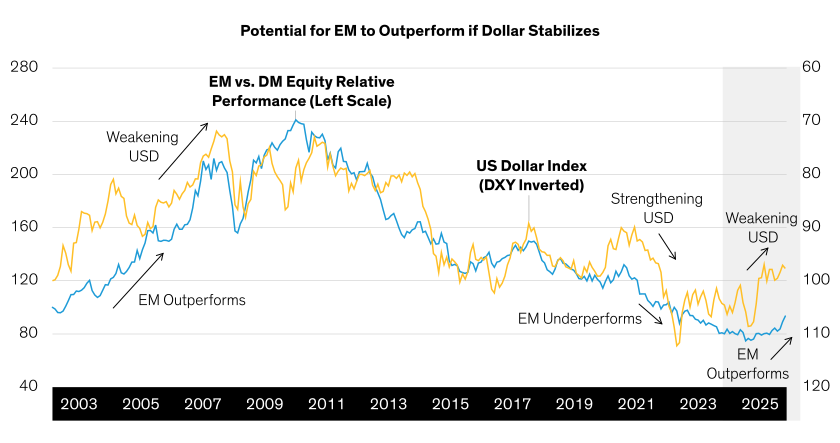
Past performance does not guarantee future results. Current analysis and forecasts do not guarantee future results. 

EM: Emerging Markets

MSCI makes no express or implied warranties or representations, and shall have no liability whatsoever with respect to any MSCI data contained herein. The MSCI data may not be further redistributed or used as a basis for other indices, any securities or financial products. This report is not approved, reviewed or produced by MSCI.

As of February 28, 2026

Source: Bloomberg, MSCI and AllianceBernstein (AB)

Oil Is a Major Driver for Emerging Countries

Higher oil prices were the war’s immediate economic impact. As with most geopolitical events, the market’s initial reaction has been driven by volatility and risk aversion. What ultimately matters for fundamentals, however, is the duration of the conflict rather than the magnitude of the initial price shock. If sustained, continuing higher energy prices are likely to lift headline inflation and weigh on global growth. As a result, financial conditions quickly began to tighten when the conflict began.

Higher energy prices don’t impact every emerging economy through the same channels, but financial markets start by distinguishing between oil importers and oil exporters (Display).

Emerging Markets Divide Between Energy Exporters and Importers
Net Exports of Oil and Gas
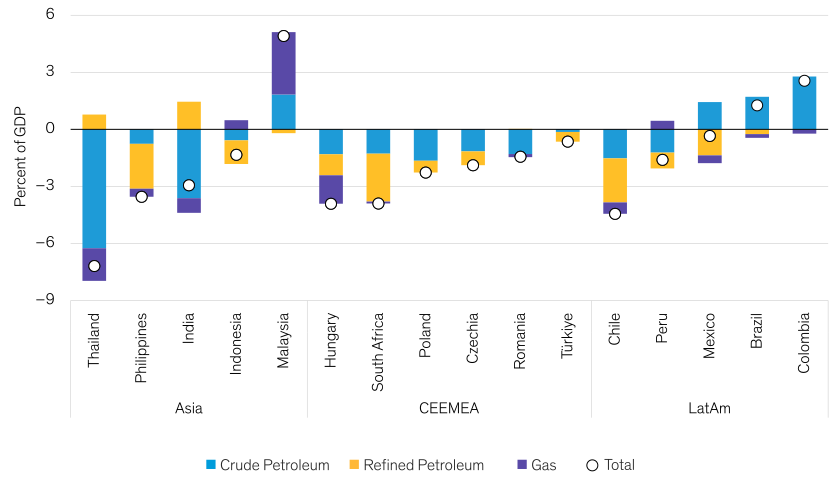
Current analysis does not guarantee future results.

As of March 31, 2026

Source: UN Comtrade, Haver Analytics and AB

To assess resilience to shocks, it’s also important to assess countries’ respective policy spaces and reserve buffers. Remittances, tourism and proximity to the conflict zone are all important considerations too, in our analysis.

Taking these factors into account, Egypt, Pakistan, Sri Lanka and Kenya appear among the most vulnerable countries, with Ecuador among the best-placed. The larger economies, such as Brazil, South Africa and Mexico, look more resilient. Latin American energy and commodity exporters are also ones to watch.

Technology Contributes to Many Emerging Economies

It’s important to keep in mind other major trends affecting emerging markets—even as the war in Iran draws headlines. Several Asian countries are central to AI supply chains, and many emerging nations globally provide AI-critical commodities, putting them in the lead in the global AI rally (Display).

Asia Equities Have Taken the Lead in the Global AI Rally
AI Sector Cumulative Returns
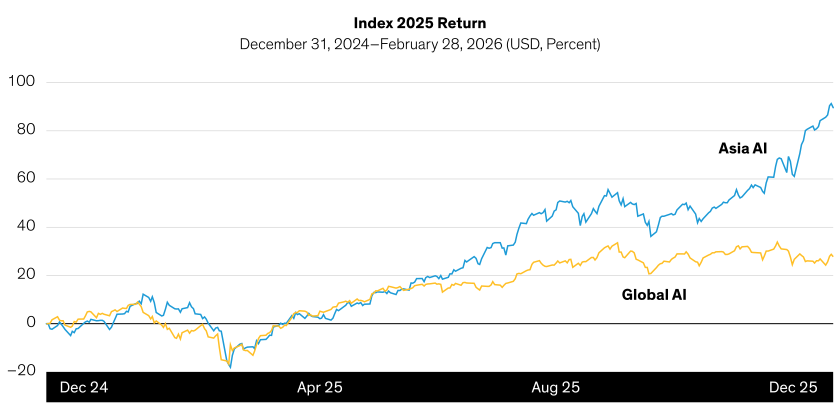
Past performance does not guarantee future results. 

Asia AI represented by Goldman Sachs Thematic Equity Baskets. Global AI represented by Nasdaq Global AI and Big Data Index.

As of February 28, 2026

Source: Bloomberg, Goldman Sachs Global Investment Research and AB

Beyond semiconductors and memory chips, emerging Asian manufacturers also offer “backdoor,” less-known AI exposures such as power and thermal management, and data-center components. Not only are these less visible investment opportunities, but they also benefit from higher barriers to entry and longer investment cycles, in our analysis.

Reconfiguration of Supply Chains Makes Security Selection Vital

We expect emerging countries to reconfigure their supply chains to mitigate the impact of the oil shock and its second-order effects.

Accordingly, from a security-selection perspective, it’s vital to identify the winners and losers within the same value chain. We think the big winners will have higher technology standards, offer greater reliability and align geopolitically.

For instance, the disruptions to natural gas supplies have increased global demand for LNG carriers. But competition is limited, as the costs of entering this market are high, standards are technically demanding, and China and Korea dominate the market. Because energy has become a prominent national security concern, some western buyers may feel reluctant to buy from China, making Korean shipyards the winner by default.

In our view, conflict-driven deglobalization need not reduce the opportunity for emerging-market investors. But it will require more selectivity and intensive bottom-up research to identify the companies in the right parts of the value supply chain.

China Remains Central to the Outlook

China’s economy remains crucial for the Asia-Pacific region and for many emerging countries worldwide, and although China’s property market and domestic consumption remain soft, there are encouraging signs for emerging-market trading partners.

Chinese policymakers have recommitted to keeping real GDP growth between 4.5% and 5%. We also expect them to help ease some of the disinflationary impulses in the economy.

We see several structural positives for China’s securities markets: the government’s anti-involution measures to reduce overcapacity; improving corporate governance (evidenced by more dividends and buybacks); improved capital discipline resulting in negative net equity issuance; and China’s strong position in critical technologies and commodities, especially those linked to electrification.

We’re already seeing more attractive opportunities in insurance and financial companies because the shareholder-friendly policy shift has led to stronger balance sheets in these sectors.

Stay Alert to Risks—and Rebounds

Rather than treating emerging markets as a single macro trade, we think investors should consider allocating selectively across regions and countries and tilting tactically between emerging equity and debt. They can also use multiple security selection techniques to focus on companies with resilient earnings, pricing power and strategic relevance.

Periods of heightened volatility have historically created opportunities. Our research indicates that, following periods of high volatility where valuations become disconnected from fundamentals, emerging markets have bounced back more strongly than their developed counterparts. We favor building positions in well-placed emerging countries and companies ahead of a normalization in volatility and sentiment.

The views expressed herein do not constitute research, investment advice or trade recommendations, do not necessarily represent the views of all AB portfolio-management teams and are subject to change over time.

MSCI makes no express or implied warranties or representations, and shall have no liability whatsoever with respect to any MSCI data contained herein. The MSCI data may not be further redistributed or used as a basis for other indices or any securities or financial products. This report is not approved, reviewed or produced by MSCI.


About the Authors