How Can DC Plan Sponsors Bridge the Gender Gap in Retirement Confidence?

Aug 24, 2026
2 min read
Women’s Low Retirement Confidence Belies High Capability
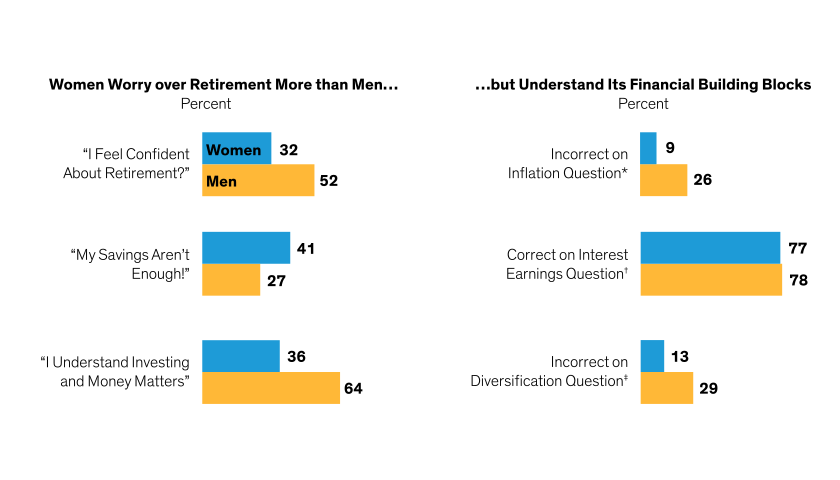
Women worry over retirement but understand its financial building blocks quite well compared to men.

Survey findings are based on the expressed opinions of respondents and do not guarantee specific outcomes.
*If the annual interest rate on your savings account is 1% and inflation is 2%, would you be able to buy more or less with the money today?
†If you had $100 in savings with an annual interest rate of 2%, after five years, would you have more than $102, less or the same?
‡True or False: Buying a single stock usually provides a safer return than a stock mutual fund. Percentages that omit “don’t know” responses may not round to 100.
As of May 2026
Source: Inside the Minds of Plan Participants, AllianceBernstein (AB), 2026

Sponsors can leverage retirement sentiment differences to benefit all participants.

Women comprise about half of the US workforce1 but worry more about retirement readiness than men, based on our latest survey data. But they’re better versed in financial topics than they believe, so we think the real gap lies in confidence, not capability. That insight gives DC plan sponsors a plan of action.

Women are more concerned than optimistic when it comes to their retirement, according to our latest Inside the Minds of Plan Participants survey. Only one in three said they’re confident that they’re funding a comfortable and on-time retirement, compared to over half of men (Display). Fewer women than men also feel financially and mentally prepared for retirement, with only half as many women believing they have the necessary financial knowledge.

Gender gaps also appeared in income security. Women were half as likely as men to feel confident that their retirement savings and other income sources would last their lifetimes.

But our survey also revealed that women were more financially savvy than they give themselves credit for, and they outscored men on several key finance-related problems. About one in four male respondents, for instance, incorrectly answered a question about the impact of inflation on purchasing power while only about one in 10 women got it wrong. And more than twice as many men incorrectly answered that investing in a single stock carries less risk than a diversified portfolio.

We think the gap between women’s confidence and ability underscores that effective plan communications must educate, engage and empower participants across the board. Women may worry more, but they’re clearly knowledgeable and forward-thinking—qualities that can be reinforced. Men may register more confidence but could still use refreshers on financial basics.

Helping both sides of the gender gap is the best way to narrow it, in our view, much like how a rising tide lifts all boats.

147% as per US Bureau of Labor Statistics, July 2026


“Target date” in a fund’s name refers to the approximate year when a plan participant expects to retire and begin withdrawing from his or her account. Target-date funds gradually adjust their asset allocation, lowering risk as a participant nears retirement. Investments in target-date funds are not guaranteed against loss of principal at any time, and account values can be more or less than the original amount invested—including at the time of the fund’s target date. Also, investing in target-date funds does not guarantee sufficient income in retirement.

The views expressed herein do not constitute research, investment advice or trade recommendations, do not necessarily represent the views of all AB portfolio-management teams and are subject to change over time.