Retirement reality for many Americans may not be as grim as forecasters predict. Could it be better? Yes. But many retirees in our new survey see a glass that’s more than half full.
As John Lennon noted, “Life is what happens to you while you’re busy making other plans.” That’s why our latest survey of defined contribution (DC) trends and issues not only included current plan participants, but retirees as well. We wanted to show a composite portrait of retirement’s realities painted by the people who are doing it—not just planning for it.
Most of our retired respondents were in the 65–75 age bracket, although 17% were younger. We asked them to think back to 10 years before they retired and tell us at what age they assumed or hoped they would retire. The average expectation was that they’d retire at age 65, but their actual retirement age was closer to 62—three years earlier. One interesting finding was that 16% expected to retire before age 60, and yet a far larger percentage—39%—actually did retire before that milestone.
It’s possible that some respondents retired earlier due to the recession that followed the global financial crisis. But employment, including part-time jobs, has been steadily on the rise for the past five years, and much of the labor market has been quite tight for a few years at least. These conditions might have convinced many retirees to reenter the work force. But very few of our retirees are even working part time. In fact, 93% are fully retired.
Where’s the Income Coming From?
The median income for our retired respondents is roughly $60,000. More than 60% of them receive a pension, and it’s likely that most or all of them are currently receiving Social Security as well. In describing their current investment portfolio, more than half (53%) say it’s a balance between growth and preservation or a tilt toward moderate growth. Only 11% solidly favor preservation, and 20% aren’t sure how to describe their portfolio. When asked how much of their current spending comes from their workplace retirement savings plan, three-fourths of our retirees say it’s 25% or less—and many of them say they currently don’t access those savings at all.
There could be a variety of reasons for such low usage of plan savings: Participants could be keeping their withdrawal amounts to a level that’s in line with their longevity expectations. They might also be delaying the use of those funds until age 70½, when the IRS requires the start of minimum withdrawals from tax-deferred retirement accounts. Regardless of when or to what extent retirees are accessing their workplace savings, a strong majority seem to be reasonably satisfied (or better) with their retirement realities.
For Quite a Few, Retirement’s Not So Bad After All…
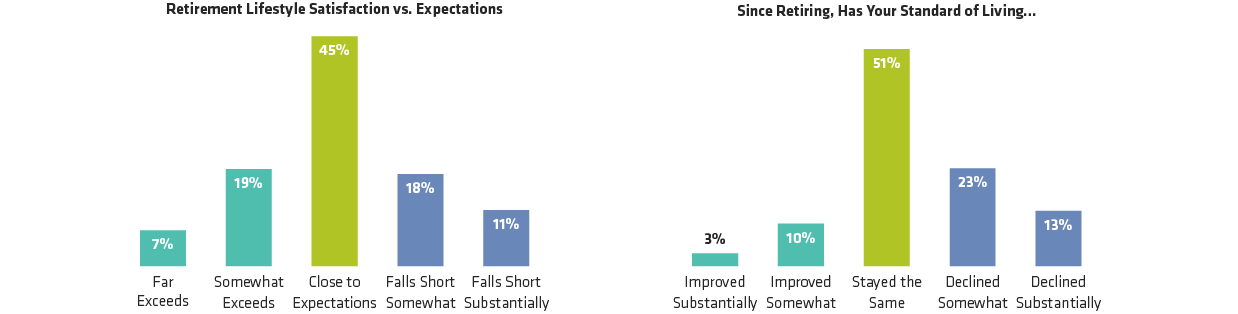
In fact, over 70% of our surveyed retirees say their current lifestyle is either in line with or better than their expectations (Display 1, left). And this upbeat assessment remained relatively consistent across several different questions. When we asked retirees if their standard of living had gone up, down or stayed the same, nearly two-thirds (64%) say it has at least stayed the same if not improved (Display 1, right).