Off-the-Shelf Target-Date Funds: Simplicity First
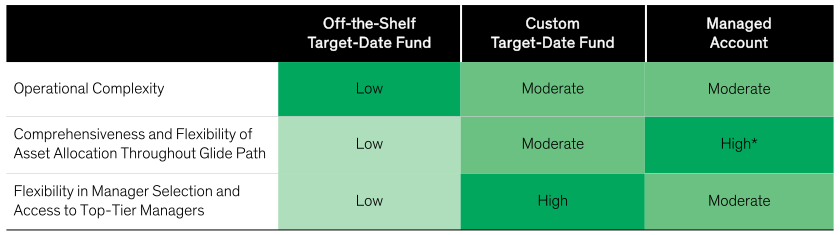
Off-the-shelf target-date funds that include private asset exposure are designed to be operationally easy for plan sponsors. The appeal is straightforward: the provider designs the glide path, selects and monitors public and private managers, rebalances allocations and manages liquidity.
Low complexity may resonate with some plan sponsors, though it could lead to less-than-optimal implementation of private assets. For example, private allocations may be applied uniformly across ages or as a static mix throughout the glide path. This limits the ability to evolve the asset allocation as participants move through different life stages as their risk tolerance and objectives change.
Off-the-shelf target-date funds limit access to a narrower universe of private asset managers. By design, they can only incorporate strategies from managers that have pre-existing partnerships with the target-date provider. As a result, the opportunity set is confined to a curated subset of private strategies—one that may exclude managers a DC plan already uses in its defined benefit (DB) plan.
Custom Target-Date Funds: A More Tailored Balance
Custom target-date funds provide plan sponsors with much more flexibility than off-the-shelf solutions. They do require more involvement from plan sponsors up front, particularly with glide path design and operational setup.
With custom target-date funds, sponsors can tailor the amount of private exposure and mix of strategies to the plan’s demographics, objectives and risk tolerance. The target-date design can incorporate key considerations such as fee budgets and a preference for certain private market segments, making it easier to align the private allocation with how participants save, invest and withdraw assets.
Custom solutions offer more flexibility in implementing managers and make it easier to hire and replace underlying managers. That flexibility is particularly important in private markets. Managers’ performance can vary much more than in public markets, so the ability to control the manager lineup may be a critical lever for improving participants’ outcomes.
Plan sponsors may also be able to unitize their existing DB assets—either the entire DB portfolio or the private-market component only—to use as target-date allocations in a custom strategy. That can be a convenient feature for sponsors that have deep DB experience and due-diligence processes and the desire to create parity across all participants by extending familiar strategies to the DC side.
Managed Accounts: Maximum Personalization, but With Complexity
The most tailored approach to private exposure, managed accounts, brings operational complexity. Instead of a pooled fund, implementation takes place at the individual participant level. That means every activity must be handled separately for each account. Contributions, withdrawals, rebalancing, private-fund subscriptions and redemptions all require seamless integration with recordkeeper systems.
Managed accounts offer the highest potential for participant personalization, allowing asset allocation design to reflect each participant’s unique circumstances. In practice, however, that flexibility may be constrained by operational realities and system limitations.
Many managed-account providers build portfolios from a plan’s core investment menu, which may require adding a private asset fund to the lineup. Many sponsors may be hesitant to make that move for governance and fiduciary reasons. Off-menu solutions are possible, as long as the recordkeeper and managed-account provider can support them.
To sum things up, private assets have the potential to enhance outcomes for DC plan participants, and a professionally managed default solution is one way to go. But it makes a lot of sense for plan sponsors to understand the trade-offs among approaches when looking for the right fit.